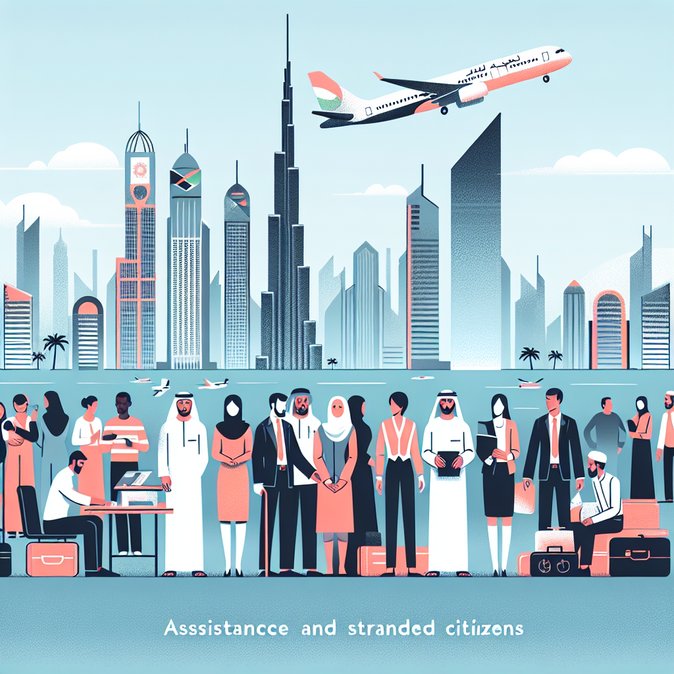
While airlines race to restore services through the Gulf, Italy’s foreign ministry has activated an unprecedented emergency cell to assist the estimated 2,000 Italian nationals unable to leave the United Arab Emirates after weekend hostilities. The new ‘Task Force Golfo’, announced by Foreign Minister Antonio Tajani on Sunday evening, deploys 50 additional crisis-response officers to work alongside the Unit à di Crisi in Rome(ansa.it). The unit operates a single hotline (+39 06 36225) that is now fielding “hundreds of calls per hour” from tourists, business travellers and school groups seeking repatriation options.
Among the stranded are roughly 200 high-school students participating in language and robotics programmes, as well as Defence Minister Guido Crosetto and the Chief of Rome Police Roberto Massucci, both caught in the region on private trips. Italian diplomats in Abu Dhabi and Dubai have secured 65 hotel rooms and are organising ground transport, medical support and psychological counselling for minors, while liaising with ITA Airways and EU partners on special return flights(ansa.it).
The Task Force is also mapping the needs of Italy’s sizeable resident community—some 20,000 citizens in the UAE, many employed in energy, construction and luxury retail. Employers are urged to upload itineraries to the ministry’s ‘Dove Siamo Nel Mondo’ portal and to issue letters of guarantee so that dependants can be moved on consular charters if required. The ministry has warned that commercial capacity is unlikely to normalise before 7 March, the date until which several carriers have suspended Tel Aviv and Dubai routes.
![Farnesina Sets Up ‘Task Force Golfo’ as 2,000+ Italians—Including 200 Students—Remain Stranded in Dubai]()
Travellers scrambling to adjust overstays or secure emergency paperwork may find it faster to engage a specialist such as VisaHQ, whose online platform provides expedited UAE and Italian visa services, real-time status alerts and multilingual support staff able to coordinate directly with consulates—useful for families and HR teams facing sudden itinerary changes (https://www.visahq.com/italy/).
For global-mobility teams, the episode underscores the importance of pre-trip registration and local emergency contacts. Companies with expatriates in the Gulf should cross-check health-insurance cover for conflict-zone exclusions, confirm payroll continuity for staff forced to overstay visas, and prepare for possible onward relocation to safer hubs such as Muscat or Manama.
Politically, the high-profile stranding of a cabinet minister has already prompted calls in Parliament for clearer disclosure rules on officials’ private travel and could accelerate legislation creating an inter-ministerial crisis-flight fund similar to France’s ‘Ariane’ mechanism. In the meantime, Tajani insists that “no Italian is in personal danger” but cautions that repatriations will be staggered to prioritise vulnerable travellers.
Among the stranded are roughly 200 high-school students participating in language and robotics programmes, as well as Defence Minister Guido Crosetto and the Chief of Rome Police Roberto Massucci, both caught in the region on private trips. Italian diplomats in Abu Dhabi and Dubai have secured 65 hotel rooms and are organising ground transport, medical support and psychological counselling for minors, while liaising with ITA Airways and EU partners on special return flights(ansa.it).
The Task Force is also mapping the needs of Italy’s sizeable resident community—some 20,000 citizens in the UAE, many employed in energy, construction and luxury retail. Employers are urged to upload itineraries to the ministry’s ‘Dove Siamo Nel Mondo’ portal and to issue letters of guarantee so that dependants can be moved on consular charters if required. The ministry has warned that commercial capacity is unlikely to normalise before 7 March, the date until which several carriers have suspended Tel Aviv and Dubai routes.

Travellers scrambling to adjust overstays or secure emergency paperwork may find it faster to engage a specialist such as VisaHQ, whose online platform provides expedited UAE and Italian visa services, real-time status alerts and multilingual support staff able to coordinate directly with consulates—useful for families and HR teams facing sudden itinerary changes (https://www.visahq.com/italy/).
For global-mobility teams, the episode underscores the importance of pre-trip registration and local emergency contacts. Companies with expatriates in the Gulf should cross-check health-insurance cover for conflict-zone exclusions, confirm payroll continuity for staff forced to overstay visas, and prepare for possible onward relocation to safer hubs such as Muscat or Manama.
Politically, the high-profile stranding of a cabinet minister has already prompted calls in Parliament for clearer disclosure rules on officials’ private travel and could accelerate legislation creating an inter-ministerial crisis-flight fund similar to France’s ‘Ariane’ mechanism. In the meantime, Tajani insists that “no Italian is in personal danger” but cautions that repatriations will be staggered to prioritise vulnerable travellers.