Germany’s flag-carrier became one of the first European airlines to ground services to the Gulf on Sunday, 1 March, as military strikes between the United States, Israel and Iran triggered widespread air-space closures.
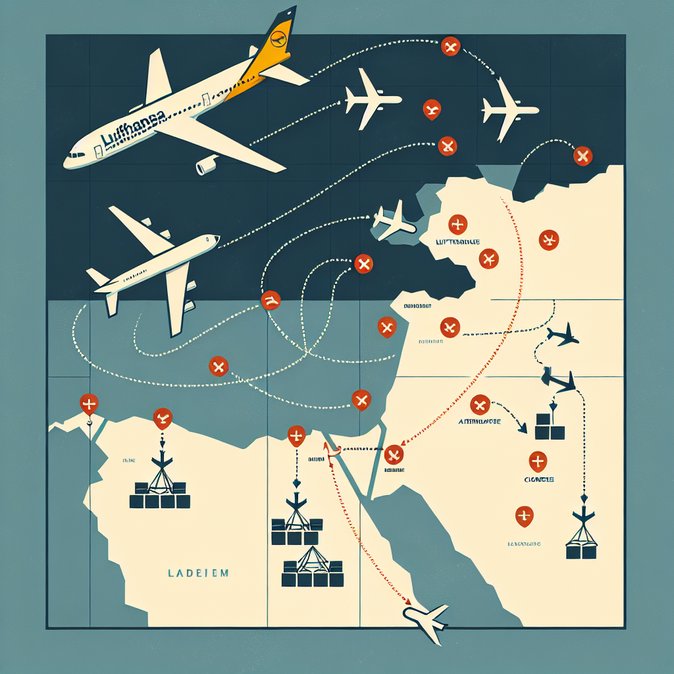
Lufthansa said it has suspended every flight to and from Dubai and Abu Dhabi and will avoid United Arab Emirates air-space at least until 4 March. Cargo flights are also affected, with freighters to Sharjah and Bahrain rerouted over the Red Sea and Greece. Long-haul passenger services from Frankfurt, Munich and Düsseldorf that normally overfly the Gulf will take northerly detours via Turkey and the Caucasus, adding up to two hours’ block time and thousands of euros in extra fuel per rotation.
The group is offering free rebooking or refunds and has activated its 24-hour “TravelCare” desk for corporate clients. Travel-management companies estimate that more than 15,000 German business travellers had bookings on Lufthansa services to the UAE in the coming week, many of them onward to Asia. German export-oriented firms with regional headquarters in Dubai – including Siemens Energy and BASF – have issued employee advisories urging staff to postpone non-essential trips.
![Lufthansa suspends all UAE flights and reroutes over Gulf amid escalating Middle-East conflict]()
Travellers suddenly faced with complex rerouting often discover that visa requirements change just as quickly as flight plans. VisaHQ can step in here, enabling German citizens and residents to obtain, expedite or modify travel visas for more than 200 countries—Gulf states included—through a single, user-friendly portal (https://www.visahq.com/germany/). The service helps companies and individuals save precious time and keep journeys compliant while airlines and air-spaces remain in flux.
Aviation insurers confirmed that Lufthansa triggered its war-risk clauses, allowing withdrawal without penalty when overflight risk moves to the highest bracket. The carrier is monitoring the situation daily with Germany’s Federal Foreign Office and the European Union Aviation Safety Agency (EASA). Should the security environment deteriorate further, analysts warn that the suspension could be extended to Qatar and Saudi Arabia, severing one of Germany’s busiest winter business-travel corridors.
For global-mobility managers the episode underscores the importance of real-time duty-of-care tracking and flexible ticketing policies. Companies with critical operations in the Gulf are already exploring rail-air combinations via Istanbul or Athens and considering permanent contingency routings in their travel programmes.
Lufthansa said it has suspended every flight to and from Dubai and Abu Dhabi and will avoid United Arab Emirates air-space at least until 4 March. Cargo flights are also affected, with freighters to Sharjah and Bahrain rerouted over the Red Sea and Greece. Long-haul passenger services from Frankfurt, Munich and Düsseldorf that normally overfly the Gulf will take northerly detours via Turkey and the Caucasus, adding up to two hours’ block time and thousands of euros in extra fuel per rotation.
The group is offering free rebooking or refunds and has activated its 24-hour “TravelCare” desk for corporate clients. Travel-management companies estimate that more than 15,000 German business travellers had bookings on Lufthansa services to the UAE in the coming week, many of them onward to Asia. German export-oriented firms with regional headquarters in Dubai – including Siemens Energy and BASF – have issued employee advisories urging staff to postpone non-essential trips.

Travellers suddenly faced with complex rerouting often discover that visa requirements change just as quickly as flight plans. VisaHQ can step in here, enabling German citizens and residents to obtain, expedite or modify travel visas for more than 200 countries—Gulf states included—through a single, user-friendly portal (https://www.visahq.com/germany/). The service helps companies and individuals save precious time and keep journeys compliant while airlines and air-spaces remain in flux.
Aviation insurers confirmed that Lufthansa triggered its war-risk clauses, allowing withdrawal without penalty when overflight risk moves to the highest bracket. The carrier is monitoring the situation daily with Germany’s Federal Foreign Office and the European Union Aviation Safety Agency (EASA). Should the security environment deteriorate further, analysts warn that the suspension could be extended to Qatar and Saudi Arabia, severing one of Germany’s busiest winter business-travel corridors.
For global-mobility managers the episode underscores the importance of real-time duty-of-care tracking and flexible ticketing policies. Companies with critical operations in the Gulf are already exploring rail-air combinations via Istanbul or Athens and considering permanent contingency routings in their travel programmes.