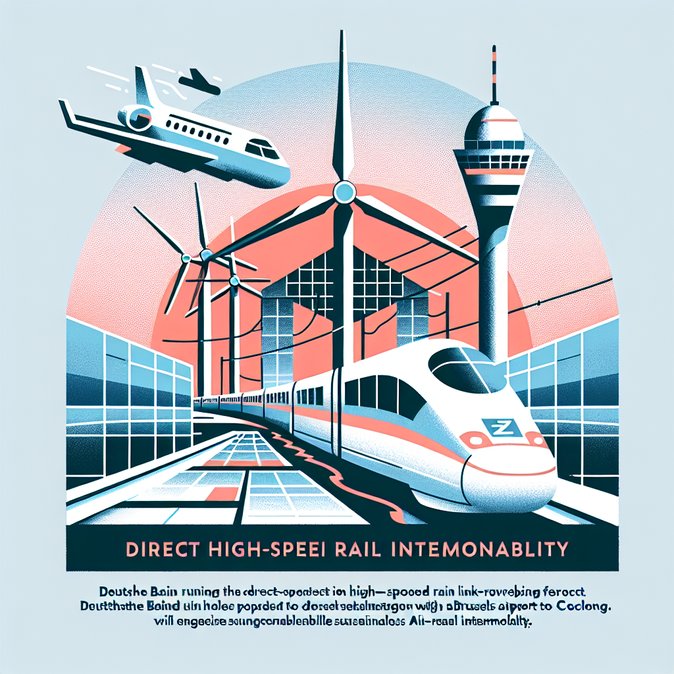
Belgium’s largest air gateway is set for a major ground-transport upgrade. On 1 March 2026, Brussels Airport and Deutsche Bahn confirmed that the German rail operator will extend its ICE high-speed network to include a dedicated stop at Brussels Airport. From September, up to six daily trains will run Cologne–Aachen–Liège–Leuven–Brussels Airport–Antwerp, slashing the journey between the airport and Cologne to roughly two hours and offering a direct rail alternative to short-haul flights.
Airport chief executive Arnaud Feist called the project “an important step for Belgium’s international connectivity”, stressing that almost 20 percent of the hub’s passengers currently originate in western Germany. Deutsche Bahn executives said the extension fits the company’s strategy of linking major European airports to its long-distance rail grid, following similar tie-ups with Frankfurt and Amsterdam-Schiphol.
For corporate mobility managers, the service means employees can connect to long-haul flights at Brussels without relying on congested road corridors or booking a feeder flight. Travel-policy specialists note that shifting travellers to rail can help firms cut Scope 3 emissions and ease compliance with EU sustainability mandates coming into force in 2027.
![Brussels Airport to gain two-hour high-speed rail link to Cologne by September]()
For international travellers planning to switch from plane to train on the Cologne–Brussels–Antwerp corridor, visa formalities can be just as important as timetables. VisaHQ’s Belgium platform (https://www.visahq.com/belgium/) allows passengers and travel managers to verify Schengen requirements in minutes and process applications online, ensuring that employees connecting through Brussels Airport on the new ICE services have the right documentation before they board.
In practical terms, tickets will be bookable on both the DB and SNCB/NMBS platforms from mid-June, with through-fares that combine air and rail segments expected to follow later in the year under existing IATA intermodal standards. Brussels Airport is already finalising track-side check-in kiosks and baggage-drop counters inside its arrival hall so that rail passengers can obtain boarding passes before clearing security.
The new connection also strengthens Belgium’s position as a multimodal hub. By integrating high-speed rail with its airport operations, the country mirrors developments in France and the Netherlands, underscoring a wider European trend of replacing short flights with rail where journey times are under three hours.
Airport chief executive Arnaud Feist called the project “an important step for Belgium’s international connectivity”, stressing that almost 20 percent of the hub’s passengers currently originate in western Germany. Deutsche Bahn executives said the extension fits the company’s strategy of linking major European airports to its long-distance rail grid, following similar tie-ups with Frankfurt and Amsterdam-Schiphol.
For corporate mobility managers, the service means employees can connect to long-haul flights at Brussels without relying on congested road corridors or booking a feeder flight. Travel-policy specialists note that shifting travellers to rail can help firms cut Scope 3 emissions and ease compliance with EU sustainability mandates coming into force in 2027.

For international travellers planning to switch from plane to train on the Cologne–Brussels–Antwerp corridor, visa formalities can be just as important as timetables. VisaHQ’s Belgium platform (https://www.visahq.com/belgium/) allows passengers and travel managers to verify Schengen requirements in minutes and process applications online, ensuring that employees connecting through Brussels Airport on the new ICE services have the right documentation before they board.
In practical terms, tickets will be bookable on both the DB and SNCB/NMBS platforms from mid-June, with through-fares that combine air and rail segments expected to follow later in the year under existing IATA intermodal standards. Brussels Airport is already finalising track-side check-in kiosks and baggage-drop counters inside its arrival hall so that rail passengers can obtain boarding passes before clearing security.
The new connection also strengthens Belgium’s position as a multimodal hub. By integrating high-speed rail with its airport operations, the country mirrors developments in France and the Netherlands, underscoring a wider European trend of replacing short flights with rail where journey times are under three hours.