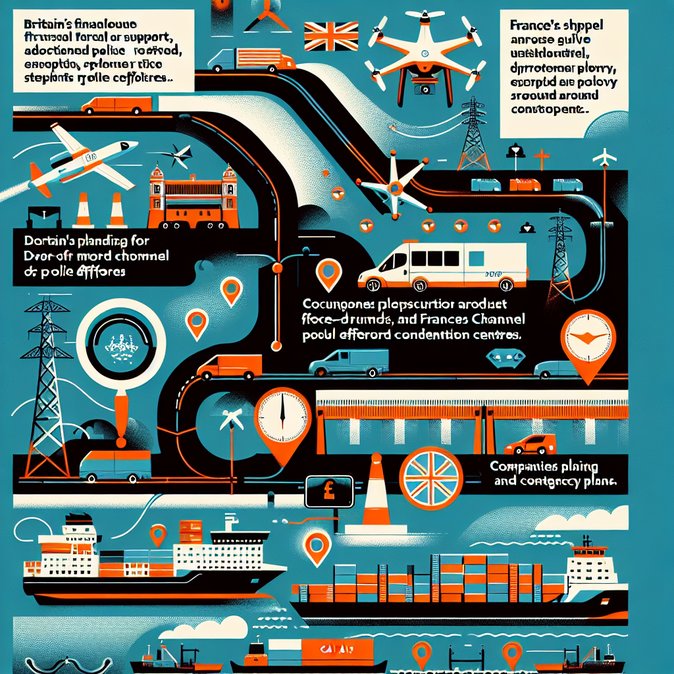
Testimony to France’s parliamentary commission on migration released on February 27 confirms that Britain has transferred €540 million to Paris since 2023 to finance patrols, technology and migrant-reception infrastructure along France’s northern coast. Laurent Touvet, director-general of the Interior Ministry’s immigration arm (DGEF), told deputies that London now shoulders “approximately 62 percent” of the joint budget to deter irregular Channel crossings, with France funding the remaining 38 percent.(thelocal.fr)
The money pays for 700 additional gendarmes and police, night-vision drones, surveillance towers and a network of mobile command vehicles stretching from Dunkirk to Cherbourg. It also covers the expansion of detention capacity and new screening facilities designed to fast-track asylum-seekers into France’s regular immigration system or return programmes. Touvet said the stepped-up effort had prevented more than 23,000 attempted departures in 2025 but acknowledged that smuggling networks “adapt quickly”, increasingly launching boats from remote estuaries and using decoy craft to divert patrols.
Businesses and individual travellers navigating this shifting landscape can turn to VisaHQ’s France portal (https://www.visahq.com/france/) for end-to-end visa processing, document checks and up-to-date guidance, ensuring cross-Channel trips proceed smoothly despite the heightened controls.
![UK pays France €540 million to curb small-boat crossings in the Channel]()
For businesses that rely on just-in-time freight across the Dover-Calais corridor, the Franco-British deal is a double-edged sword. More patrols mean occasional road closures on the A16 and access restrictions around the Port of Calais, disrupting truck flows. At the same time, reducing mass arrivals lessens the risk of spontaneous migrant blockades that have periodically paralysed ferry and Eurotunnel services. Logistics operators therefore broadly welcome the sustained funding but call for ‘yellow-lane’ fast-track permits so that time-critical cargo can bypass security bottlenecks during major police operations.
Politically, the disclosure underlines the extent of post-Brexit interdependence. Britain’s Home Office is effectively outsourcing frontline border enforcement to a Schengen partner, while Paris secures a significant cash flow that offsets the strain on northern municipalities. Yet NGOs question the strategy’s humanitarian cost, citing a record 249 asylum-seekers rescued with hypothermia in a single January night.
With a new five-year bilateral “Framework for Joint Action” up for negotiation in June, corporate mobility teams should expect further spending on surveillance tech and—potentially—more stringent checks on corporate coach and shuttle services. Employers moving staff between UK and French sites should build extra buffer time into itineraries during high-alert periods announced by the prefecture.
The money pays for 700 additional gendarmes and police, night-vision drones, surveillance towers and a network of mobile command vehicles stretching from Dunkirk to Cherbourg. It also covers the expansion of detention capacity and new screening facilities designed to fast-track asylum-seekers into France’s regular immigration system or return programmes. Touvet said the stepped-up effort had prevented more than 23,000 attempted departures in 2025 but acknowledged that smuggling networks “adapt quickly”, increasingly launching boats from remote estuaries and using decoy craft to divert patrols.
Businesses and individual travellers navigating this shifting landscape can turn to VisaHQ’s France portal (https://www.visahq.com/france/) for end-to-end visa processing, document checks and up-to-date guidance, ensuring cross-Channel trips proceed smoothly despite the heightened controls.

For businesses that rely on just-in-time freight across the Dover-Calais corridor, the Franco-British deal is a double-edged sword. More patrols mean occasional road closures on the A16 and access restrictions around the Port of Calais, disrupting truck flows. At the same time, reducing mass arrivals lessens the risk of spontaneous migrant blockades that have periodically paralysed ferry and Eurotunnel services. Logistics operators therefore broadly welcome the sustained funding but call for ‘yellow-lane’ fast-track permits so that time-critical cargo can bypass security bottlenecks during major police operations.
Politically, the disclosure underlines the extent of post-Brexit interdependence. Britain’s Home Office is effectively outsourcing frontline border enforcement to a Schengen partner, while Paris secures a significant cash flow that offsets the strain on northern municipalities. Yet NGOs question the strategy’s humanitarian cost, citing a record 249 asylum-seekers rescued with hypothermia in a single January night.
With a new five-year bilateral “Framework for Joint Action” up for negotiation in June, corporate mobility teams should expect further spending on surveillance tech and—potentially—more stringent checks on corporate coach and shuttle services. Employers moving staff between UK and French sites should build extra buffer time into itineraries during high-alert periods announced by the prefecture.