European aviation bodies Airports Council International (ACI) Europe, Airlines for Europe (A4E) and the International Air Transport Association (IATA) issued a joint statement on 27 February warning that the European Union’s new Entry/Exit System (EES) could create “four-hour queues or worse” at external-Schengen borders this summer. The industry groups are calling for a temporary suspension of the mandatory biometric checks—fingerprints and facial images—until staffing and technical problems are resolved.
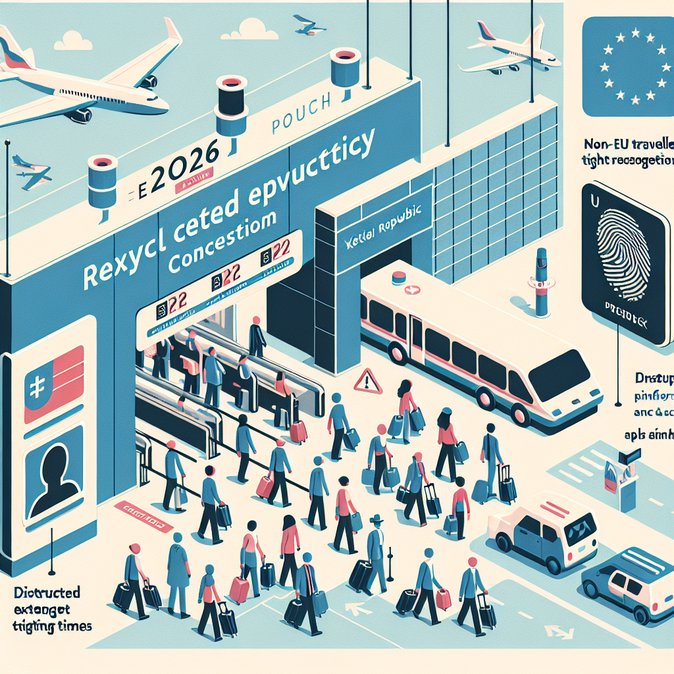
Although Prague’s Václav Havel Airport is an internal-Schengen gateway, it handles sizeable traffic from non-EU destinations such as the United Kingdom, the Gulf and North Africa; all those passengers will have to register in EES before 10 April 2026. The airport’s website now carries a pop-up alert advising third-country nationals to expect longer processing times and to arrive earlier for departure. Staff are being retrained to redirect flows between manual booths and 100 per-cent biometric kiosks, while additional space has been reserved in Terminal 1 to prevent queues spilling into duty-free areas.
For travellers looking to minimise disruption, VisaHQ provides an easy way to verify entry requirements, prepare documentation and receive updates on forthcoming programmes like EES and ETIAS. Its Czech Republic portal (https://www.visahq.com/czech-republic/) offers step-by-step guidance and secure data submission, helping passengers move through airport formalities with greater confidence.
![Airports and Airlines Push to Delay EU Biometric Border System; Prague Airport Braces for Four-Hour Queues]()
Czech tour operators and corporate-travel managers fear that even modest delays could have knock-on effects on tightly-timed charter rotations, connecting flights and crew-rostering rules. Some firms are already factoring an extra hour into ground-handling schedules and advising travellers to pre-register their data via the “Travel to Europe” app where available.
The Czech Interior Ministry supports a phased rollout but says it lacks legal authority to opt out unilaterally; any suspension would need European Council approval. In the meantime, airlines operating from Prague have asked for dedicated “previously-enrolled” lanes and clearer signage in English, Czech and Ukrainian to ease first-time registration.
If postponed, the EES delay could also push back the linked ETIAS €20 visa-waiver scheme, now pencilled in for late 2026, giving Czech businesses more time to update HR travel policies and data-protection procedures.
Although Prague’s Václav Havel Airport is an internal-Schengen gateway, it handles sizeable traffic from non-EU destinations such as the United Kingdom, the Gulf and North Africa; all those passengers will have to register in EES before 10 April 2026. The airport’s website now carries a pop-up alert advising third-country nationals to expect longer processing times and to arrive earlier for departure. Staff are being retrained to redirect flows between manual booths and 100 per-cent biometric kiosks, while additional space has been reserved in Terminal 1 to prevent queues spilling into duty-free areas.
For travellers looking to minimise disruption, VisaHQ provides an easy way to verify entry requirements, prepare documentation and receive updates on forthcoming programmes like EES and ETIAS. Its Czech Republic portal (https://www.visahq.com/czech-republic/) offers step-by-step guidance and secure data submission, helping passengers move through airport formalities with greater confidence.

Czech tour operators and corporate-travel managers fear that even modest delays could have knock-on effects on tightly-timed charter rotations, connecting flights and crew-rostering rules. Some firms are already factoring an extra hour into ground-handling schedules and advising travellers to pre-register their data via the “Travel to Europe” app where available.
The Czech Interior Ministry supports a phased rollout but says it lacks legal authority to opt out unilaterally; any suspension would need European Council approval. In the meantime, airlines operating from Prague have asked for dedicated “previously-enrolled” lanes and clearer signage in English, Czech and Ukrainian to ease first-time registration.
If postponed, the EES delay could also push back the linked ETIAS €20 visa-waiver scheme, now pencilled in for late 2026, giving Czech businesses more time to update HR travel policies and data-protection procedures.