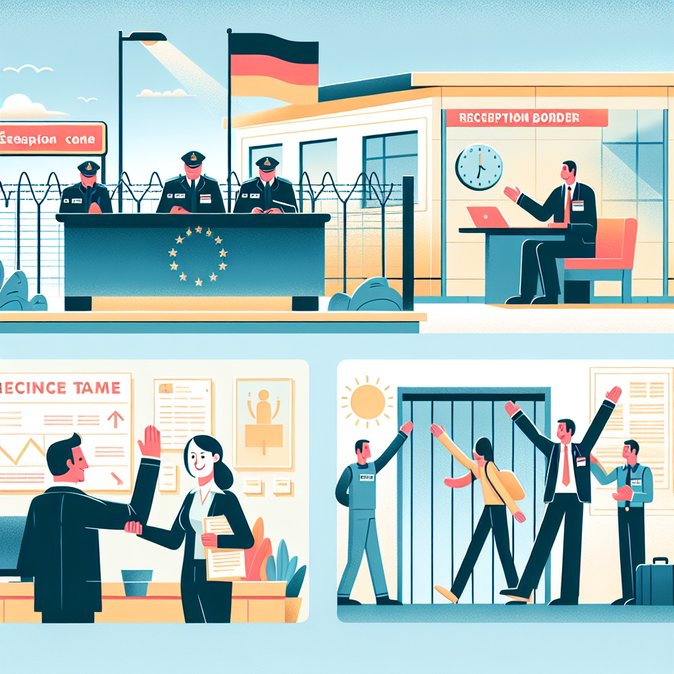
Germany’s lower house of parliament on 27 February approved two bills that transpose the 2024 overhaul of the Common European Asylum System (GEAS) into national law. The principal act introduces mandatory identification checks on arrival, accelerated border-procedure hearings for applicants from countries with low recognition rates and a fast-track transfer mechanism for people who have already applied for asylum in another EU member state. A companion bill amends the Central Register of Foreigners to allow real-time data-sharing among federal and state authorities.
For employers the biggest change is that asylum seekers housed in initial reception centres will be able to take up employment after just three months instead of six. Business associations, led by the DIHK, estimate that the measure could immediately open a pool of 40 000 potential workers—particularly in logistics, hospitality and agriculture—where seasonal labour gaps persist. Human-resources teams will, however, need to monitor residence-status documentation closely: the reform also tightens movement restrictions for applicants routed into the new border procedures, meaning work permits will be issued with geographic as well as sectoral conditions.
To help organisations stay on top of these evolving rules, VisaHQ provides up-to-date guidance on German entry categories, residence documents and work permissions. Companies can use the service’s online tools and expert support—see https://www.visahq.com/germany/—to verify paperwork, track processing times and ensure compliant onboarding when hiring asylum applicants or other foreign nationals.
![Bundestag Passes EU-Aligned Asylum Reform, Allowing Work After 3 Months]()
Interior Minister Alexander Dobrindt (CSU) framed the package as “Europeanising” German asylum practice while keeping migration “orderly and manageable”. Opposition reactions were mixed: CDU/CSU lawmakers backed the bills as a necessary tightening of rules, whereas Greens and Die Linke warned of legal challenges over the quasi-detention conditions foreseen at external-border facilities. The far-right AfD voted against the reform, arguing that it would still attract irregular migration.
Implementation now moves to the Bundesrat; because asylum is a concurrent competence, the upper chamber must sign off on certain enforcement details such as minimum standards in the planned ‘secondary-migration centres’. Most provisions are slated to enter into force on 1 July 2026, giving states four months to adapt accommodation capacity and IT links to the federal register.
For global-mobility managers the headline is clear: asylum applicants will reach the German labour market sooner, but onboarding will require careful compliance checks, especially where workers remain subject to border-procedure residence restrictions. Companies should update right-to-work processes, liaise with local foreigners’ authorities about geographic limitations and prepare for short-notice audits once the new digital interfaces go live.
For employers the biggest change is that asylum seekers housed in initial reception centres will be able to take up employment after just three months instead of six. Business associations, led by the DIHK, estimate that the measure could immediately open a pool of 40 000 potential workers—particularly in logistics, hospitality and agriculture—where seasonal labour gaps persist. Human-resources teams will, however, need to monitor residence-status documentation closely: the reform also tightens movement restrictions for applicants routed into the new border procedures, meaning work permits will be issued with geographic as well as sectoral conditions.
To help organisations stay on top of these evolving rules, VisaHQ provides up-to-date guidance on German entry categories, residence documents and work permissions. Companies can use the service’s online tools and expert support—see https://www.visahq.com/germany/—to verify paperwork, track processing times and ensure compliant onboarding when hiring asylum applicants or other foreign nationals.

Interior Minister Alexander Dobrindt (CSU) framed the package as “Europeanising” German asylum practice while keeping migration “orderly and manageable”. Opposition reactions were mixed: CDU/CSU lawmakers backed the bills as a necessary tightening of rules, whereas Greens and Die Linke warned of legal challenges over the quasi-detention conditions foreseen at external-border facilities. The far-right AfD voted against the reform, arguing that it would still attract irregular migration.
Implementation now moves to the Bundesrat; because asylum is a concurrent competence, the upper chamber must sign off on certain enforcement details such as minimum standards in the planned ‘secondary-migration centres’. Most provisions are slated to enter into force on 1 July 2026, giving states four months to adapt accommodation capacity and IT links to the federal register.
For global-mobility managers the headline is clear: asylum applicants will reach the German labour market sooner, but onboarding will require careful compliance checks, especially where workers remain subject to border-procedure residence restrictions. Companies should update right-to-work processes, liaise with local foreigners’ authorities about geographic limitations and prepare for short-notice audits once the new digital interfaces go live.