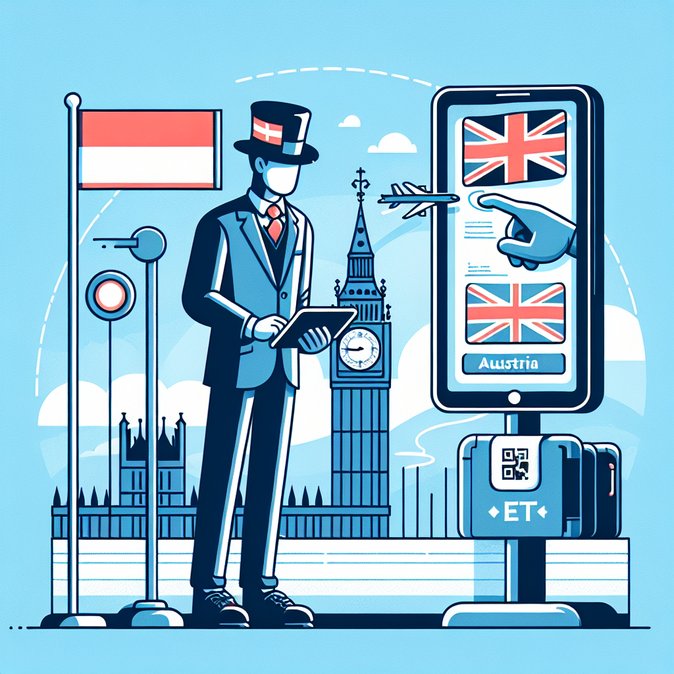
The United Kingdom’s long-trailed Electronic Travel Authorisation (ETA) scheme formally entered its operational phase on 25 February 2026, extending the requirement to all visa-exempt visitors, including Austrian nationals. The online authorisation costs £10, is valid for two years (or until passport expiry) and must be obtained at least 72 hours before boarding a carrier bound for the UK.
For Austrian businesses the change ends decades of completely friction-free entry for short-term meetings, trade fairs and intra-company support visits. Although the ETA is conceptually similar to the US ESTA or upcoming EU ETIAS, British border officials warn that carriers will deny boarding to travellers who have not received approval. Airlines have already updated check-in systems to verify ETA numbers against passport details.
Businesses and individual travellers who would prefer not to wrestle with yet another online portal can turn to VisaHQ’s Austria platform (https://www.visahq.com/austria/), which streamlines the entire ETA application: the service pre-populates forms, flags common errors, and tracks approvals in real time—saving mobility teams from chasing confirmations and ensuring no employee is left stranded at the gate.
![UK Electronic Travel Authorisation Becomes Mandatory—Austrian Travellers Now Need Pre-Arrival Clearance]()
The Home Office insists that processing will be almost instant in the vast majority of cases, relying on automated watch-list checks. Nevertheless, privacy lawyers point out that the UK retains the right to refuse an application without stating reasons, and rejected applicants must then apply for a standard visa – a process that can take weeks. Mobility managers are therefore urging staff to apply as soon as itineraries are pencilled in, not as a last-minute task.
Austria’s Chamber of Commerce (WKÖ) estimates that around 160,000 business trips are made from Austria to the UK each year. Consulting firm FM Global calculates the additional administrative burden at roughly €3 million annually in direct fees and staff time. Some firms are exploring virtual alternatives for routine training sessions, while others are bundling meetings to reduce travel frequency.
The ETA launch is also a dress rehearsal for the EU’s own ETIAS, now scheduled for April 2027, under which British citizens will face a mirror requirement when visiting Austria. Companies with two-way mobility flows should therefore use the UK rollout to fine-tune workflows, data storage practices and traveller education materials.
For Austrian businesses the change ends decades of completely friction-free entry for short-term meetings, trade fairs and intra-company support visits. Although the ETA is conceptually similar to the US ESTA or upcoming EU ETIAS, British border officials warn that carriers will deny boarding to travellers who have not received approval. Airlines have already updated check-in systems to verify ETA numbers against passport details.
Businesses and individual travellers who would prefer not to wrestle with yet another online portal can turn to VisaHQ’s Austria platform (https://www.visahq.com/austria/), which streamlines the entire ETA application: the service pre-populates forms, flags common errors, and tracks approvals in real time—saving mobility teams from chasing confirmations and ensuring no employee is left stranded at the gate.

The Home Office insists that processing will be almost instant in the vast majority of cases, relying on automated watch-list checks. Nevertheless, privacy lawyers point out that the UK retains the right to refuse an application without stating reasons, and rejected applicants must then apply for a standard visa – a process that can take weeks. Mobility managers are therefore urging staff to apply as soon as itineraries are pencilled in, not as a last-minute task.
Austria’s Chamber of Commerce (WKÖ) estimates that around 160,000 business trips are made from Austria to the UK each year. Consulting firm FM Global calculates the additional administrative burden at roughly €3 million annually in direct fees and staff time. Some firms are exploring virtual alternatives for routine training sessions, while others are bundling meetings to reduce travel frequency.
The ETA launch is also a dress rehearsal for the EU’s own ETIAS, now scheduled for April 2027, under which British citizens will face a mirror requirement when visiting Austria. Companies with two-way mobility flows should therefore use the UK rollout to fine-tune workflows, data storage practices and traveller education materials.