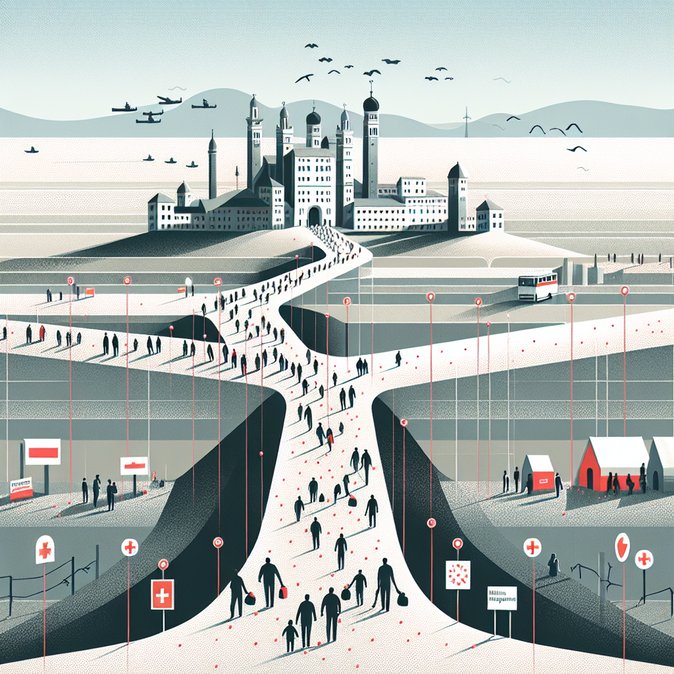
The International Rescue Committee (IRC) and faith-based partner Diaconia Valdese have released their January 2026 Protection Monitoring Report for Trieste, published on 24 February 2026. Field teams recorded 1,482 new arrivals via the Balkan route in January—a 27 % increase over December and the highest monthly figure since records began in 2022. The majority of travellers originated from Afghanistan (42 %), Pakistan (18 %) and Bangladesh (9 %), with smaller flows from Syria and the Horn of Africa.(rescue.org)
The report highlights acute gaps in reception: the state-run Campo San Giovanni facility reached 186 % of its official capacity, forcing many asylum-seekers to sleep rough around Trieste Central Station. Municipal authorities have requisitioned a disused warehouse near the port as an overflow shelter but admit they lack funding beyond March.
![IRC warns of rising land arrivals on Italy–Slovenia border as winter shelter capacity stretches thin]()
Amid the evolving situation at Italy’s north-eastern border, VisaHQ’s Italy portal (https://www.visahq.com/italy/) can help companies and individual travellers stay compliant with shifting documentation rules. The platform provides real-time updates on Schengen entry requirements, assists HR teams in obtaining work and transit visas, and offers concierge support for last-minute itinerary changes—streamlining mobility for staff passing through Trieste or onward into the wider EU.
For multinational companies moving staff through the North-east corridor or posting engineers to Fincantieri’s Monfalcone shipyard, the spikes could translate into longer border-crossing times and ad-hoc ID checks as police intensify patrols along the A23 motorway. HR teams should advise assignees to carry passports—even for domestic rail legs—until controls ease.
The IRC urges Rome and Brussels to establish a coordinated winter relief fund and expedite Dublin transfer decisions to reduce onward movement into Italy’s urban centres. In the meantime, employers involved in corporate volunteering or ESG programmes may find partnership opportunities to support emergency accommodation and legal orientation services.
The report highlights acute gaps in reception: the state-run Campo San Giovanni facility reached 186 % of its official capacity, forcing many asylum-seekers to sleep rough around Trieste Central Station. Municipal authorities have requisitioned a disused warehouse near the port as an overflow shelter but admit they lack funding beyond March.
Amid the evolving situation at Italy’s north-eastern border, VisaHQ’s Italy portal (https://www.visahq.com/italy/) can help companies and individual travellers stay compliant with shifting documentation rules. The platform provides real-time updates on Schengen entry requirements, assists HR teams in obtaining work and transit visas, and offers concierge support for last-minute itinerary changes—streamlining mobility for staff passing through Trieste or onward into the wider EU.
For multinational companies moving staff through the North-east corridor or posting engineers to Fincantieri’s Monfalcone shipyard, the spikes could translate into longer border-crossing times and ad-hoc ID checks as police intensify patrols along the A23 motorway. HR teams should advise assignees to carry passports—even for domestic rail legs—until controls ease.
The IRC urges Rome and Brussels to establish a coordinated winter relief fund and expedite Dublin transfer decisions to reduce onward movement into Italy’s urban centres. In the meantime, employers involved in corporate volunteering or ESG programmes may find partnership opportunities to support emergency accommodation and legal orientation services.