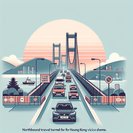
In a commentary published on 23 February, state-run Global Times highlighted a spike in two-way travel among the Chinese mainland, Hong Kong and Macao over the Spring Festival, calling it evidence of “ever-closer integration” across the Greater Bay Area (GBA). Citing Immigration Department data, the article noted simultaneous surges in mainland visitors to the SARs and SAR residents holidaying in Guangdong and beyond.
Photos showed passengers crowding West Kowloon Station on 22 February—one day before the official end of the mainland’s nine-day break—as families carried luggage through e-Channels revamped for higher throughput.
Economists interviewed by the paper argued that increased people-to-people flows are translating into stronger retail, MICE (meetings, incentives, conferences and exhibitions) and professional-services demand. They pointed to Hong Kong’s Top Talent Pass Scheme and Macao’s “1+4” diversification plan as policy backdrops encouraging longer cross-border stays for work and study.
![Mainland–Hong Kong–Macao Exchanges ‘Flourish’ During Spring Festival, Analysts See Deeper GBA Integration]()
For travelers and HR teams that now find themselves juggling multiple entry requirements across these jurisdictions, VisaHQ can simplify the process. Through its Hong Kong portal (https://www.visahq.com/hong-kong/), the platform consolidates visa rules, digital applications and document logistics, helping both individuals and corporations secure the right paperwork quickly and stay compliant as movement within the GBA accelerates.
Yet the commentary also flagged pain points: hotel prices in central districts rose up to 20 percent year-on-year, while inter-city bus tickets sold out days in advance. It urged accelerated completion of the Shenzhen–Jiangmen high-speed line and wider adoption of RMB digital wallets to smooth payments for visitors.
For global-mobility professionals, the piece signals that the GBA labour pool is becoming more fluid, making it easier to rotate staff between Hong Kong, Shenzhen and Macao but also heightening competition for short-term housing and office space during festival peaks.
Photos showed passengers crowding West Kowloon Station on 22 February—one day before the official end of the mainland’s nine-day break—as families carried luggage through e-Channels revamped for higher throughput.
Economists interviewed by the paper argued that increased people-to-people flows are translating into stronger retail, MICE (meetings, incentives, conferences and exhibitions) and professional-services demand. They pointed to Hong Kong’s Top Talent Pass Scheme and Macao’s “1+4” diversification plan as policy backdrops encouraging longer cross-border stays for work and study.

For travelers and HR teams that now find themselves juggling multiple entry requirements across these jurisdictions, VisaHQ can simplify the process. Through its Hong Kong portal (https://www.visahq.com/hong-kong/), the platform consolidates visa rules, digital applications and document logistics, helping both individuals and corporations secure the right paperwork quickly and stay compliant as movement within the GBA accelerates.
Yet the commentary also flagged pain points: hotel prices in central districts rose up to 20 percent year-on-year, while inter-city bus tickets sold out days in advance. It urged accelerated completion of the Shenzhen–Jiangmen high-speed line and wider adoption of RMB digital wallets to smooth payments for visitors.
For global-mobility professionals, the piece signals that the GBA labour pool is becoming more fluid, making it easier to rotate staff between Hong Kong, Shenzhen and Macao but also heightening competition for short-term housing and office space during festival peaks.