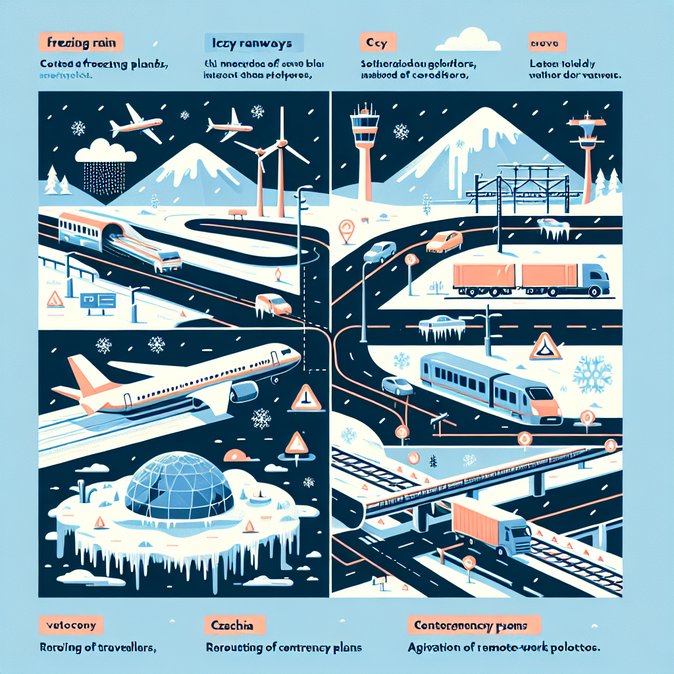
A powerful band of super-cooled rain swept across Bohemia and Moravia during the night of 12–13 January, but the operational fallout reached a critical point only this weekend. In the early hours of Sunday, 18 January, Prague’s Václav Havel Airport (PRG) confirmed that it was still running in “very-limited mode,” with arrival slots metered so that ground crews could repeatedly de-ice the primary runway. Flag-carrier Czech Airlines plus Lufthansa, Air France–KLM and several Gulf carriers opted to divert wide-body arrivals to Munich and Cologne, obliging passengers to pass German border controls and arrange overnight accommodation at their own cost.
The rail network fared little better. Czech Railways (ČD) was forced to cancel more than 90 regional services after ice sheathed overhead traction lines, while private operator RegioJet warned of knock-on delays of up to four hours on flagship InterCity trains linking Prague with Brno, Ostrava and Vienna. Road hauliers reported jack-knifed HGVs on the D5 and D8 motorway corridors to Germany, prompting logistics managers to dust off “snow desk’’ protocols and reroute time-critical consignments via Slovakia or Poland.
For mobility managers the cascading disruption is a stark reminder that business-travel resilience must now cover weather events that paralyse multiple transport modes simultaneously. Companies with Czech or regional headquarters in Prague told VisaHQ that they had already activated work-from-anywhere policies for visiting assignees, re-booked dozens of in-country visa and biometrics appointments, and issued practical advisories ranging from wearing crampons on icy pavements to carrying extra medication.
![Ice Storm Freezes Czech Transport, Forcing Corporates to Trigger Mobility Contingency Plans]()
Whether employees are rerouted through Germany or find themselves unexpectedly overstaying in the Czech Republic, VisaHQ’s online platform can cut through the paperwork. From express Schengen visa extensions to rescheduling Czech residency biometrics, our Prague-focused portal (https://www.visahq.com/czech-republic/) lets travel coordinators upload passports, track application status in real time, and receive on-the-ground alerts—ensuring compliance even when the weather is anything but predictable.
The Czech Hydrometeorological Institute expects temperatures to hover just below freezing through mid-week, meaning that any additional precipitation could quickly produce a fresh layer of black ice. HR and travel teams are therefore extending contingency measures until at least Wednesday. Experts advise corporates to: 1) verify whether diverted travellers need a German Schengen entry stamp to avoid overstaying, 2) allow double the usual transfer time between rail and air connections, and 3) document any missed immigration or medical appointments so that they can request official leniency later.
Although Prague Airport hopes to resume normal operations by Monday afternoon, the episode highlights the value of robust duty-of-care procedures: automated traveller-tracking, pre-negotiated hotel blocks outside the airport perimeter, and local language support lines for stranded employees proved decisive for firms that sailed through the crisis with minimal disruption.
The rail network fared little better. Czech Railways (ČD) was forced to cancel more than 90 regional services after ice sheathed overhead traction lines, while private operator RegioJet warned of knock-on delays of up to four hours on flagship InterCity trains linking Prague with Brno, Ostrava and Vienna. Road hauliers reported jack-knifed HGVs on the D5 and D8 motorway corridors to Germany, prompting logistics managers to dust off “snow desk’’ protocols and reroute time-critical consignments via Slovakia or Poland.
For mobility managers the cascading disruption is a stark reminder that business-travel resilience must now cover weather events that paralyse multiple transport modes simultaneously. Companies with Czech or regional headquarters in Prague told VisaHQ that they had already activated work-from-anywhere policies for visiting assignees, re-booked dozens of in-country visa and biometrics appointments, and issued practical advisories ranging from wearing crampons on icy pavements to carrying extra medication.

Whether employees are rerouted through Germany or find themselves unexpectedly overstaying in the Czech Republic, VisaHQ’s online platform can cut through the paperwork. From express Schengen visa extensions to rescheduling Czech residency biometrics, our Prague-focused portal (https://www.visahq.com/czech-republic/) lets travel coordinators upload passports, track application status in real time, and receive on-the-ground alerts—ensuring compliance even when the weather is anything but predictable.
The Czech Hydrometeorological Institute expects temperatures to hover just below freezing through mid-week, meaning that any additional precipitation could quickly produce a fresh layer of black ice. HR and travel teams are therefore extending contingency measures until at least Wednesday. Experts advise corporates to: 1) verify whether diverted travellers need a German Schengen entry stamp to avoid overstaying, 2) allow double the usual transfer time between rail and air connections, and 3) document any missed immigration or medical appointments so that they can request official leniency later.
Although Prague Airport hopes to resume normal operations by Monday afternoon, the episode highlights the value of robust duty-of-care procedures: automated traveller-tracking, pre-negotiated hotel blocks outside the airport perimeter, and local language support lines for stranded employees proved decisive for firms that sailed through the crisis with minimal disruption.