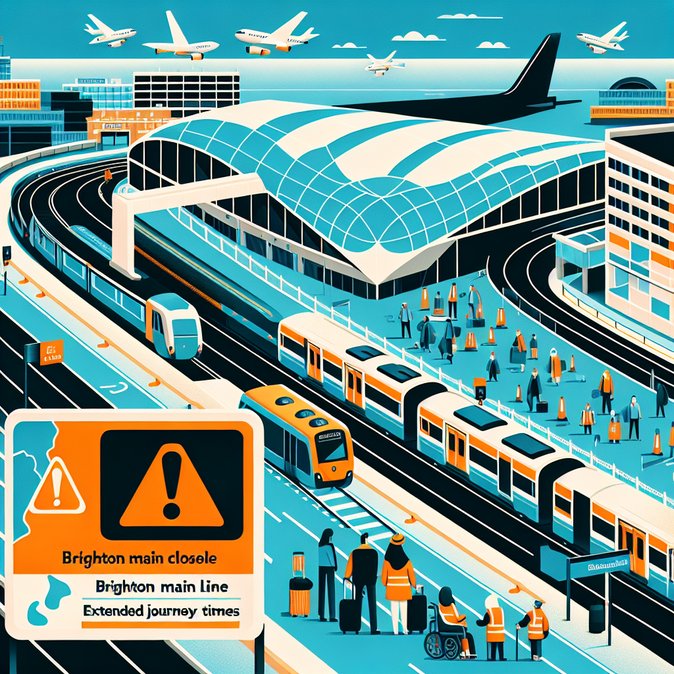
Train services on the busy Brighton Main Line are suspended from the early hours of Saturday 17 January through the end of Sunday 18 January while Network Rail completes a fresh phase of its £160 million resilience programme. The closure halts all Southern, Thameslink, Gatwick Express and Great Western services between East Croydon/Purley and Redhill/Gatwick Airport, forcing passengers onto replacement buses or long-distance diversions via Horsham and Three Bridges.
Network Rail engineers will replace life-expired track, drainage and conductor rails in a 3 km stretch south of Coulsdon, inspect a Victorian-era bridge near Redhill and install new signal power supplies designed to cut the number of line-side failures that plagued 2024’s winter timetable. The works form part of nine blocked-line weekends scheduled to run until 10 May 2026 and follow last weekend’s early-bird blockade that already caught out an estimated 45,000 passengers.
Gatwick Airport handled 40 million passengers in 2025—around 15 % of the UK total—so losing its fastest rail links for 48 hours is expected to affect 110,000 air travellers as well as weekend commuters. Airlines have issued ‘minimum connection time’ alerts urging passengers to arrive at least 30 minutes earlier than usual, and several corporate travel managers have pre-emptively re-booked Monday-morning long-haul crews into airport hotels to avoid last-minute missed flights.
![Weekend Shutdown of Key Gatwick Airport Rail Corridor to Disrupt Thousands of Travellers]()
For international passengers whose re-routed journeys now involve different transit points or unexpected overnight stays, VisaHQ’s online platform can fast-track any visa or transit authorization you might suddenly require. Their UK portal (https://www.visahq.com/united-kingdom/) presents up-to-date entry rules for more than 200 destinations and offers expedited processing options, helping you stay focused on navigating the rail disruption rather than chasing last-minute paperwork.
Network Rail argues that bundling critical works into concentrated weekend blocks will save 45,000 overnight possessions and reduce weekday disruption by 20 % over the next five years. Business-travel associations broadly welcome the strategy but are pressing the Department for Transport for clearer advance communication and a commitment that rail-replacement buses will accept contactless payment and mobility-impaired passengers.
Practical tip: travellers with non-flexible airline tickets should include at least one extra hour in their surface-access plans; rail-replacement buses will pick up at Redhill’s main taxi rank and are expected to run every 15 minutes, but journey times to Gatwick could exceed one hour during peak holiday periods.
Network Rail engineers will replace life-expired track, drainage and conductor rails in a 3 km stretch south of Coulsdon, inspect a Victorian-era bridge near Redhill and install new signal power supplies designed to cut the number of line-side failures that plagued 2024’s winter timetable. The works form part of nine blocked-line weekends scheduled to run until 10 May 2026 and follow last weekend’s early-bird blockade that already caught out an estimated 45,000 passengers.
Gatwick Airport handled 40 million passengers in 2025—around 15 % of the UK total—so losing its fastest rail links for 48 hours is expected to affect 110,000 air travellers as well as weekend commuters. Airlines have issued ‘minimum connection time’ alerts urging passengers to arrive at least 30 minutes earlier than usual, and several corporate travel managers have pre-emptively re-booked Monday-morning long-haul crews into airport hotels to avoid last-minute missed flights.

For international passengers whose re-routed journeys now involve different transit points or unexpected overnight stays, VisaHQ’s online platform can fast-track any visa or transit authorization you might suddenly require. Their UK portal (https://www.visahq.com/united-kingdom/) presents up-to-date entry rules for more than 200 destinations and offers expedited processing options, helping you stay focused on navigating the rail disruption rather than chasing last-minute paperwork.
Network Rail argues that bundling critical works into concentrated weekend blocks will save 45,000 overnight possessions and reduce weekday disruption by 20 % over the next five years. Business-travel associations broadly welcome the strategy but are pressing the Department for Transport for clearer advance communication and a commitment that rail-replacement buses will accept contactless payment and mobility-impaired passengers.
Practical tip: travellers with non-flexible airline tickets should include at least one extra hour in their surface-access plans; rail-replacement buses will pick up at Redhill’s main taxi rank and are expected to run every 15 minutes, but journey times to Gatwick could exceed one hour during peak holiday periods.