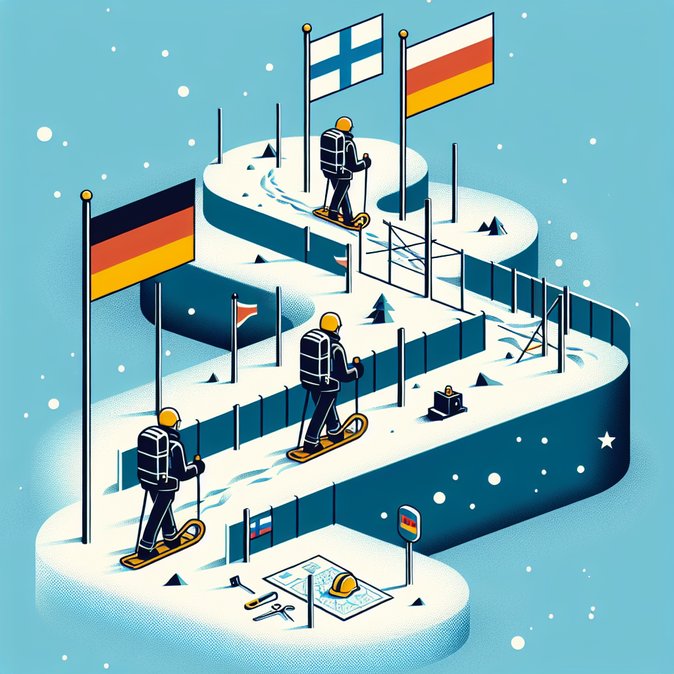
The Finnish Border Guard has opened a criminal investigation after three German tourists on snowshoes briefly wandered across Finland’s eastern frontier into Russia and back on the evening of 14 January. The incident occurred in the Paljakka wilderness area of Kuusamo, where no section of the new 200-kilometre border fence has yet been erected. A patrol from the Kainuu Border Guard caught up with the men almost immediately and escorted them to a nearby station for questioning. All three admitted they had been ‘curious’ to see the border and claimed they did not realise they had crossed it until they spotted Russian boundary markers. (raja.fi)
Although the hikers were released pending further inquiries, they now face charges of “valtionrajarikos” (state-border offence), which can carry fines or up to one year in prison. The Finnish and Russian regional border commissioners have exchanged information about the case in line with bilateral protocols, but Moscow has not requested further action. (raja.fi)
The episode highlights how sensitive the 1,340-kilometre border has become since Finland joined NATO in 2024 and since Helsinki shut all eight official crossings late last year in response to what it calls Russia’s “instrumentalisation” of irregular migration. While most attention has focused on asylum flows, the Border Guard says smaller tourist infractions also strain resources because every breach must be treated as a potential security incident. (aljazeera.com)
![Finnish Border Guard probes illegal snowshoe crossing into Russia]()
Travellers hoping to explore the wilds of eastern Finland can minimise border-related risks long before departure. VisaHQ’s Finland portal (https://www.visahq.com/finland/) consolidates the latest Schengen and Russian visa requirements, transit advisories and up-to-date entry rules in one place, helping outdoor enthusiasts and tour organisers stay compliant and avoid costly penalties.
For companies organising incentive trips or outdoor adventures in Lapland and Kainuu, the probe is a timely reminder to brief clients thoroughly on restricted zones and to use licensed guides with GPS devices pre-loaded with the exact border coordinates. Travel insurers also warn that policies rarely cover fines arising from illegal entry into Russia. The Border Guard advises hikers to stay at least 100 metres from the demarcation line unless on an officially marked trail.
Looking ahead, officials say the next 15-kilometre stretch of the steel-mesh fence—complete with sensor-equipped razor wire—will be completed near Kuusamo’s Juuma village by early spring, reducing accidental crossings. Until then, tour operators should monitor daily NOTAMs and regional advisories before venturing near the frontier.
Although the hikers were released pending further inquiries, they now face charges of “valtionrajarikos” (state-border offence), which can carry fines or up to one year in prison. The Finnish and Russian regional border commissioners have exchanged information about the case in line with bilateral protocols, but Moscow has not requested further action. (raja.fi)
The episode highlights how sensitive the 1,340-kilometre border has become since Finland joined NATO in 2024 and since Helsinki shut all eight official crossings late last year in response to what it calls Russia’s “instrumentalisation” of irregular migration. While most attention has focused on asylum flows, the Border Guard says smaller tourist infractions also strain resources because every breach must be treated as a potential security incident. (aljazeera.com)

Travellers hoping to explore the wilds of eastern Finland can minimise border-related risks long before departure. VisaHQ’s Finland portal (https://www.visahq.com/finland/) consolidates the latest Schengen and Russian visa requirements, transit advisories and up-to-date entry rules in one place, helping outdoor enthusiasts and tour organisers stay compliant and avoid costly penalties.
For companies organising incentive trips or outdoor adventures in Lapland and Kainuu, the probe is a timely reminder to brief clients thoroughly on restricted zones and to use licensed guides with GPS devices pre-loaded with the exact border coordinates. Travel insurers also warn that policies rarely cover fines arising from illegal entry into Russia. The Border Guard advises hikers to stay at least 100 metres from the demarcation line unless on an officially marked trail.
Looking ahead, officials say the next 15-kilometre stretch of the steel-mesh fence—complete with sensor-equipped razor wire—will be completed near Kuusamo’s Juuma village by early spring, reducing accidental crossings. Until then, tour operators should monitor daily NOTAMs and regional advisories before venturing near the frontier.