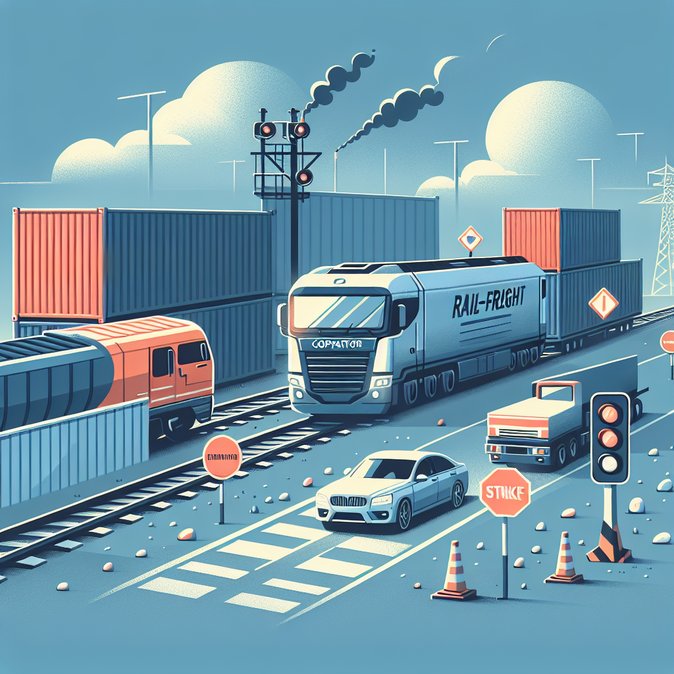
A nationwide 24-hour strike called by the rail unions FILT-CGIL, FIT-CISL and UILT-UIL began at 16:01 on 14 January 2026 and is due to end at 16:00 today, 15 January. The action targets Captrain Italia, the country’s second-largest rail-freight operator, and has disrupted cargo flows on key north-south corridors linking the ports of Genoa and La Spezia with logistics hubs in Lombardy and Emilia-Romagna.
Union leaders say talks over a new collective agreement have stalled, with particular friction around night-shift allowances and rostering of train drivers. Management counters that wage demands exceed productivity gains in a highly competitive sector.
For multinationals relying on just-in-time supply chains, the walk-out risks cascading delays. Automotive plants around Turin and Verona reportedly diverted components to road transport overnight, while several freight forwarders warned clients of 24- to 48-hour slippages.
![24-hour freight-rail stoppage hits Captrain Italia network]()
If executives or technicians suddenly need to fly in or out of Italy to mitigate supply-chain disruptions, VisaHQ can accelerate the paperwork. Through its Italy portal (https://www.visahq.com/italy/), the service offers real-time visa requirement checks, electronic authorizations, and courier assistance for passports, enabling companies to redeploy staff or contractors across Schengen borders without additional downtime.
Under Italy’s strike law, a minimum-services guarantee applies only to passenger rail, leaving freight completely exposed. The Ministry of Infrastructure has urged the parties to resume negotiations but has little leverage beyond moral suasion.
Corporate mobility teams should monitor port-rail interchange times and consider alternative routings via Brenner and Tarvisio crossings, where competing operators are still running. If no deal is reached, the unions hinted at a second stoppage in February, which could coincide with peak pre-Jubilee construction shipments.
Union leaders say talks over a new collective agreement have stalled, with particular friction around night-shift allowances and rostering of train drivers. Management counters that wage demands exceed productivity gains in a highly competitive sector.
For multinationals relying on just-in-time supply chains, the walk-out risks cascading delays. Automotive plants around Turin and Verona reportedly diverted components to road transport overnight, while several freight forwarders warned clients of 24- to 48-hour slippages.
If executives or technicians suddenly need to fly in or out of Italy to mitigate supply-chain disruptions, VisaHQ can accelerate the paperwork. Through its Italy portal (https://www.visahq.com/italy/), the service offers real-time visa requirement checks, electronic authorizations, and courier assistance for passports, enabling companies to redeploy staff or contractors across Schengen borders without additional downtime.
Under Italy’s strike law, a minimum-services guarantee applies only to passenger rail, leaving freight completely exposed. The Ministry of Infrastructure has urged the parties to resume negotiations but has little leverage beyond moral suasion.
Corporate mobility teams should monitor port-rail interchange times and consider alternative routings via Brenner and Tarvisio crossings, where competing operators are still running. If no deal is reached, the unions hinted at a second stoppage in February, which could coincide with peak pre-Jubilee construction shipments.