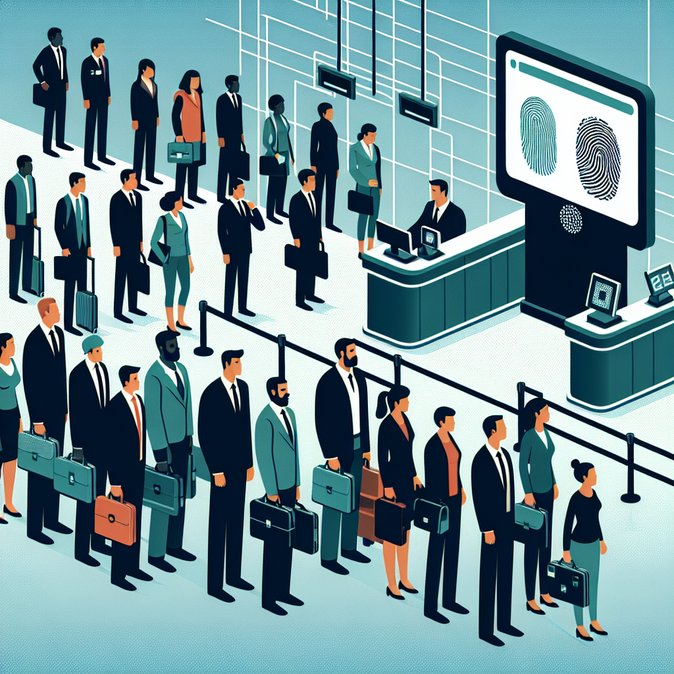
Business travellers landing in France on 15 January were greeted by snaking lines that snatched away connection times and meeting schedules. The bottlenecks stem from the next-phase roll-out of the European Union’s Entry/Exit System (EES), the new biometric border regime for non-EU nationals. According to industry news outlet Travel Tomorrow, wait times at peak periods have ballooned by up to 70 %, with some passengers reporting three-hour delays at Paris-Charles-de-Gaulle, Orly, Lyon and Nice airports. (traveltomorrow.com)
EES became operational at selected French airports in October 2025, but 15 January marked the point at which several more kiosks and manual counters were switched from “test” to “live” mode. Non-EU travellers—including UK passport holders on business trips—must now enrol fingerprints and a facial image at automated kiosks before proceeding to a border-guard desk for verification. A promised mobile pre-registration app has yet to appear, forcing most travellers to complete the process on arrival.
Specialist assistance is close at hand: VisaHQ’s France portal (https://www.visahq.com/france/) tracks real-time Schengen entry requirements, pre-screens documents and offers courier handling of visa applications, helping corporate travellers smooth their passage and avoid last-minute border surprises.
![EU Entry/Exit System expansion triggers hours-long queues at French airports]()
Airlines and travel-management companies are warning corporate clients to extend minimum connection times at French hubs by at least 90 minutes. Several carriers, notably Air France and British Airways, have begun proactive rebooking of short-haul connections that fall below the new threshold. Travel-industry trade body ABTA urged EU authorities to deploy contingency staffing and to stagger future enrolment quotas to avoid “systemic disruption” during the spring conference season. (traveltomorrow.com)
French border police (PAF) stress that delays will ease as the proportion of fully registered travellers rises, yet ACI Europe notes that only around 10 % of eligible passengers have completed biometric capture so far. The share is due to climb to 35 % on 9 January 2027, raising fears of an even sharper spike in processing times unless software glitches and staffing shortages are resolved.
For mobility managers the practical guidance is clear: build in larger buffers, warn employees against separate-ticket itineraries through France, and encourage frequent travellers to enrol during off-peak hours where possible. Companies with large assignee populations entering on Talent Passports or EU Blue Cards should brief staff that the EES requirement applies even to long-stay-visa holders who cross an external Schengen frontier after time outside the bloc.
EES became operational at selected French airports in October 2025, but 15 January marked the point at which several more kiosks and manual counters were switched from “test” to “live” mode. Non-EU travellers—including UK passport holders on business trips—must now enrol fingerprints and a facial image at automated kiosks before proceeding to a border-guard desk for verification. A promised mobile pre-registration app has yet to appear, forcing most travellers to complete the process on arrival.
Specialist assistance is close at hand: VisaHQ’s France portal (https://www.visahq.com/france/) tracks real-time Schengen entry requirements, pre-screens documents and offers courier handling of visa applications, helping corporate travellers smooth their passage and avoid last-minute border surprises.

Airlines and travel-management companies are warning corporate clients to extend minimum connection times at French hubs by at least 90 minutes. Several carriers, notably Air France and British Airways, have begun proactive rebooking of short-haul connections that fall below the new threshold. Travel-industry trade body ABTA urged EU authorities to deploy contingency staffing and to stagger future enrolment quotas to avoid “systemic disruption” during the spring conference season. (traveltomorrow.com)
French border police (PAF) stress that delays will ease as the proportion of fully registered travellers rises, yet ACI Europe notes that only around 10 % of eligible passengers have completed biometric capture so far. The share is due to climb to 35 % on 9 January 2027, raising fears of an even sharper spike in processing times unless software glitches and staffing shortages are resolved.
For mobility managers the practical guidance is clear: build in larger buffers, warn employees against separate-ticket itineraries through France, and encourage frequent travellers to enrol during off-peak hours where possible. Companies with large assignee populations entering on Talent Passports or EU Blue Cards should brief staff that the EES requirement applies even to long-stay-visa holders who cross an external Schengen frontier after time outside the bloc.