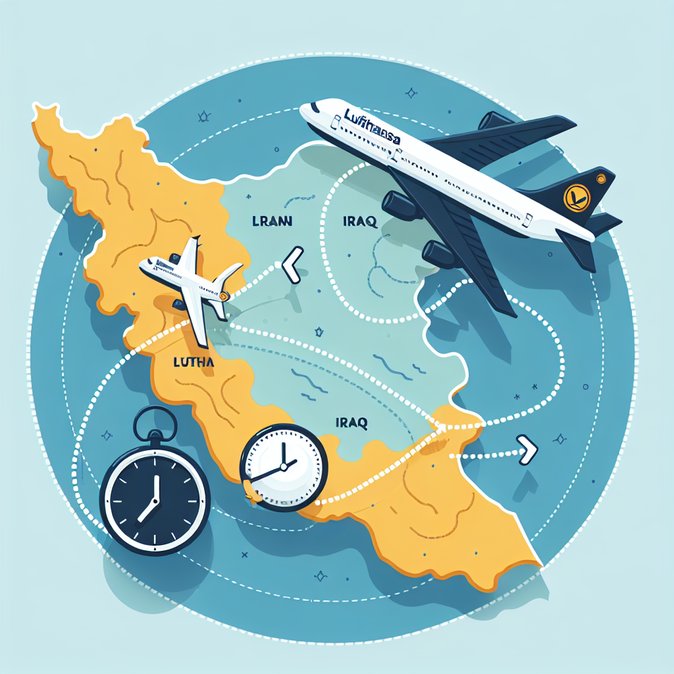
Germany’s Federal Ministry for Digital and Transport (BMDV) has renewed its warning to German-licensed airlines not to overfly Iran or Iraq after Tehran briefly reopened its skies following last week’s escalation with the United States. Lufthansa confirmed that it will maintain the longer northerly detours it introduced at the weekend, adding 40–60 minutes to typical Frankfurt-Bangkok or Munich-Delhi sectors. (reuters.com)
The German directive comes despite Iran’s Civil Aviation Organisation declaring the airspace safe again late on 14 January. Berlin’s risk assessment echoes that of France, the Netherlands and the UK, whose civil-aviation authorities say the security environment remains “volatile and unpredictable”. Flights are now funnelling through Afghanistan’s newly reopened FIR or taking Caucasus routes—creating fresh congestion and crew-duty challenges for schedulers. (reuters.com)
For passengers and crew facing last-minute route changes and unexpected tech stops, having the right travel documents is essential. VisaHQ’s Germany portal (https://www.visahq.com/germany/) lets travellers, corporate mobility teams and airlines instantly verify visa requirements for any country, submit applications online and track approvals in real time—helping avoid delays when flights are rerouted through unfamiliar airports.
![Germany tells carriers to keep avoiding Iranian and Iraqi airspace as Europe reroutes flights]()
For corporate mobility managers the immediate impact is longer block times, higher fuel burn and potential misconnections for passengers using Frankfurt and Munich as hubs. Several carriers—including British Airways and Finnair—have introduced technical stops in Cyprus or Athens to refuel within crew-duty limits. Travel buyers are being advised to build in longer transfer buffers and to monitor flight numbers that have moved into ‘operational-irregularity’ categories for EU261 compensation.
From a risk-management perspective, German multinationals are reviewing their travel policies for staff assigned to the Middle East and South Asia. Some companies are shifting time-sensitive cargo—especially automotive and pharmaceutical components—onto sea-air corridors via Dubai or Jeddah until routings stabilise. Mobility teams should brief travellers on potential schedule changes, ensure travel insurance remains valid for modified routings, and remind staff to carry hard-copy visas or eTA confirmations in case of unscheduled tech stops outside Schengen.
Analysts note that geopolitics is once again overriding pure cost considerations in air-route planning. As one aviation security consultant put it, “European carriers learned after MH17 that flying over conflict zones carries existential brand risk. Germany’s stance reinforces the idea that safety trumps schedule—even if it pushes up CO₂ emissions and ticket prices in the short term.”
The German directive comes despite Iran’s Civil Aviation Organisation declaring the airspace safe again late on 14 January. Berlin’s risk assessment echoes that of France, the Netherlands and the UK, whose civil-aviation authorities say the security environment remains “volatile and unpredictable”. Flights are now funnelling through Afghanistan’s newly reopened FIR or taking Caucasus routes—creating fresh congestion and crew-duty challenges for schedulers. (reuters.com)
For passengers and crew facing last-minute route changes and unexpected tech stops, having the right travel documents is essential. VisaHQ’s Germany portal (https://www.visahq.com/germany/) lets travellers, corporate mobility teams and airlines instantly verify visa requirements for any country, submit applications online and track approvals in real time—helping avoid delays when flights are rerouted through unfamiliar airports.
For corporate mobility managers the immediate impact is longer block times, higher fuel burn and potential misconnections for passengers using Frankfurt and Munich as hubs. Several carriers—including British Airways and Finnair—have introduced technical stops in Cyprus or Athens to refuel within crew-duty limits. Travel buyers are being advised to build in longer transfer buffers and to monitor flight numbers that have moved into ‘operational-irregularity’ categories for EU261 compensation.
From a risk-management perspective, German multinationals are reviewing their travel policies for staff assigned to the Middle East and South Asia. Some companies are shifting time-sensitive cargo—especially automotive and pharmaceutical components—onto sea-air corridors via Dubai or Jeddah until routings stabilise. Mobility teams should brief travellers on potential schedule changes, ensure travel insurance remains valid for modified routings, and remind staff to carry hard-copy visas or eTA confirmations in case of unscheduled tech stops outside Schengen.
Analysts note that geopolitics is once again overriding pure cost considerations in air-route planning. As one aviation security consultant put it, “European carriers learned after MH17 that flying over conflict zones carries existential brand risk. Germany’s stance reinforces the idea that safety trumps schedule—even if it pushes up CO₂ emissions and ticket prices in the short term.”