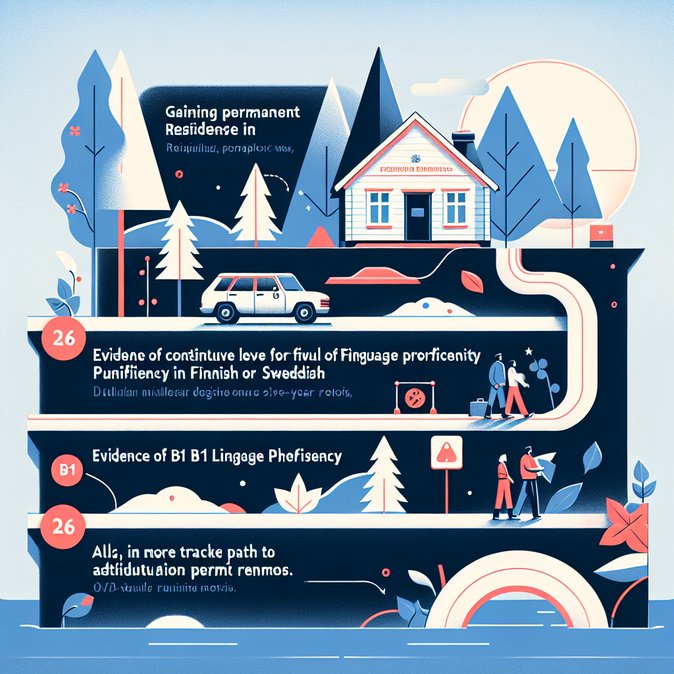
Foreign professionals eyeing a long-term future in Finland woke up this week to a very different rule-book. Amendments to the Aliens Act approved in late December entered into force on 8 January, but the Finnish Immigration Service (Migri) formally confirmed the transition on 11 January. Standard permanent-residence (P-permit) applications now require six years of continuous residence—up from four—a minimum B1 command of Finnish or Swedish (proven via the YKI exam) and at least two years of documented employment. (visahq.com)
Integrity provisions have also tightened: more than three months on unemployment or social-assistance benefits, or any unconditional prison sentence, resets the residency clock. Migri expects a brief surge of ‘old-rule’ applications lodged before 8 January, followed by a dip as would-be applicants accumulate the extra years. Employers must therefore budget for an additional renewal of the four-year continuous (A) permit and may need to subsidise language training earlier in an assignee’s stay. (visahq.com)
Three fast-track options survive, allowing settlement after four years for applicants who (1) earn ≥€40,000 annually, (2) hold a Finnish master’s degree plus two years’ work, or (3) achieve C1-level language skills and have three years’ Finnish employment. International graduates—vital to Finland’s tech and clean-energy clusters—retain a pathway but only if they tackle language requirements early. (visahq.com)
![Finland’s Tougher Permanent-Residence Rules Now in Force]()
For readers mapping out their own route through these new hurdles, VisaHQ can simplify the process: its Finland portal (https://www.visahq.com/finland/) consolidates up-to-date permit guides, bespoke document checklists and real-time support from visa professionals who understand both Migri policy and corporate mobility needs. The service can pre-screen applications, flag integrity risks and even coordinate language-test bookings, giving assignees and HR teams a clearer shot at first-time approval.
From a compliance standpoint, HR teams should update internal assignment policies immediately. Payroll data must align with tax records, and language-test bookings can take six months to secure. The Enter Finland portal now pre-populates certain tax and police data, yet practitioners predict longer adjudication times as officers interpret the new integrity clauses. Employers planning to transition key staff to long-term status in 2026-27 should begin evidence collation—payslips, contracts, YKI certificates—without delay. (visahq.com)
Law firms also advise checking dependent pathways: children of new P-permit holders remain exempt from the language and work criteria, but spouses will face the same six-year rule unless they qualify under their own fast-track route. With neighbouring Sweden mulling similar reforms, the Nordic talent market may tighten, pushing companies to enhance retention packages for highly skilled non-EU staff.
Integrity provisions have also tightened: more than three months on unemployment or social-assistance benefits, or any unconditional prison sentence, resets the residency clock. Migri expects a brief surge of ‘old-rule’ applications lodged before 8 January, followed by a dip as would-be applicants accumulate the extra years. Employers must therefore budget for an additional renewal of the four-year continuous (A) permit and may need to subsidise language training earlier in an assignee’s stay. (visahq.com)
Three fast-track options survive, allowing settlement after four years for applicants who (1) earn ≥€40,000 annually, (2) hold a Finnish master’s degree plus two years’ work, or (3) achieve C1-level language skills and have three years’ Finnish employment. International graduates—vital to Finland’s tech and clean-energy clusters—retain a pathway but only if they tackle language requirements early. (visahq.com)

For readers mapping out their own route through these new hurdles, VisaHQ can simplify the process: its Finland portal (https://www.visahq.com/finland/) consolidates up-to-date permit guides, bespoke document checklists and real-time support from visa professionals who understand both Migri policy and corporate mobility needs. The service can pre-screen applications, flag integrity risks and even coordinate language-test bookings, giving assignees and HR teams a clearer shot at first-time approval.
From a compliance standpoint, HR teams should update internal assignment policies immediately. Payroll data must align with tax records, and language-test bookings can take six months to secure. The Enter Finland portal now pre-populates certain tax and police data, yet practitioners predict longer adjudication times as officers interpret the new integrity clauses. Employers planning to transition key staff to long-term status in 2026-27 should begin evidence collation—payslips, contracts, YKI certificates—without delay. (visahq.com)
Law firms also advise checking dependent pathways: children of new P-permit holders remain exempt from the language and work criteria, but spouses will face the same six-year rule unless they qualify under their own fast-track route. With neighbouring Sweden mulling similar reforms, the Nordic talent market may tighten, pushing companies to enhance retention packages for highly skilled non-EU staff.