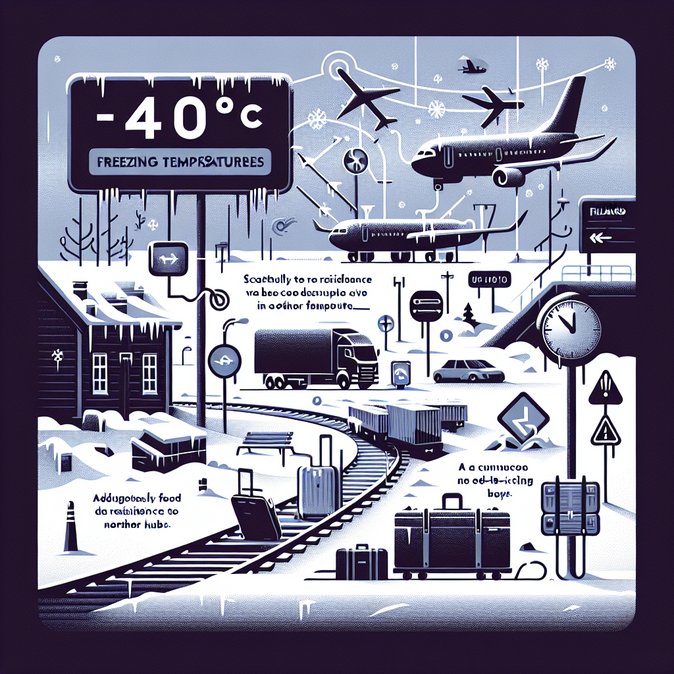
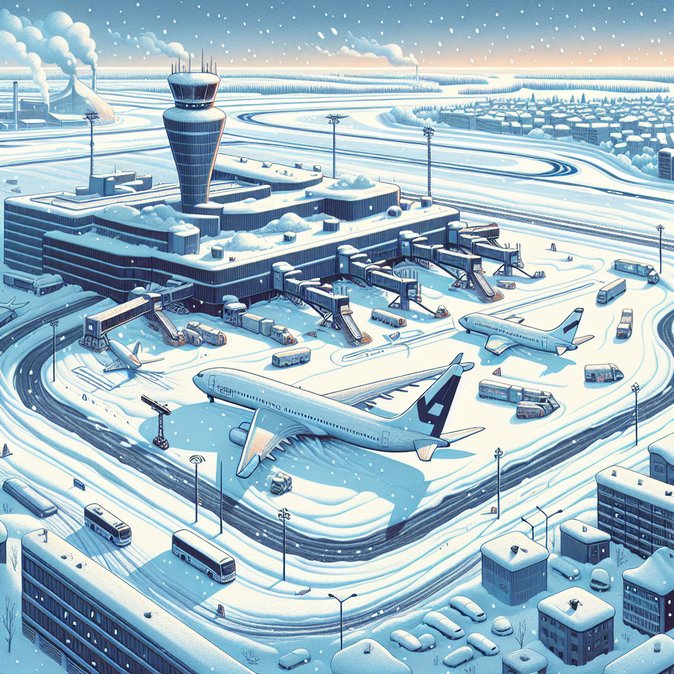
An Arctic cold snap that pushed temperatures below –40 °C in Lapland and –30 °C as far south as Helsinki between 12 and 14 January paralysed much of Finland’s transport network. Finavia reported 12 cancellations and 157 delays at Helsinki-Vantaa on 12 January, while Kittilä Airport—the main gateway to the Levi and Ylläs ski resorts—was effectively shut for almost 18 hours, stranding winter-holiday visitors and business travellers alike. Flag-carrier Finnair absorbed the bulk of the disruption but partner KLM and several charter operators also trimmed schedules. (visahq.com)
Although Finland is famed for its winter resilience, ground-handling systems proved vulnerable once the mercury dipped below –32 °C. Hydraulic fluid in de-icing trucks gelled, loaders froze and baggage belts stalled. Finavia trucked additional snow-clearance equipment north and activated contingency berths at Helsinki, but engineers conceded that most commercial de-icers are certified only to –29 °C. Finnair urged travellers to re-book via its mobile app and warned of baggage back-logs that could take several days to clear. Corporate travel managers are now advising staff to build 24-hour buffers into itineraries and to secure hotel rooms near Helsinki or Rovaniemi in case of missed connections. (visahq.com)
Road and rail services fared little better. VR long-distance trains reported multiple two-hour delays after rails contracted in –35 °C overnight lows, while the E75 arterial highway was briefly closed near Sodankylä due to ice fog. Emergency-medical flights serving Lapland’s mines and data-centre clusters were curtailed, prompting companies to review evacuation plans and insurance cover. Analysts expect renewed calls in Parliament for a €200 million northern-mobility package that would fund heated de-icing bays and longer runways at secondary airports. (visahq.com)
![Deep Freeze Grounds Flights Across Finland, Disrupting Business Travel]()
For travellers suddenly forced into complicated rerouting or unexpected stops, VisaHQ’s Finland portal (https://www.visahq.com/finland/) can fast-track Schengen extensions, multi-entry upgrades and replacement visas entirely online, sparing passengers and mobility teams the headache of hunting down open consulates while temperatures plummet.
From a mobility-compliance perspective, the weather shock is doubly disruptive. Travellers rerouted through Stockholm or Copenhagen must confirm that their Schengen validity covers multi-state transits; UK, US and Asian nationals on single-entry visas risk breaching conditions if they leave and re-enter Finland. Visa brokers report a surge in last-minute extension requests, while global mobility teams are refreshing ‘duty of care’ checklists to include extreme-cold protocols and power-bank requirements for staff working outdoors in Lapland. (visahq.com)
Looking ahead, meteorologists forecast that the deep freeze will ease by 16 January, but Finavia warns that returning aircraft and crew rotations will take another 48 hours to normalise. Companies with high-value cargo routed via Helsinki should prepare for back-to-back delays as warehouses clear snow-related backlogs. For now, the episode is a stark reminder that even a well-engineered Scandinavian hub can falter when the thermometer plunges beyond design limits.
Although Finland is famed for its winter resilience, ground-handling systems proved vulnerable once the mercury dipped below –32 °C. Hydraulic fluid in de-icing trucks gelled, loaders froze and baggage belts stalled. Finavia trucked additional snow-clearance equipment north and activated contingency berths at Helsinki, but engineers conceded that most commercial de-icers are certified only to –29 °C. Finnair urged travellers to re-book via its mobile app and warned of baggage back-logs that could take several days to clear. Corporate travel managers are now advising staff to build 24-hour buffers into itineraries and to secure hotel rooms near Helsinki or Rovaniemi in case of missed connections. (visahq.com)
Road and rail services fared little better. VR long-distance trains reported multiple two-hour delays after rails contracted in –35 °C overnight lows, while the E75 arterial highway was briefly closed near Sodankylä due to ice fog. Emergency-medical flights serving Lapland’s mines and data-centre clusters were curtailed, prompting companies to review evacuation plans and insurance cover. Analysts expect renewed calls in Parliament for a €200 million northern-mobility package that would fund heated de-icing bays and longer runways at secondary airports. (visahq.com)
For travellers suddenly forced into complicated rerouting or unexpected stops, VisaHQ’s Finland portal (https://www.visahq.com/finland/) can fast-track Schengen extensions, multi-entry upgrades and replacement visas entirely online, sparing passengers and mobility teams the headache of hunting down open consulates while temperatures plummet.
From a mobility-compliance perspective, the weather shock is doubly disruptive. Travellers rerouted through Stockholm or Copenhagen must confirm that their Schengen validity covers multi-state transits; UK, US and Asian nationals on single-entry visas risk breaching conditions if they leave and re-enter Finland. Visa brokers report a surge in last-minute extension requests, while global mobility teams are refreshing ‘duty of care’ checklists to include extreme-cold protocols and power-bank requirements for staff working outdoors in Lapland. (visahq.com)
Looking ahead, meteorologists forecast that the deep freeze will ease by 16 January, but Finavia warns that returning aircraft and crew rotations will take another 48 hours to normalise. Companies with high-value cargo routed via Helsinki should prepare for back-to-back delays as warehouses clear snow-related backlogs. For now, the episode is a stark reminder that even a well-engineered Scandinavian hub can falter when the thermometer plunges beyond design limits.