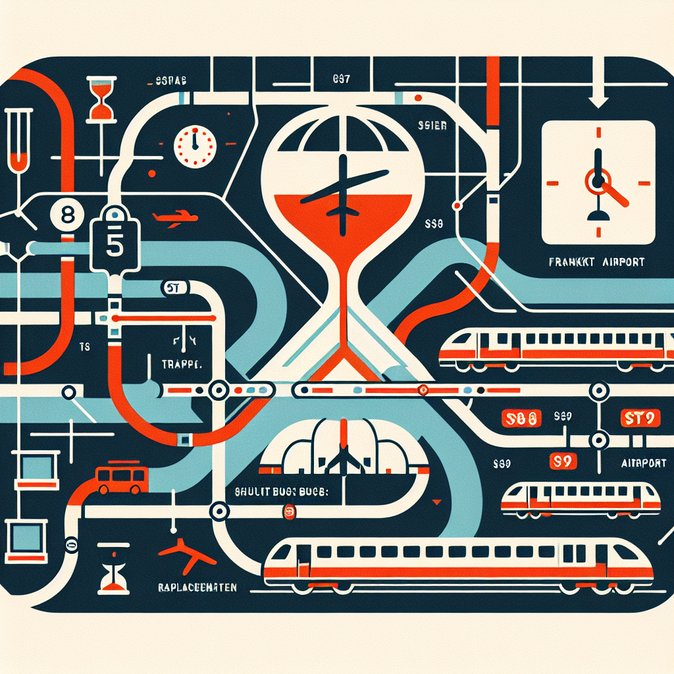
Deutsche Bahn has announced that the S8 and S9 urban-rail lines will be partially suspended between Kelsterbach and Wiesbaden Hauptbahnhof from 16 January through February as part of a multi-year infrastructure-modernisation project around Mainz. (welt.de)
The works coincide with the peak of winter-weather disruption and ongoing airport strikes, compounding mobility challenges for travellers heading to Frankfurt Airport. DB will run replacement buses, while an hourly S-Bahn shuttle will continue between Mainz and Wiesbaden. Direct Regional-Express trains will link Mainz and Frankfurt Hauptbahnhof, but journey times to the airport are expected to increase by 30–40 minutes.
![S-Bahn shutdown between Wiesbaden and Frankfurt to hinder airport access from 16 January]()
For international assignees and business travellers whose rail or flight plans are shifting at short notice, VisaHQ’s Germany portal (https://www.visahq.com/germany/) can take the hassle out of securing visas, residence permits and other travel documents. The platform offers end-to-end application support and real-time status tracking, giving mobility managers one less variable to worry about while contingency routes are being arranged.
Employers with commuter workforces in the Rhine-Main corridor should update travel-policies to allow taxi or ride-share reimbursement where public-transport connections become untenable. Global-mobility teams coordinating short-term assignments through Frankfurt should add buffer time for residence-permit and registration appointments in the city.
DB is investing several hundred million euros to renew tracks, points and catenary as part of its ‘Generalsanierung’ (general overhaul) programme. Although the upgrades promise greater reliability in the long term, the near-term impact on punctuality is significant: previous closures on the same corridor in December triggered average delays of 18 minutes per train.
The works coincide with the peak of winter-weather disruption and ongoing airport strikes, compounding mobility challenges for travellers heading to Frankfurt Airport. DB will run replacement buses, while an hourly S-Bahn shuttle will continue between Mainz and Wiesbaden. Direct Regional-Express trains will link Mainz and Frankfurt Hauptbahnhof, but journey times to the airport are expected to increase by 30–40 minutes.
For international assignees and business travellers whose rail or flight plans are shifting at short notice, VisaHQ’s Germany portal (https://www.visahq.com/germany/) can take the hassle out of securing visas, residence permits and other travel documents. The platform offers end-to-end application support and real-time status tracking, giving mobility managers one less variable to worry about while contingency routes are being arranged.
Employers with commuter workforces in the Rhine-Main corridor should update travel-policies to allow taxi or ride-share reimbursement where public-transport connections become untenable. Global-mobility teams coordinating short-term assignments through Frankfurt should add buffer time for residence-permit and registration appointments in the city.
DB is investing several hundred million euros to renew tracks, points and catenary as part of its ‘Generalsanierung’ (general overhaul) programme. Although the upgrades promise greater reliability in the long term, the near-term impact on punctuality is significant: previous closures on the same corridor in December triggered average delays of 18 minutes per train.