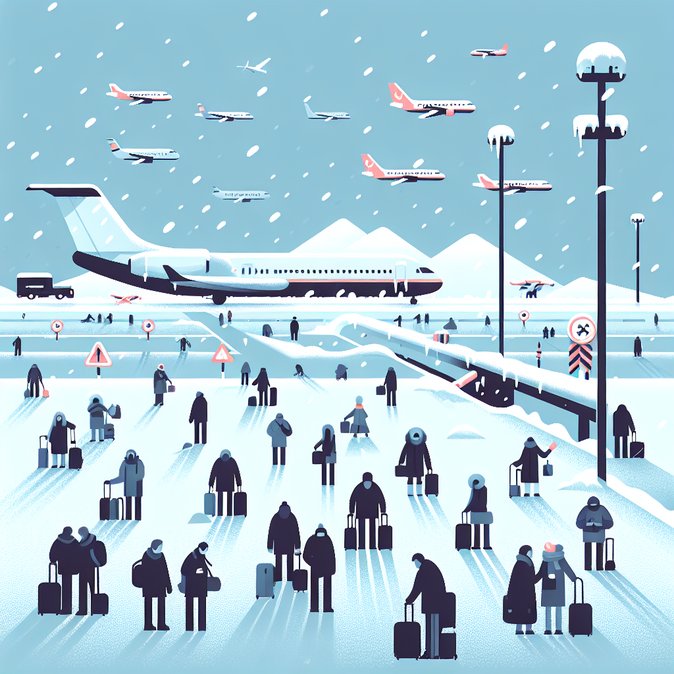
An intense band of freezing rain sweeping across eastern Austria in the early hours of 13 January blanketed Vienna International Airport (VIE) in black ice and forced the hub to halt all arrivals and departures shortly after 07:00 CET. De-icing crews worked around the clock, but super-cooled drizzle re-froze almost instantly on runways, taxiways and service roads, prompting the airport authority to suspend operations until early afternoon. More than 120 flights—including Austrian Airlines’ morning bank of European services and several long-haul departures to North America and Asia—were cancelled within the first six hours, while dozens of inbound aircraft diverted to Munich, Frankfurt, Venice and other alternate airports.
Because Vienna functions as a key Lufthansa-Group hub linking Central and South-Eastern Europe, the knock-on effects were immediate. Travellers bound for Bratislava, Budapest and the Balkans lost same-day connections, corporate mobility teams scrambled to rebook staff and secure hotel rooms at overcrowded alternates, and forwarders rerouted high-value cargo to Cologne-Bonn and Frankfurt. ÖBB simultaneously suspended rail links between the airport and Vienna Hauptbahnhof, severing Austria’s signature rail-air inter-modal corridor.
Meteorologists at Austria’s Central Institute for Meteorology and Geodynamics (ZAMG) warned that temperatures would hover around –2 °C through the evening, complicating recovery. One runway reopened just after 13:00, but airport spokesman Peter Kleemann cautioned that de-icing backlogs would push full normalisation well into 14 January. Travellers were urged not to proceed to the airport unless their flight status was confirmed.
![Ice storm shuts Vienna Airport, ripples through European business travel]()
For mobility managers the incident underscores the vulnerability of single-hub countries to weather shocks. Experts recommend ensuring employees carry multi-entry Schengen visas so diversions through neighbouring states do not create documentation hurdles, and that traveller-tracking tools are set to trigger automatic duty-of-care alerts when flights reroute.
Organisations or individual travellers needing to secure those multi-entry Schengen visas quickly can turn to VisaHQ, an online visa and passport facilitation service. The platform (https://www.visahq.com/austria/) offers step-by-step application guidance, real-time status tracking and dedicated support, making it easier to obtain the correct documents before unexpected diversions or last-minute itinerary changes arise.
Companies with time-sensitive consignments are advised to pre-book contingency trucking from alternate airports and verify insurance coverage for cold-chain interruptions.
The episode follows several smaller snow-related disruptions earlier this month and renews calls for a second de-icing pad at VIE—an investment airport authorities say is under review for the 2026-27 winter season.
Because Vienna functions as a key Lufthansa-Group hub linking Central and South-Eastern Europe, the knock-on effects were immediate. Travellers bound for Bratislava, Budapest and the Balkans lost same-day connections, corporate mobility teams scrambled to rebook staff and secure hotel rooms at overcrowded alternates, and forwarders rerouted high-value cargo to Cologne-Bonn and Frankfurt. ÖBB simultaneously suspended rail links between the airport and Vienna Hauptbahnhof, severing Austria’s signature rail-air inter-modal corridor.
Meteorologists at Austria’s Central Institute for Meteorology and Geodynamics (ZAMG) warned that temperatures would hover around –2 °C through the evening, complicating recovery. One runway reopened just after 13:00, but airport spokesman Peter Kleemann cautioned that de-icing backlogs would push full normalisation well into 14 January. Travellers were urged not to proceed to the airport unless their flight status was confirmed.

For mobility managers the incident underscores the vulnerability of single-hub countries to weather shocks. Experts recommend ensuring employees carry multi-entry Schengen visas so diversions through neighbouring states do not create documentation hurdles, and that traveller-tracking tools are set to trigger automatic duty-of-care alerts when flights reroute.
Organisations or individual travellers needing to secure those multi-entry Schengen visas quickly can turn to VisaHQ, an online visa and passport facilitation service. The platform (https://www.visahq.com/austria/) offers step-by-step application guidance, real-time status tracking and dedicated support, making it easier to obtain the correct documents before unexpected diversions or last-minute itinerary changes arise.
Companies with time-sensitive consignments are advised to pre-book contingency trucking from alternate airports and verify insurance coverage for cold-chain interruptions.
The episode follows several smaller snow-related disruptions earlier this month and renews calls for a second de-icing pad at VIE—an investment airport authorities say is under review for the 2026-27 winter season.