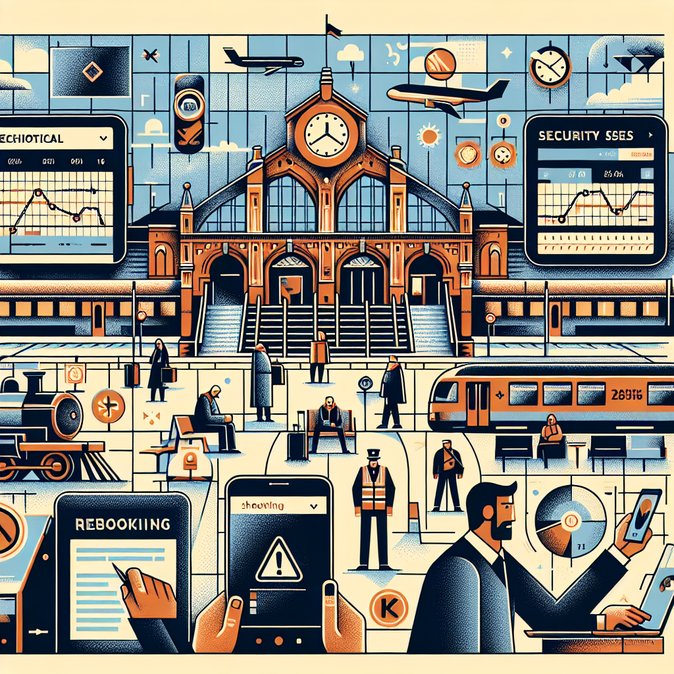
Eurostar’s operations team issued an urgent travel bulletin on 13 January after a string of technical failures and security incidents around Brussels-Midi station rippled across its Belgian network. Morning services to London, Paris, Amsterdam and Cologne started the day with 20- to 40-minute delays when an unauthorised person was reported on the tracks south of Brussels. Knock-on congestion, combined with a points failure near Halle, quickly forced Eurostar to slow or hold departing trains while Infrabel engineers carried out repairs.
By midday, eight departures had lost their scheduled pathways through the busy North–South Junction, obliging Eurostar to terminate two London services at Lille and re-route others via Gent-Sint-Pieters. The station’s juxtaposed UK border zone—where UK Border Force and Belgian Police operate side-by-side checks—became a chokepoint, with queues of up to 600 passengers reported. SNCB confirmed that dozens of travellers missed onward domestic connections despite efforts to honour through-tickets.
![Eurostar alerts business travellers after technical issues at Brussels-Midi cause cascading delays]()
For travellers suddenly confronted with unexpected schedule changes or new routing requirements, VisaHQ’s Belgium portal (https://www.visahq.com/belgium/) can quickly verify visa needs and process documentation for the UK, Schengen area and beyond. The service offers real-time entry-rule alerts, expedited handling and live support—helping both corporate and leisure passengers keep journeys on track even when trains are not.
Eurostar is offering fee-free rebooking within 60 days and advising corporate travel managers to pad schedules by at least two hours if itineraries rely on same-day onward rail. Mobility specialists warn that disrupted travellers who re-route via air may face fresh entry rules once Belgium activates the EU Entry/Exit System (EES) at Brussels Airport later this quarter.
The episode highlights the fragility of pan-European rail schedules favoured by multinationals seeking greener mobility options. Employers are urged to review duty-of-care policies, brief assignees on compensation rights under EU Rail Passenger Regulation 1371/2007 and consider remote-meeting alternatives when critical cross-border journeys look exposed to infrastructure risk.
By midday, eight departures had lost their scheduled pathways through the busy North–South Junction, obliging Eurostar to terminate two London services at Lille and re-route others via Gent-Sint-Pieters. The station’s juxtaposed UK border zone—where UK Border Force and Belgian Police operate side-by-side checks—became a chokepoint, with queues of up to 600 passengers reported. SNCB confirmed that dozens of travellers missed onward domestic connections despite efforts to honour through-tickets.
For travellers suddenly confronted with unexpected schedule changes or new routing requirements, VisaHQ’s Belgium portal (https://www.visahq.com/belgium/) can quickly verify visa needs and process documentation for the UK, Schengen area and beyond. The service offers real-time entry-rule alerts, expedited handling and live support—helping both corporate and leisure passengers keep journeys on track even when trains are not.
Eurostar is offering fee-free rebooking within 60 days and advising corporate travel managers to pad schedules by at least two hours if itineraries rely on same-day onward rail. Mobility specialists warn that disrupted travellers who re-route via air may face fresh entry rules once Belgium activates the EU Entry/Exit System (EES) at Brussels Airport later this quarter.
The episode highlights the fragility of pan-European rail schedules favoured by multinationals seeking greener mobility options. Employers are urged to review duty-of-care policies, brief assignees on compensation rights under EU Rail Passenger Regulation 1371/2007 and consider remote-meeting alternatives when critical cross-border journeys look exposed to infrastructure risk.