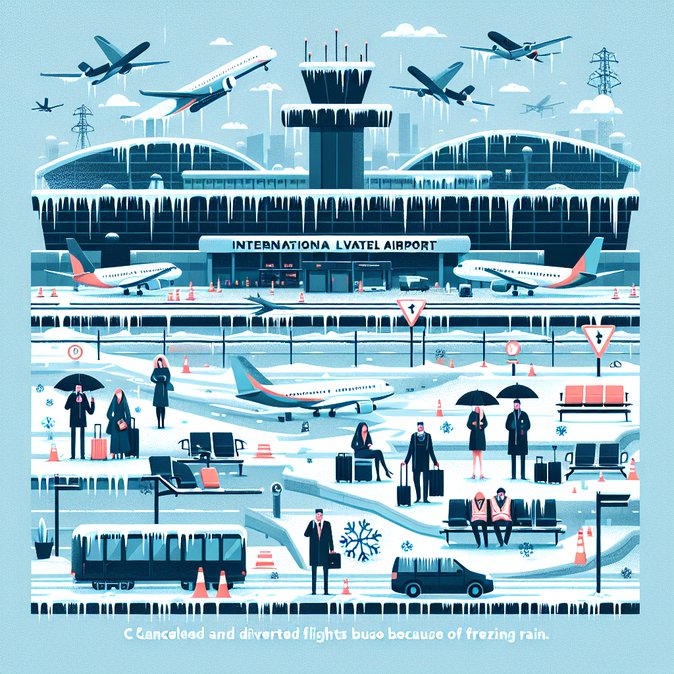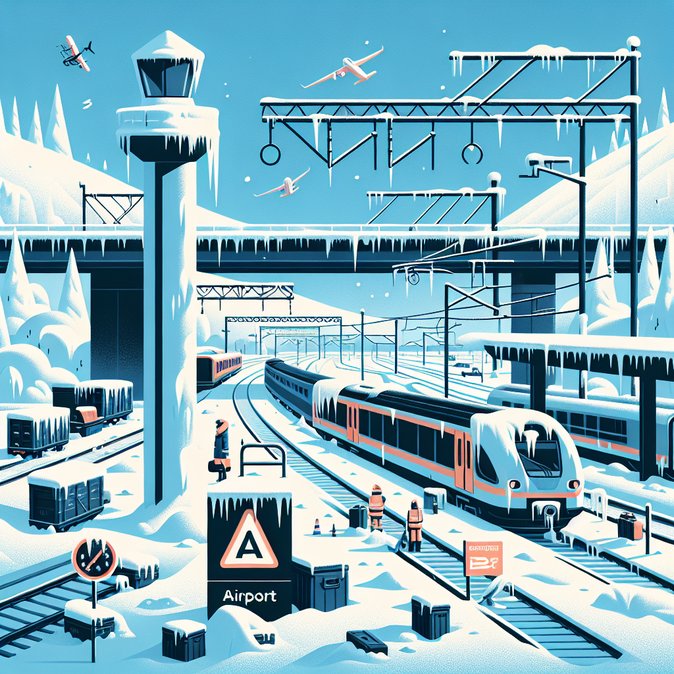
Austria’s state railway ÖBB took the unusual step of releasing a formal "Reisewarnung" late on 12 January, urging passengers to defer non-essential travel after forecasters predicted a night of freezing rain across the eastern half of the country. By the morning rush hour of 13 January the warning proved prescient: dozens of services on the busy Vienna–St Pölten–Salzburg corridor were cancelled, while long-distance Railjet trains were terminated at Vienna-Meidling instead of Vienna Hauptbahnhof to ease congestion.
Services to Vienna Airport were suspended entirely until early afternoon, severing the usual rail-air inter-modal connection that many corporate travellers rely on. ÖBB said City Airport Train (CAT) and S-Bahn operations were able to continue at reduced speed, but advised customers to check real-time updates and expect extended journey times. The operator temporarily lifted “Zugbindung” (fixed-train) conditions on all domestic tickets purchased up to 12 January, allowing travellers to rebook or seek refunds without penalty.
In the same spirit of proactive travel management, VisaHQ’s Vienna-based specialists can help businesses and leisure passengers stay on top of changing entry rules, secure urgent e-visas or passport renewals, and receive live travel alerts—so paperwork never adds to the chaos when weather already does. Learn more at https://www.visahq.com/austria/
![ÖBB issues nationwide travel warning as ice storm knocks out inter-city rail links]()
Freight movements were also affected. Rail Cargo Austria reported ice build-up on overhead lines, forcing it to reroute several trans-Alpine goods trains carrying automotive parts and consumer electronics destined for German assembly plants. Logistics analysts estimate that each 24-hour disruption on the Weststrecke can cost manufacturers up to €3 million in delayed production.
Municipal authorities in Vienna, Lower Austria and Styria deployed extra road-salt crews and briefly lifted environmental restrictions on grit usage to keep bus lanes and tram tracks operable. Nevertheless, workplace-mobility apps reported absentee spikes of 15–18 % in the greater Vienna area as commuters stayed home.
For HR and mobility managers, ÖBB’s flexible rebooking measures offer a template for mitigating employee-travel stress. Experts suggest updating corporate travel policies to reflect the carrier’s options and communicating them proactively during Central-European winters, when ice storms of this magnitude, though infrequent, can grind multimodal transport to a halt.
Services to Vienna Airport were suspended entirely until early afternoon, severing the usual rail-air inter-modal connection that many corporate travellers rely on. ÖBB said City Airport Train (CAT) and S-Bahn operations were able to continue at reduced speed, but advised customers to check real-time updates and expect extended journey times. The operator temporarily lifted “Zugbindung” (fixed-train) conditions on all domestic tickets purchased up to 12 January, allowing travellers to rebook or seek refunds without penalty.
In the same spirit of proactive travel management, VisaHQ’s Vienna-based specialists can help businesses and leisure passengers stay on top of changing entry rules, secure urgent e-visas or passport renewals, and receive live travel alerts—so paperwork never adds to the chaos when weather already does. Learn more at https://www.visahq.com/austria/

Freight movements were also affected. Rail Cargo Austria reported ice build-up on overhead lines, forcing it to reroute several trans-Alpine goods trains carrying automotive parts and consumer electronics destined for German assembly plants. Logistics analysts estimate that each 24-hour disruption on the Weststrecke can cost manufacturers up to €3 million in delayed production.
Municipal authorities in Vienna, Lower Austria and Styria deployed extra road-salt crews and briefly lifted environmental restrictions on grit usage to keep bus lanes and tram tracks operable. Nevertheless, workplace-mobility apps reported absentee spikes of 15–18 % in the greater Vienna area as commuters stayed home.
For HR and mobility managers, ÖBB’s flexible rebooking measures offer a template for mitigating employee-travel stress. Experts suggest updating corporate travel policies to reflect the carrier’s options and communicating them proactively during Central-European winters, when ice storms of this magnitude, though infrequent, can grind multimodal transport to a halt.