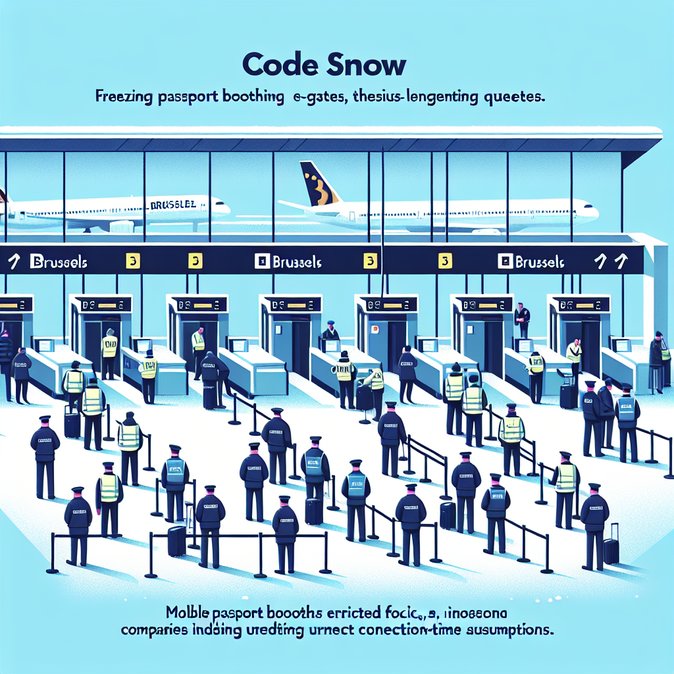
Within hours of the flight cancellations, Brussels Airport Company escalated its response by activating an internal ‘Code Snow’ protocol designed to safeguard passenger processing in sub-zero conditions. Federal Police installed mobile passport booths at remote stands after operators warned that automated e-gates can malfunction when biometric scanners freeze. Twelve extra snow-plough teams were placed on standby airside, but the immediate headache for mobility planners was inside the terminal. (visahq.com)
Airlines were told to build 30–45 minutes of de-icing into every turnaround—pushing tight intra-Schengen connections into zones where mis-directed passengers might exit into the wrong immigration channel. A misplaced queue can invalidate boarding passes and trigger full-border inspections that risk over-stay calculations under the 90/180-day rule. Multinational employers have been urged to brief travelling staff to double-check gate signage and allow for extended minimum connection times when transiting Brussels this week. (visahq.com)
![‘Code Snow’ introduces mobile passport booths and longer queues at Brussels Airport]()
For anyone suddenly unsure whether a brief diversion through the wrong channel could put their Schengen tally over the limit—or whether they now need a different type of visa to cover an extended layover—VisaHQ’s Belgium portal is a useful fallback. The service provides up-to-date entry rules, visa calculators and expedited application options, allowing travellers and corporate mobility teams to double-check requirements or arrange the correct documents in a hurry. More details are available at https://www.visahq.com/belgium/
The deployment demonstrates that contingency planning for winter weather extends beyond tarmac operations. Although police unions settled a 2025 dispute over the use of Article 9 of the Schengen Borders Code, today’s rapid installation of manual booths shows resources can still be redeployed with little notice. Travel-risk managers should therefore expect sporadic ID sweeps in the coming days, particularly on flights carrying large numbers of third-country nationals. (visahq.com)
If the mobile infrastructure performs well, airport authorities may add it permanently to their winter-operations playbook, forcing corporate travel tools to revise Brussels’ published minimum connection times. In the meantime, HR teams should review employee communications, ensuring that travellers understand where to queue and how to count Schengen days correctly—a small detail that can avert costly visa violations. (visahq.com)
Airlines were told to build 30–45 minutes of de-icing into every turnaround—pushing tight intra-Schengen connections into zones where mis-directed passengers might exit into the wrong immigration channel. A misplaced queue can invalidate boarding passes and trigger full-border inspections that risk over-stay calculations under the 90/180-day rule. Multinational employers have been urged to brief travelling staff to double-check gate signage and allow for extended minimum connection times when transiting Brussels this week. (visahq.com)

For anyone suddenly unsure whether a brief diversion through the wrong channel could put their Schengen tally over the limit—or whether they now need a different type of visa to cover an extended layover—VisaHQ’s Belgium portal is a useful fallback. The service provides up-to-date entry rules, visa calculators and expedited application options, allowing travellers and corporate mobility teams to double-check requirements or arrange the correct documents in a hurry. More details are available at https://www.visahq.com/belgium/
The deployment demonstrates that contingency planning for winter weather extends beyond tarmac operations. Although police unions settled a 2025 dispute over the use of Article 9 of the Schengen Borders Code, today’s rapid installation of manual booths shows resources can still be redeployed with little notice. Travel-risk managers should therefore expect sporadic ID sweeps in the coming days, particularly on flights carrying large numbers of third-country nationals. (visahq.com)
If the mobile infrastructure performs well, airport authorities may add it permanently to their winter-operations playbook, forcing corporate travel tools to revise Brussels’ published minimum connection times. In the meantime, HR teams should review employee communications, ensuring that travellers understand where to queue and how to count Schengen days correctly—a small detail that can avert costly visa violations. (visahq.com)