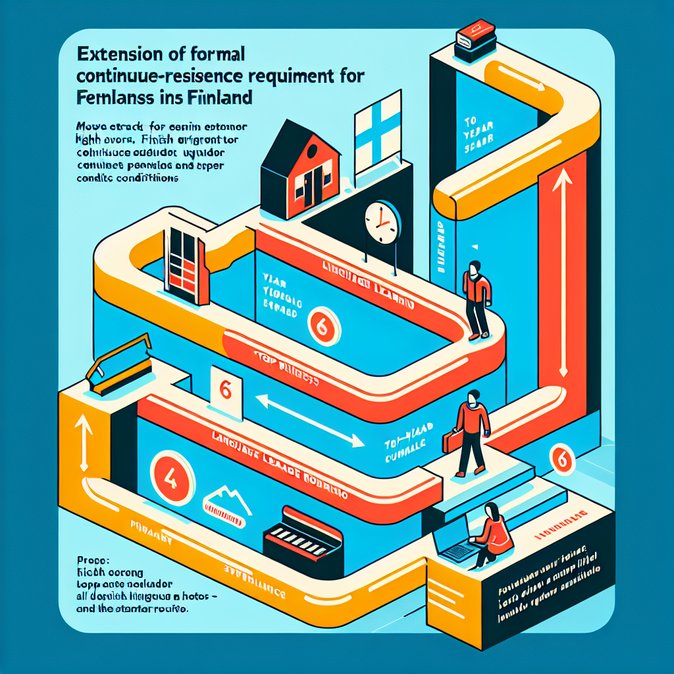
On 8 January 2026, sweeping amendments to Finland’s Aliens Act took effect, fundamentally reshaping the pathway from temporary to permanent residence. The new law lengthens the standard continuous-residence requirement from four to six years for most applicants. It also introduces mandatory proof of at least “satisfactory” proficiency in either Finnish or Swedish and evidence of two years of gainful employment in Finland. The Ministry of the Interior argues that the tougher criteria will better align long-term immigration with integration goals and labour-market participation, while critics warn that the changes could deter international talent.
The six-year rule is not absolute. Applicants who have lived in Finland for four years may still qualify if they satisfy at least one of three fast-track conditions: (1) a gross annual income of €40,000, (2) completion of a Finnish-recognised bachelor’s, master’s or doctoral degree plus “developing” language skills, or (3) high-level language proficiency combined with three years of Finnish work history. Even under these exceptions, benefit usage is capped: applicants must not have relied on unemployment security or social assistance for more than three months in total.
If you need hands-on help navigating these new requirements, VisaHQ provides streamlined support for Finnish visa and residence applications. Their portal (https://www.visahq.com/finland/) offers up-to-date checklists, document review, and real-time tracking, making it easier for both individuals and HR teams to stay compliant under the revised Aliens Act.
![Finland’s Stricter Permanent-Residence Rules Enter Into Force]()
For employers that routinely sponsor foreign staff, the heightened thresholds create both risks and opportunities. HR teams will need to revise mobility timelines, budget for extended local contracts, and ensure that sponsored employees engage in language training early. Tax and payroll departments should monitor the knock-on effect on work-based residence-permit categories, which remain valid stepping-stones toward permanence. The Finnish Immigration Service (Migri) has updated its Enter Finland portal and published new guidance, but it cautions that processing times may spike temporarily as legacy applications are phased out.
Business chambers have voiced mixed reactions. The Finland Chamber of Commerce recognises the integration rationale but stresses that companies in engineering, healthcare and IT already struggle to fill vacancies. “If Finland wants to stay competitive, work-based immigration pathways must remain predictable and fast,” the chamber said in a statement. Start-up hubs in Helsinki and Oulu are lobbying for an expansion of the Talent Boost visa to offset the longer wait for permanence.
Practically, foreign residents nearing the old four-year mark face decisive choices. Those eligible under the new fast-track clauses are encouraged to file by spring to avoid backlogs. Others may need to extend their fixed-term residence permits and invest in language studies. Legal advisers recommend compiling employment certificates, payslips and language-test results well in advance, as incomplete submissions will be rejected outright under the new rules. Companies with rotational expatriate programmes should review assignment lengths immediately to maintain compliance and avoid unexpected repatriation costs.
The six-year rule is not absolute. Applicants who have lived in Finland for four years may still qualify if they satisfy at least one of three fast-track conditions: (1) a gross annual income of €40,000, (2) completion of a Finnish-recognised bachelor’s, master’s or doctoral degree plus “developing” language skills, or (3) high-level language proficiency combined with three years of Finnish work history. Even under these exceptions, benefit usage is capped: applicants must not have relied on unemployment security or social assistance for more than three months in total.
If you need hands-on help navigating these new requirements, VisaHQ provides streamlined support for Finnish visa and residence applications. Their portal (https://www.visahq.com/finland/) offers up-to-date checklists, document review, and real-time tracking, making it easier for both individuals and HR teams to stay compliant under the revised Aliens Act.

For employers that routinely sponsor foreign staff, the heightened thresholds create both risks and opportunities. HR teams will need to revise mobility timelines, budget for extended local contracts, and ensure that sponsored employees engage in language training early. Tax and payroll departments should monitor the knock-on effect on work-based residence-permit categories, which remain valid stepping-stones toward permanence. The Finnish Immigration Service (Migri) has updated its Enter Finland portal and published new guidance, but it cautions that processing times may spike temporarily as legacy applications are phased out.
Business chambers have voiced mixed reactions. The Finland Chamber of Commerce recognises the integration rationale but stresses that companies in engineering, healthcare and IT already struggle to fill vacancies. “If Finland wants to stay competitive, work-based immigration pathways must remain predictable and fast,” the chamber said in a statement. Start-up hubs in Helsinki and Oulu are lobbying for an expansion of the Talent Boost visa to offset the longer wait for permanence.
Practically, foreign residents nearing the old four-year mark face decisive choices. Those eligible under the new fast-track clauses are encouraged to file by spring to avoid backlogs. Others may need to extend their fixed-term residence permits and invest in language studies. Legal advisers recommend compiling employment certificates, payslips and language-test results well in advance, as incomplete submissions will be rejected outright under the new rules. Companies with rotational expatriate programmes should review assignment lengths immediately to maintain compliance and avoid unexpected repatriation costs.