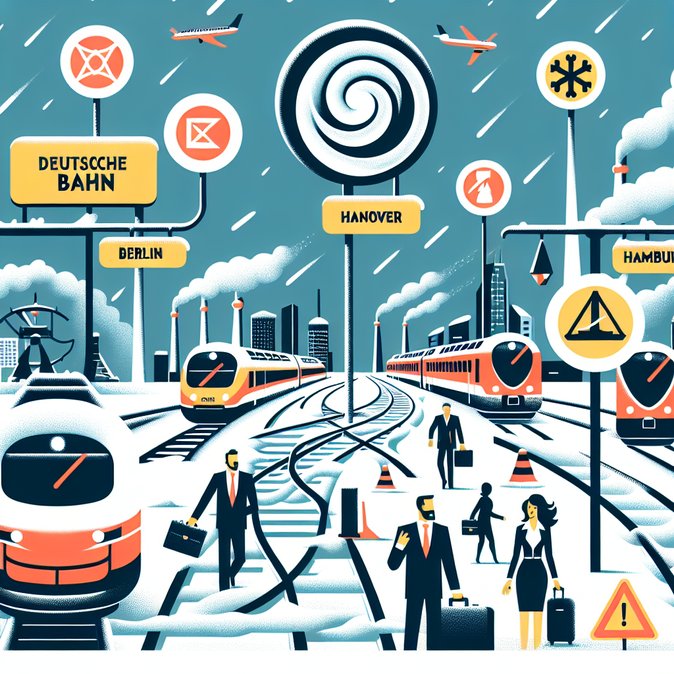
Germany woke up on 9 January 2026 to the rare sight of an empty departures board: rail operator Deutsche Bahn (DB) suspended all long-distance services north of Hanover after heavy snow, ice and hurricane-force gusts from winter storm “Elli” – known internationally as Storm Goretti – paralysed tracks and overhead lines.
The shutdown affects the backbone of the German network, including ICE and IC links between Berlin, Hamburg, Bremen and North-Rhine Westphalia. DB said the Hanover hub is “no longer operational” and urged travelers to postpone trips. Regional operators in Lower Saxony and Schleswig-Holstein also cancelled dozens of services, while S-Bahn lines in Hamburg ran on an emergency timetable.
Beyond rail, the German Weather Service (DWD) kept orange alerts in place for large parts of the north, warning of drifting snow and black ice. Schools in Hamburg and Bremen remained closed, and police asked motorists to avoid Autobahn A7, where jack-knifed lorries caused kilometre-long tailbacks.
![Winter storm ‘Elli’ forces Deutsche Bahn to shut down long-distance rail in northern Germany]()
If you find yourself stranded in Germany or rerouting through another country at short notice, VisaHQ can expedite the paperwork: in a few clicks you can verify entry requirements, renew expiring permits, or apply for emergency visas via https://www.visahq.com/germany/ Having documents sorted ahead of time can make rebooking flights or rail tickets far less stressful once services resume.
For business travellers the disruption is more than an inconvenience: companies that rely on same-day connections between Berlin and the port of Hamburg—or on rail/road legs to catch intercontinental flights—have had to activate contingency plans. Mobility managers are re-routing staff via Cologne or Frankfurt and advising virtual meetings where possible.
DB will review conditions every six hours, but infrastructure managers say clearing frozen switches and de-icing overhead catenary could take at least 24–36 hours. Employers with critical staff movements should monitor DB’s live map and consider overnight accommodation near southern hubs unaffected by the storm.
The shutdown affects the backbone of the German network, including ICE and IC links between Berlin, Hamburg, Bremen and North-Rhine Westphalia. DB said the Hanover hub is “no longer operational” and urged travelers to postpone trips. Regional operators in Lower Saxony and Schleswig-Holstein also cancelled dozens of services, while S-Bahn lines in Hamburg ran on an emergency timetable.
Beyond rail, the German Weather Service (DWD) kept orange alerts in place for large parts of the north, warning of drifting snow and black ice. Schools in Hamburg and Bremen remained closed, and police asked motorists to avoid Autobahn A7, where jack-knifed lorries caused kilometre-long tailbacks.

If you find yourself stranded in Germany or rerouting through another country at short notice, VisaHQ can expedite the paperwork: in a few clicks you can verify entry requirements, renew expiring permits, or apply for emergency visas via https://www.visahq.com/germany/ Having documents sorted ahead of time can make rebooking flights or rail tickets far less stressful once services resume.
For business travellers the disruption is more than an inconvenience: companies that rely on same-day connections between Berlin and the port of Hamburg—or on rail/road legs to catch intercontinental flights—have had to activate contingency plans. Mobility managers are re-routing staff via Cologne or Frankfurt and advising virtual meetings where possible.
DB will review conditions every six hours, but infrastructure managers say clearing frozen switches and de-icing overhead catenary could take at least 24–36 hours. Employers with critical staff movements should monitor DB’s live map and consider overnight accommodation near southern hubs unaffected by the storm.