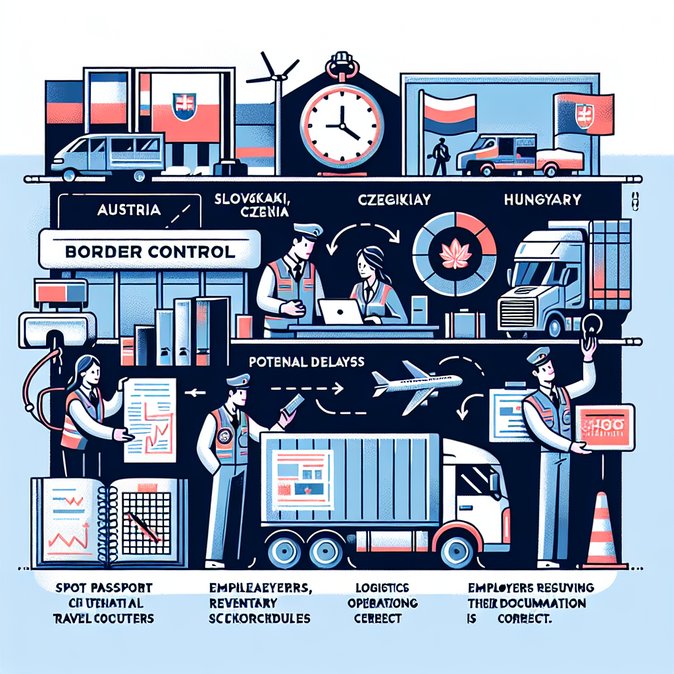
Companies moving staff across Central Europe will face another six months of on-the-spot passport inspections after Vienna extended its temporary reintroduction of border controls at crossings with Slovakia, Czechia, Hungary and Slovenia. A European Commission notice dated 7 January lists Austria’s renewed derogation from normal Schengen free-movement rules, valid from 16 December 2025 through 15 June 2026. (home-affairs.ec.europa.eu)
The Interior Ministry cites continued pressure from irregular migration along the Western Balkan route, overstretched asylum-reception capacity and heightened terrorism concerns linked to the conflicts in Ukraine and the Middle East. While the controls are officially “targeted and risk-based,” logistics firms report that freight convoys can wait up to 45 minutes at Nickelsdorf (HU) and Spielfeld (SI) during peak traffic.
![Austria Renews Internal Schengen Border Checks Until 15 June 2026]()
Business travellers should budget extra time when driving or taking cross-border coaches: officers may request proof of employment or hotel bookings in addition to passports or national ID cards. EU citizens can still use e-gates at major airports, but spot checks on trains have increased, particularly on the Vienna–Bratislava and Vienna–Prague routes.
In this fluid environment, VisaHQ can serve as a one-stop resource for employers and individual travelers who need clarity on Austrian entry formalities. The company’s Austria portal (https://www.visahq.com/austria/) provides real-time border-control updates, visa and permit application assistance, and courier solutions, helping teams avoid costly surprises at checkpoints and keep operations moving smoothly.
Employers with frontier-worker populations must also remember that Austria’s pilot Frontier-Worker Permit, launched in December 2025, requires commuters to carry their permit card plus proof of residence abroad. Failure to present both documents can result in €120 on-the-spot fines or, in rare cases, refusal of entry. HR teams are advised to circulate updated travel protocols and ensure A1 social-security certificates are accessible on mobile devices.
The Interior Ministry cites continued pressure from irregular migration along the Western Balkan route, overstretched asylum-reception capacity and heightened terrorism concerns linked to the conflicts in Ukraine and the Middle East. While the controls are officially “targeted and risk-based,” logistics firms report that freight convoys can wait up to 45 minutes at Nickelsdorf (HU) and Spielfeld (SI) during peak traffic.

Business travellers should budget extra time when driving or taking cross-border coaches: officers may request proof of employment or hotel bookings in addition to passports or national ID cards. EU citizens can still use e-gates at major airports, but spot checks on trains have increased, particularly on the Vienna–Bratislava and Vienna–Prague routes.
In this fluid environment, VisaHQ can serve as a one-stop resource for employers and individual travelers who need clarity on Austrian entry formalities. The company’s Austria portal (https://www.visahq.com/austria/) provides real-time border-control updates, visa and permit application assistance, and courier solutions, helping teams avoid costly surprises at checkpoints and keep operations moving smoothly.
Employers with frontier-worker populations must also remember that Austria’s pilot Frontier-Worker Permit, launched in December 2025, requires commuters to carry their permit card plus proof of residence abroad. Failure to present both documents can result in €120 on-the-spot fines or, in rare cases, refusal of entry. HR teams are advised to circulate updated travel protocols and ensure A1 social-security certificates are accessible on mobile devices.