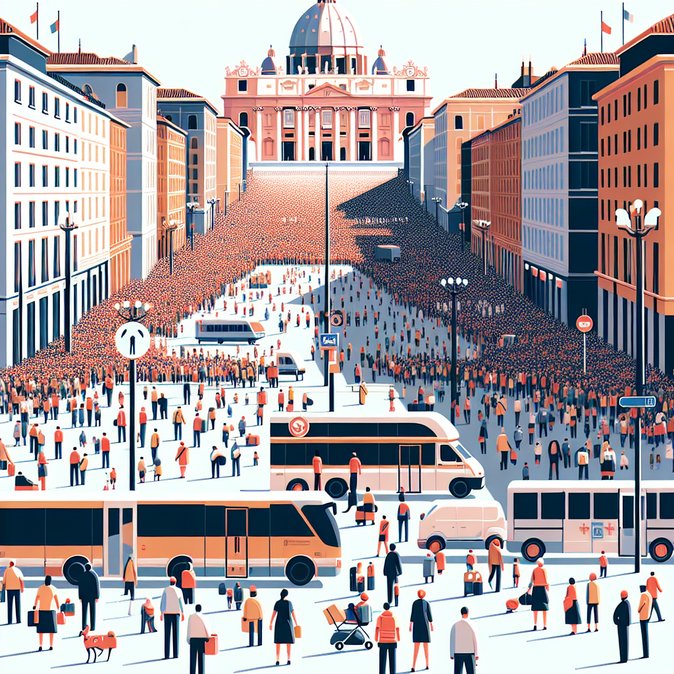
Rome’s year-long Jubilee officially concluded on 6 January when Pope Leo sealed the bronze Holy Door at St Peter’s Basilica, closing an event that attracted a record 33.5 million pilgrims from 185 countries. The unprecedented influx tested the capital’s transport, hospitality and consular systems but also injected an estimated €9 billion into the local economy, according to tourism board figures.
In his homily, the first U.S.-born pontiff urged the faithful to see “a neighbour in the foreigner” and warned against the commodification of people in an economy that “tries to profit from everything.” The remarks were widely interpreted as an appeal for more humane migration policies at a time when Italy continues to enforce temporary border checks with Slovenia and plans new quotas for non-EU workers.
From a mobility standpoint, the Jubilee functioned as an enormous stress-test ahead of the 2026 Winter Olympics and the Vatican’s next Holy Year in 2033. Trenitalia added 160 extra high-speed services during peak weeks, while Rome Fiumicino airport processed up to 200,000 passengers a day, relying on biometric e-gates to keep queues manageable. City authorities issued 1.4 million temporary transit permits to foreign tour buses and expanded multilingual signage across the metro network.
![Holy Year ends after drawing 33.5 million pilgrims to Rome, sparking calls for kinder treatment of migrants]()
For travelers who plan to join future pilgrimages, Olympic festivities, or any business trip in Italy, VisaHQ can streamline the visa application process online, offer up-to-date entry requirements, and provide real-time status tracking—saving precious time before you arrive at Rome’s crowded terminals. Explore their dedicated Italy services at https://www.visahq.com/italy/
Hotels reached average occupancy rates of 92 percent, pushing corporate travellers to peripheral districts or neighbouring cities such as Florence and Naples. Travel-risk analysts note that large-scale religious gatherings now rank alongside sporting mega-events as catalysts for sudden surges in visa demand, flight bookings and short-term housing prices. Companies with expatriate staff in Italy are advised to monitor the Vatican’s event calendar, as papal celebrations often prompt last-minute crowd-control measures that can spill over into work commutes.
With the Holy Door closed, pilgrims began a rapid exodus that will ease pressure on Rome’s infrastructure—but only briefly. The city begins preparatory works next month for the 2026 Olympics torch relay, which is expected to draw another wave of international visitors and re-ignite the debate over border controls and Schengen flexibility.
In his homily, the first U.S.-born pontiff urged the faithful to see “a neighbour in the foreigner” and warned against the commodification of people in an economy that “tries to profit from everything.” The remarks were widely interpreted as an appeal for more humane migration policies at a time when Italy continues to enforce temporary border checks with Slovenia and plans new quotas for non-EU workers.
From a mobility standpoint, the Jubilee functioned as an enormous stress-test ahead of the 2026 Winter Olympics and the Vatican’s next Holy Year in 2033. Trenitalia added 160 extra high-speed services during peak weeks, while Rome Fiumicino airport processed up to 200,000 passengers a day, relying on biometric e-gates to keep queues manageable. City authorities issued 1.4 million temporary transit permits to foreign tour buses and expanded multilingual signage across the metro network.

For travelers who plan to join future pilgrimages, Olympic festivities, or any business trip in Italy, VisaHQ can streamline the visa application process online, offer up-to-date entry requirements, and provide real-time status tracking—saving precious time before you arrive at Rome’s crowded terminals. Explore their dedicated Italy services at https://www.visahq.com/italy/
Hotels reached average occupancy rates of 92 percent, pushing corporate travellers to peripheral districts or neighbouring cities such as Florence and Naples. Travel-risk analysts note that large-scale religious gatherings now rank alongside sporting mega-events as catalysts for sudden surges in visa demand, flight bookings and short-term housing prices. Companies with expatriate staff in Italy are advised to monitor the Vatican’s event calendar, as papal celebrations often prompt last-minute crowd-control measures that can spill over into work commutes.
With the Holy Door closed, pilgrims began a rapid exodus that will ease pressure on Rome’s infrastructure—but only briefly. The city begins preparatory works next month for the 2026 Olympics torch relay, which is expected to draw another wave of international visitors and re-ignite the debate over border controls and Schengen flexibility.