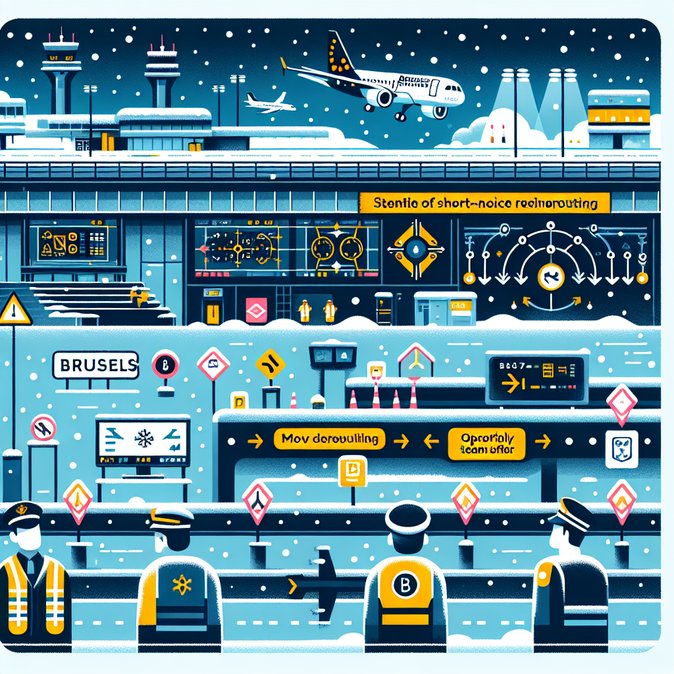
With the Royal Meteorological Institute forecasting up to five centimetres of snow overnight, Brussels Airport on 6 January 2026 urged travellers to arrive early on Wednesday and monitor flight status updates. Airport spokesperson Jeffrey Franssens said de-icing teams and glycol supplies were on standby but conceded that runway clearance could slow departures.
While the airport expects only minor timetable slippage, Belgian Federal Police confirmed that winter-weather contingency plans include mobile passport booths at remote stands to reduce queuing in sub-zero wind-chill. Carriers have been told to stagger boarding and to reinforce documentation checks so that any last-minute gate changes do not funnel passengers into the wrong Schengen/Non-Schengen streams.
![Brussels Airport issues snow alert, warns passengers of possible delays and stricter ID checks]()
For mobility managers the key takeaway is timing: de-icing can add 30-45 minutes to each turn-round, jeopardising tight connections and potentially pushing travellers over the six-hour layover threshold that triggers Belgian short-stay visa requirements for certain nationalities. Employers should pre-book lounge access or day rooms for vulnerable travellers and remind staff to travel with printed Belgian residence cards or entry stamps—even intra-Schengen flyers—because police have authority to conduct spot checks during weather-related operational disruptions.
Should a weather-induced layover unexpectedly trigger visa obligations, VisaHQ can step in fast. Through its Belgium portal (https://www.visahq.com/belgium/) the company offers instant eligibility checks, electronic application guides and courier pickup of passports, enabling travel managers and stranded passengers to secure the necessary short-stay paperwork even while still airside.
The airport has also activated its Business Travel Centre hotline to coordinate re-ticketing for corporate clients, a service that proved invaluable during last winter’s Storm Felix when 300 transfer passengers required overnight accommodation. If the snowfall intensifies, Brussels may adopt the same slot-reduction model used by Frankfurt, allowing airlines to cancel flights pre-emptively without financial penalty and rebook passengers on services later in the week.
While the airport expects only minor timetable slippage, Belgian Federal Police confirmed that winter-weather contingency plans include mobile passport booths at remote stands to reduce queuing in sub-zero wind-chill. Carriers have been told to stagger boarding and to reinforce documentation checks so that any last-minute gate changes do not funnel passengers into the wrong Schengen/Non-Schengen streams.

For mobility managers the key takeaway is timing: de-icing can add 30-45 minutes to each turn-round, jeopardising tight connections and potentially pushing travellers over the six-hour layover threshold that triggers Belgian short-stay visa requirements for certain nationalities. Employers should pre-book lounge access or day rooms for vulnerable travellers and remind staff to travel with printed Belgian residence cards or entry stamps—even intra-Schengen flyers—because police have authority to conduct spot checks during weather-related operational disruptions.
Should a weather-induced layover unexpectedly trigger visa obligations, VisaHQ can step in fast. Through its Belgium portal (https://www.visahq.com/belgium/) the company offers instant eligibility checks, electronic application guides and courier pickup of passports, enabling travel managers and stranded passengers to secure the necessary short-stay paperwork even while still airside.
The airport has also activated its Business Travel Centre hotline to coordinate re-ticketing for corporate clients, a service that proved invaluable during last winter’s Storm Felix when 300 transfer passengers required overnight accommodation. If the snowfall intensifies, Brussels may adopt the same slot-reduction model used by Frankfurt, allowing airlines to cancel flights pre-emptively without financial penalty and rebook passengers on services later in the week.
More From Belgium
View all
Amsterdam snow forces Bulgaria Air diversion to Brussels, underscoring need to pre-clear Belgian entry rules

De-icing delays ripple through Brussels Airport operations but flights continue amid Europe-wide freeze