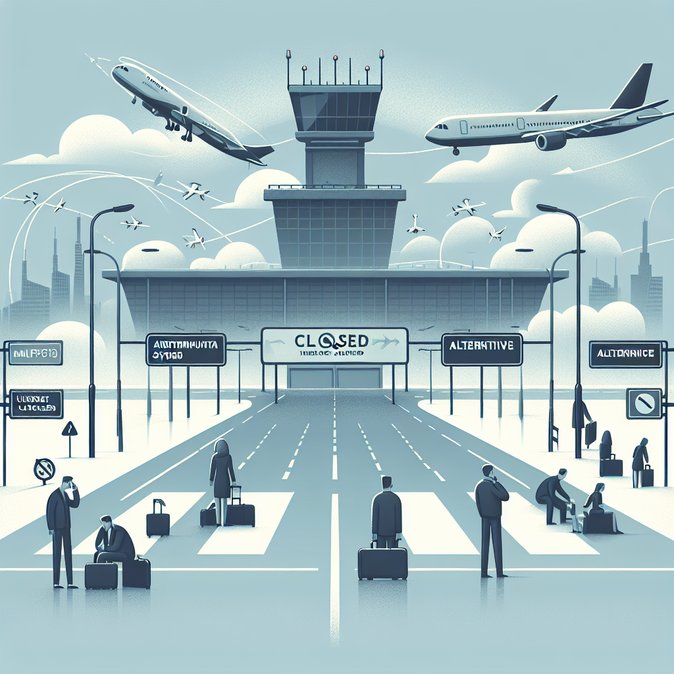
A rare technical failure in the instrument landing system (ILS) at Milan-Bergamo Il Caravaggio Airport (BGY) paralysed one of Italy’s busiest low-cost hubs on Saturday night, 3 January, and its effects were still being felt throughout Sunday, 4 January. According to airport operator SACBO and air-navigation provider ENAV, a malfunction in the precision-approach equipment coincided with dense evening fog, forcing controllers to suspend all arrivals and departures for almost five hours. Reuters counted 26 departing flights cancelled, six diversions and seven heavily retimed departures, leaving thousands of passengers sleeping on conveyor belts and terminal floors.
Although engineers restored the ILS shortly before midnight, the knock-on effect of displaced aircraft and out-of-hours crew meant that early-morning services on 4 January launched with rolling delays. Ryanair, which bases more than 20 aircraft at Bergamo, warned that recovery could take “24-48 hours” as aircraft and crews were repositioned from alternate airports such as Malpensa (MXP) and Linate (LIN).
Amid the scramble for alternative flights, it pays to confirm that all travel documents are in order. VisaHQ can quickly arrange or renew Italian visas, provide guidance on entry requirements and even manage group or corporate applications, giving disrupted travellers peace of mind when rerouted to other Italian airports. Visit https://www.visahq.com/italy/ for streamlined online processing and real-time support.
![Instrument Landing System Failure at Milan-Bergamo Ripples Across European Flight Schedules]()
Travel-risk consultancy Adept Traveler advised flyers to treat 4 January as a “network-reset day”, noting that self-connecting passengers on separate tickets were at highest risk of mis-connecting onward legs.
For corporate mobility managers, the incident is a reminder of the fragility of point-to-point low-cost networks. When a base airport shuts down, aircraft and crews end up out of rotation, causing secondary cancellations across Europe; staff travelling to Milan for Monday meetings suddenly found themselves routed via Vienna or sleeping in Cologne. Companies with strict travel-approval windows discovered that same-day alternatives were substantially more expensive or simply sold out.
Practically, travellers with Italian itineraries this week should consider building longer layovers or choosing full-service carriers whose alliance protections ease reaccommodation. Those already ticketed into BGY can still reroute to MXP, which is linked to Milan Centrale by a 51-minute Malpensa Express train (€15) or to LIN, now connected to the centre by the new M4 metro in just 12 minutes. Employers should also remember that EU-261 compensation applies when technical faults are within the airport’s control, meaning eligible passengers can claim up to €250 for short-haul and €400 for longer intra-EU sectors.
The episode has prompted ENAV to launch an internal review of maintenance protocols for regional ILS installations, amid concerns that winter fog events are becoming more frequent and more disruptive. SACBO said it would publish a passenger-handling “lessons-learned” report before the busy ski-charter period later in January.
Although engineers restored the ILS shortly before midnight, the knock-on effect of displaced aircraft and out-of-hours crew meant that early-morning services on 4 January launched with rolling delays. Ryanair, which bases more than 20 aircraft at Bergamo, warned that recovery could take “24-48 hours” as aircraft and crews were repositioned from alternate airports such as Malpensa (MXP) and Linate (LIN).
Amid the scramble for alternative flights, it pays to confirm that all travel documents are in order. VisaHQ can quickly arrange or renew Italian visas, provide guidance on entry requirements and even manage group or corporate applications, giving disrupted travellers peace of mind when rerouted to other Italian airports. Visit https://www.visahq.com/italy/ for streamlined online processing and real-time support.

Travel-risk consultancy Adept Traveler advised flyers to treat 4 January as a “network-reset day”, noting that self-connecting passengers on separate tickets were at highest risk of mis-connecting onward legs.
For corporate mobility managers, the incident is a reminder of the fragility of point-to-point low-cost networks. When a base airport shuts down, aircraft and crews end up out of rotation, causing secondary cancellations across Europe; staff travelling to Milan for Monday meetings suddenly found themselves routed via Vienna or sleeping in Cologne. Companies with strict travel-approval windows discovered that same-day alternatives were substantially more expensive or simply sold out.
Practically, travellers with Italian itineraries this week should consider building longer layovers or choosing full-service carriers whose alliance protections ease reaccommodation. Those already ticketed into BGY can still reroute to MXP, which is linked to Milan Centrale by a 51-minute Malpensa Express train (€15) or to LIN, now connected to the centre by the new M4 metro in just 12 minutes. Employers should also remember that EU-261 compensation applies when technical faults are within the airport’s control, meaning eligible passengers can claim up to €250 for short-haul and €400 for longer intra-EU sectors.
The episode has prompted ENAV to launch an internal review of maintenance protocols for regional ILS installations, amid concerns that winter fog events are becoming more frequent and more disruptive. SACBO said it would publish a passenger-handling “lessons-learned” report before the busy ski-charter period later in January.