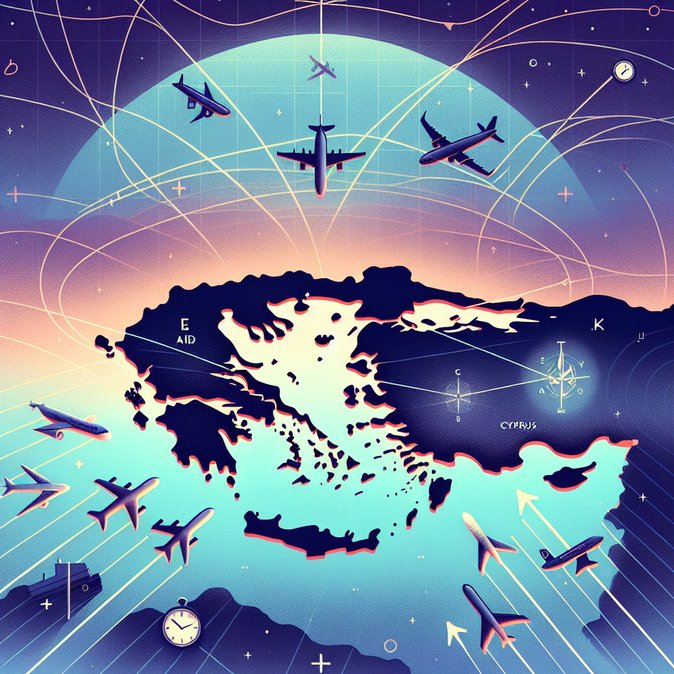
Holiday-makers returning to Cyprus on 4 January found themselves stranded after the Hellenic Civil Aviation Authority (HCAA) ordered an immediate shutdown of Greek airspace when a high-pitched ‘noise’ jammed all primary and backup radio frequencies. The NOTAM, issued at 09:45 local, halted take-offs and landings at Athens, Thessaloniki and 12 regional airports and forced aircraft scheduled to cross the Athens FIR – including Larnaca-bound services from western Europe – to divert via Turkish or Egyptian corridors.
Cyprus’ Transport Ministry confirmed that at least nine rotations between Larnaca or Paphos and Greek hubs were cancelled and that east-west long-haul flights that normally overfly Greece added up to 40 minutes to avoid the closure. Ground handlers at Larnaca reported knock-on delays lasting into the early hours of 5 January as aircraft and crew rosters were repositioned. Some passengers were rerouted through Istanbul, while others accepted hotel vouchers in Athens after security queues stretched beyond passport control.
![Greek Airspace Blackout Disrupts Cyprus–Greece Flights and Overflights]()
For passengers suddenly finding themselves routed through non-Schengen hubs such as Istanbul or Cairo, arranging the correct travel paperwork at short notice can be stressful. VisaHQ’s Cyprus portal (https://www.visahq.com/cyprus/) provides fast, step-by-step assistance in securing Turkish, Egyptian and other transit visas, delivering digital approvals in hours and giving travellers peace of mind when flight plans change unexpectedly.
Greek officials have ruled out a cyber-attack but have not yet identified the fault, reviving debate about the region’s ageing communications hardware and chronic ATC understaffing. Eurocontrol has asked carriers to file contingency flight plans that bypass the Athens FIR for the next 48 hours in case intermittent outages recur.
For mobility managers the incident highlights the vulnerability of the Cyprus–Greece air bridge, which carries the bulk of business and VFR traffic to the island. Companies with time-critical assignees are advised to keep alternative routings on hold and to pre-clear crew for Turkey overflights until HCAA publishes its technical report.
Cyprus’ Transport Ministry confirmed that at least nine rotations between Larnaca or Paphos and Greek hubs were cancelled and that east-west long-haul flights that normally overfly Greece added up to 40 minutes to avoid the closure. Ground handlers at Larnaca reported knock-on delays lasting into the early hours of 5 January as aircraft and crew rosters were repositioned. Some passengers were rerouted through Istanbul, while others accepted hotel vouchers in Athens after security queues stretched beyond passport control.
For passengers suddenly finding themselves routed through non-Schengen hubs such as Istanbul or Cairo, arranging the correct travel paperwork at short notice can be stressful. VisaHQ’s Cyprus portal (https://www.visahq.com/cyprus/) provides fast, step-by-step assistance in securing Turkish, Egyptian and other transit visas, delivering digital approvals in hours and giving travellers peace of mind when flight plans change unexpectedly.
Greek officials have ruled out a cyber-attack but have not yet identified the fault, reviving debate about the region’s ageing communications hardware and chronic ATC understaffing. Eurocontrol has asked carriers to file contingency flight plans that bypass the Athens FIR for the next 48 hours in case intermittent outages recur.
For mobility managers the incident highlights the vulnerability of the Cyprus–Greece air bridge, which carries the bulk of business and VFR traffic to the island. Companies with time-critical assignees are advised to keep alternative routings on hold and to pre-clear crew for Turkey overflights until HCAA publishes its technical report.