Belgium’s Flemish Region has flipped the switch on a completely redesigned online “Single-Permit” portal, marking the most ambitious modernisation of the country’s economic-migration system since work-authorisation powers were devolved to the regions in 2014. The platform quietly went live on 4 January 2026 after months of load-testing and coincides with legislative amendments that entered into force on New Year’s Day.
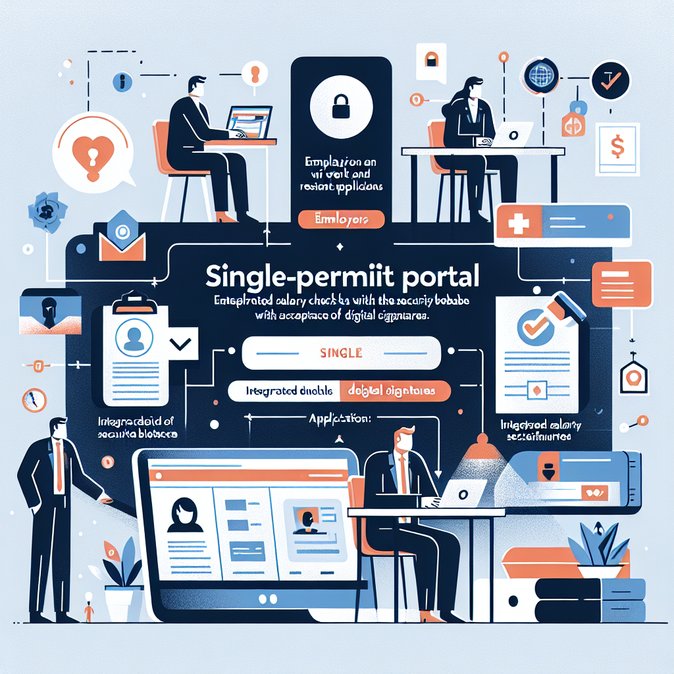
What changes for employers? HR and global-mobility teams can now lodge fixed-term permits, intra-corporate-transfer (ICT) assignments **and, for the first time, unlimited-duration Single Permits** through a single dashboard instead of juggling paper forms, PDF email drop-boxes and in-person appointments. The portal connects directly to Belgium’s Crossroads Bank for Social Security, allowing real-time salary-threshold validation and eliminating duplicate data entry. Electronic-ID signatures are accepted throughout the workflow, cutting courier costs and shaving days off typical filing times.
If your organisation is navigating Belgium’s updated work-authorisation landscape for the first time, VisaHQ’s Belgium desk (https://www.visahq.com/belgium/) can simplify the process. Their specialists monitor the latest Single-Permit developments, pre-screen application packs and coordinate eID-based submissions, giving HR teams a reliable compliance partner while internal resources focus on onboarding talent.
![Flanders Goes Fully Digital: New Single-Permit Portal Live for Work & Residence Applications]()
The upgrade also harmonises practice across Belgium’s regions. Brussels, Wallonia and the German-speaking Community still run their own portals, but officials have confirmed they will migrate to the same back-end within 18 months. That will finally give multinationals a single, end-to-end digital gateway comparable to the Netherlands’ IND or Ireland’s Employment Permit Online System.
Tightening accompanies streamlining. For medium-skilled occupations no longer on Flanders’ shortage list, employers must now prove a gross annual salary of €43,396 (up 4 %) or demonstrate an exhaustive nine-week EU recruitment search. The changes are designed to push companies toward higher value roles while protecting the domestic labour market in lower-wage sectors.
Practical tips: because the system was offline on 1 January, officials warn of a small backlog and advise users to clear browser caches and use fresh eID certificates to avoid “black-screen” login errors. Processing-time targets remain 60 days, but learning-curve delays are likely this month, so companies with March start-dates should file immediately.
What changes for employers? HR and global-mobility teams can now lodge fixed-term permits, intra-corporate-transfer (ICT) assignments **and, for the first time, unlimited-duration Single Permits** through a single dashboard instead of juggling paper forms, PDF email drop-boxes and in-person appointments. The portal connects directly to Belgium’s Crossroads Bank for Social Security, allowing real-time salary-threshold validation and eliminating duplicate data entry. Electronic-ID signatures are accepted throughout the workflow, cutting courier costs and shaving days off typical filing times.
If your organisation is navigating Belgium’s updated work-authorisation landscape for the first time, VisaHQ’s Belgium desk (https://www.visahq.com/belgium/) can simplify the process. Their specialists monitor the latest Single-Permit developments, pre-screen application packs and coordinate eID-based submissions, giving HR teams a reliable compliance partner while internal resources focus on onboarding talent.

The upgrade also harmonises practice across Belgium’s regions. Brussels, Wallonia and the German-speaking Community still run their own portals, but officials have confirmed they will migrate to the same back-end within 18 months. That will finally give multinationals a single, end-to-end digital gateway comparable to the Netherlands’ IND or Ireland’s Employment Permit Online System.
Tightening accompanies streamlining. For medium-skilled occupations no longer on Flanders’ shortage list, employers must now prove a gross annual salary of €43,396 (up 4 %) or demonstrate an exhaustive nine-week EU recruitment search. The changes are designed to push companies toward higher value roles while protecting the domestic labour market in lower-wage sectors.
Practical tips: because the system was offline on 1 January, officials warn of a small backlog and advise users to clear browser caches and use fresh eID certificates to avoid “black-screen” login errors. Processing-time targets remain 60 days, but learning-curve delays are likely this month, so companies with March start-dates should file immediately.