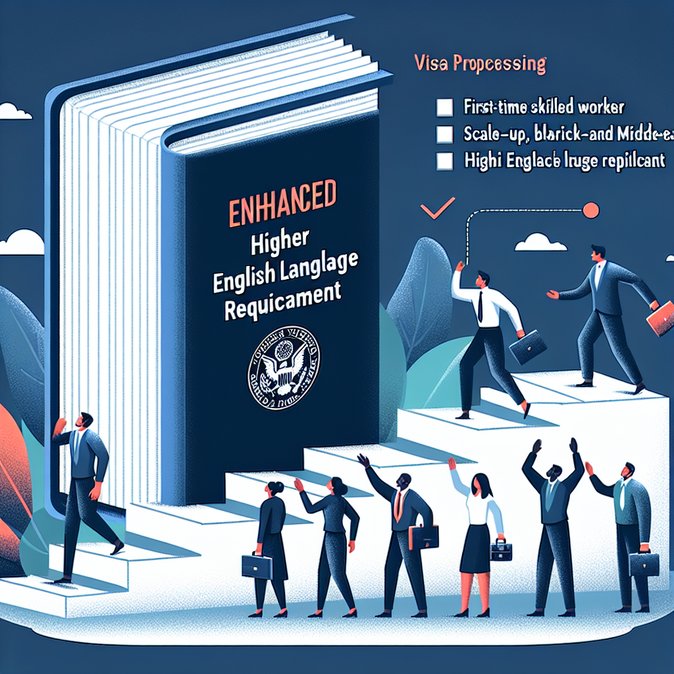
With less than a week to go before the new English-language standard enters force, the Home Office has refreshed multiple guidance pages – including the Scale-up Worker visa section – to highlight that **first-time Skilled Worker, Scale-up and High Potential Individual (HPI) applicants must meet CEFR level B2 from 8 January 2026**. The change, announced in Statement of Changes HC 1333, raises the bar from B1 (intermediate) to B2 (upper-intermediate/A-level). Applicants who have already proved English at B1 in a previous grant remain exempt at extension stage.
For employers, the immediate risk is pipeline candidates who have booked Secure English Language Tests (SELTs) at the lower level. Where possible, tests should be rescheduled, or alternative evidence – such as an English-taught degree – sourced. Immigration advisers report a spike in “urgent upgrade” requests at UKVI-approved test centres, with some locations in India, Nigeria and the Gulf already fully booked.
Employers and applicants who are unsure about the new requirements can streamline the process by using VisaHQ’s online visa and passport platform, which offers step-by-step guidance on approved English-language evidence and live appointment availability worldwide. Their UK portal (https://www.visahq.com/united-kingdom/) consolidates the latest Home Office updates, making it easier to spot when a B1 booking needs to be upgraded to B2 and to compile the supporting documents needed for a Scale-up, HPI or Skilled Worker application.
![English requirement jumps to B2 next week – employers urged to brief applicants now]()
The higher threshold aligns economic migration routes with the Government’s narrative of attracting ‘high-skilled, high-wage’ talent. Critics argue that it disproportionately affects sectors facing acute labour shortages, such as social care, hospitality and parts of the tech start-up ecosystem targeted by the Scale-up visa.
Businesses should update recruitment adverts, onboarding check-lists and Certificate of Sponsorship workflows immediately. Where relocation packages include test fees, budgets may need adjustment because B2-level preparation courses are typically 20–30 percent more expensive than B1.
Finally, note that in parallel, the Immigration Skills Charge rises by 32 percent (to £1,320 per skilled worker per year) on 16 December 2025, further increasing the cost of sponsorship. Combined, the policy shifts reinforce the need for strategic workforce planning rather than last-minute visa filings.
For employers, the immediate risk is pipeline candidates who have booked Secure English Language Tests (SELTs) at the lower level. Where possible, tests should be rescheduled, or alternative evidence – such as an English-taught degree – sourced. Immigration advisers report a spike in “urgent upgrade” requests at UKVI-approved test centres, with some locations in India, Nigeria and the Gulf already fully booked.
Employers and applicants who are unsure about the new requirements can streamline the process by using VisaHQ’s online visa and passport platform, which offers step-by-step guidance on approved English-language evidence and live appointment availability worldwide. Their UK portal (https://www.visahq.com/united-kingdom/) consolidates the latest Home Office updates, making it easier to spot when a B1 booking needs to be upgraded to B2 and to compile the supporting documents needed for a Scale-up, HPI or Skilled Worker application.

The higher threshold aligns economic migration routes with the Government’s narrative of attracting ‘high-skilled, high-wage’ talent. Critics argue that it disproportionately affects sectors facing acute labour shortages, such as social care, hospitality and parts of the tech start-up ecosystem targeted by the Scale-up visa.
Businesses should update recruitment adverts, onboarding check-lists and Certificate of Sponsorship workflows immediately. Where relocation packages include test fees, budgets may need adjustment because B2-level preparation courses are typically 20–30 percent more expensive than B1.
Finally, note that in parallel, the Immigration Skills Charge rises by 32 percent (to £1,320 per skilled worker per year) on 16 December 2025, further increasing the cost of sponsorship. Combined, the policy shifts reinforce the need for strategic workforce planning rather than last-minute visa filings.