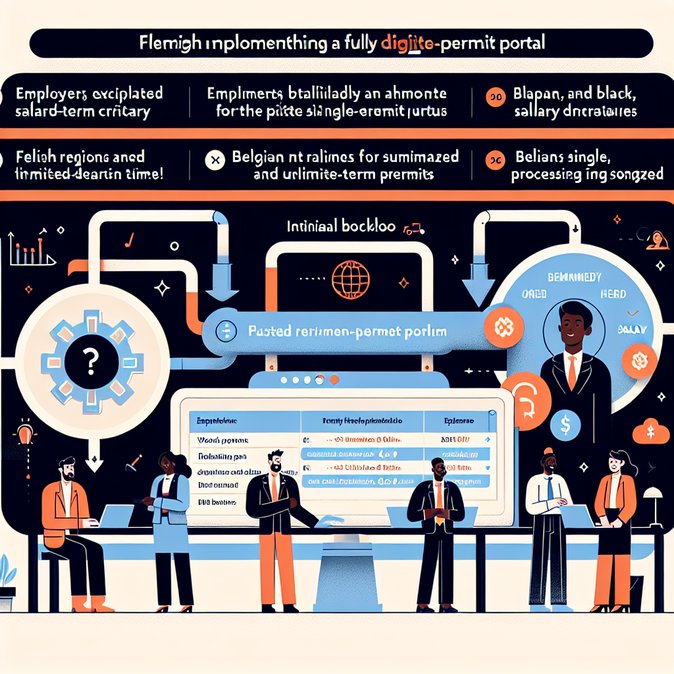
Barely 48 hours into the new year, the Flemish Region switched on an overhauled online portal for work-and-residence ‘Single Permit’ applications. The launch, which coincides with legislation that took effect on 1 January 2026, is the most far-reaching modernisation of Belgium’s economic-migration process since the federal-regional split of 2014. HR teams can now file fixed-term permits and—crucially—unlimited-duration permits through a single dashboard, replacing a patchwork of paper forms and e-mail drop-boxes. Regional officials confirmed that the portal integrates directly with Belgium’s national social-security database and accepts electronic identity (eID) signatures, reducing duplicate data entry and courier costs.
The reform also harmonises Flemish practice with Brussels, Wallonia and the German-speaking Community, ending the long-criticised disparity whereby employers had to learn three different filing systems inside one country. At the same time, the decree tightens eligibility for several medium-skilled occupations: employers must now prove a gross annual salary of €43,396 (up 4 %) or demonstrate that the role appears on the Flemish shortage-occupation list.
Employers who want an extra layer of expertise during this transition can lean on VisaHQ, whose Brussels-based specialists handle Single Permit filings daily and can navigate the fresh portal on a client’s behalf; full service details are available at https://www.visahq.com/belgium/
![Flanders Unveils One-Stop Online Portal as 2026 Single-Permit Reform Goes Live]()
For global-mobility managers the practical implications are immediate. Because the portal was offline on 1 January, a 48-hour backlog has formed; officials recommend clearing browser cookies and using fresh eID certificates to avoid ‘black-screen’ errors during the first week. Processing-time targets remain 60 days, but authorities warn of learning-curve delays this month, making it wise to lodge March start-dates now.
Longer-term, the ability to file indefinite-duration permits online is a game-changer for assignees who qualify after five years of residence. It eliminates mid-career paper renewals and should reduce administrative costs for multinationals with large Belgian footprints. Companies unfamiliar with the interface are scheduling refresher training and auditing power-of-attorney mandates—still the main cause of technical rejections.
Ultimately, the portal marks another step toward end-to-end digital immigration in Belgium. Observers expect Brussels and Wallonia to plug into the same back-end architecture over the next 18 months, creating a truly national gateway that rivals the Netherlands and Ireland for user experience.
The reform also harmonises Flemish practice with Brussels, Wallonia and the German-speaking Community, ending the long-criticised disparity whereby employers had to learn three different filing systems inside one country. At the same time, the decree tightens eligibility for several medium-skilled occupations: employers must now prove a gross annual salary of €43,396 (up 4 %) or demonstrate that the role appears on the Flemish shortage-occupation list.
Employers who want an extra layer of expertise during this transition can lean on VisaHQ, whose Brussels-based specialists handle Single Permit filings daily and can navigate the fresh portal on a client’s behalf; full service details are available at https://www.visahq.com/belgium/
For global-mobility managers the practical implications are immediate. Because the portal was offline on 1 January, a 48-hour backlog has formed; officials recommend clearing browser cookies and using fresh eID certificates to avoid ‘black-screen’ errors during the first week. Processing-time targets remain 60 days, but authorities warn of learning-curve delays this month, making it wise to lodge March start-dates now.
Longer-term, the ability to file indefinite-duration permits online is a game-changer for assignees who qualify after five years of residence. It eliminates mid-career paper renewals and should reduce administrative costs for multinationals with large Belgian footprints. Companies unfamiliar with the interface are scheduling refresher training and auditing power-of-attorney mandates—still the main cause of technical rejections.
Ultimately, the portal marks another step toward end-to-end digital immigration in Belgium. Observers expect Brussels and Wallonia to plug into the same back-end architecture over the next 18 months, creating a truly national gateway that rivals the Netherlands and Ireland for user experience.