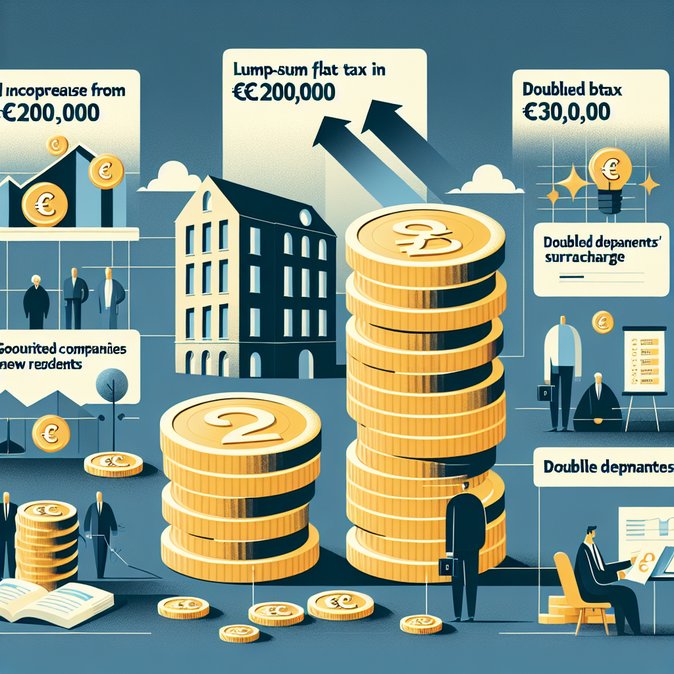
Italy’s flagship lump-sum tax regime for newly resident high-net-worth individuals just became significantly more expensive. Article 1 of the 2026 Budget Law, published late on 31 December, increases the annual flat tax under the “regime dei nuovi residenti” from €200,000 to €300,000 and doubles the supplementary levy for each accompanying family member from €25,000 to €50,000. The change applies to newcomers taking up tax residence from 1 January 2026; existing beneficiaries are grandfathered at the old rates.
The government argues that the programme remains competitive for households with foreign income above €1 million because it still undercuts progressive rates of up to 50 % elsewhere in Europe while exempting offshore assets from wealth, inheritance and gift taxes. Investment-migration analysts agree but expect a short-term rush of applications from prospects already in the pipeline who want to lock in the lower rate before relocating.
![Flat-Tax Sweetener for Inbound Executives Raised to €300,000 a Year]()
For applicants who still need the requisite entry visas, VisaHQ can streamline the paperwork. Its dedicated Italy portal (https://www.visahq.com/italy/) offers up-to-date requirements, online submission tools and live support, helping both individuals and HR teams secure residence permits quickly so they can focus on the more complex tax planning described here.
For global mobility managers the headline is cost. Assignment budgets built around the €200,000 figure must be revisited, and employers may need to consider alternative structures such as split pay or shadow payrolls to keep expatriation packages attractive. Relocation advisers also point out that the higher tax may increase demand for Italy’s more restrictive but cheaper “impatriate” income-tax exemption, potentially stretching HR compliance resources across multiple incentive regimes.
Practically, the tax hike does not alter immigration mechanics. Eligible applicants still need an entry visa, the standard residence-permit process and proof of accommodation, but those steps are quick compared with the financial planning now required. Wealth advisers expect the government to leave the levy untouched for several years after three successive increases (from €100k in 2023, €200k in 2024 and €300k today), giving employers a stable planning horizon once the new rate is absorbed.
The government argues that the programme remains competitive for households with foreign income above €1 million because it still undercuts progressive rates of up to 50 % elsewhere in Europe while exempting offshore assets from wealth, inheritance and gift taxes. Investment-migration analysts agree but expect a short-term rush of applications from prospects already in the pipeline who want to lock in the lower rate before relocating.

For applicants who still need the requisite entry visas, VisaHQ can streamline the paperwork. Its dedicated Italy portal (https://www.visahq.com/italy/) offers up-to-date requirements, online submission tools and live support, helping both individuals and HR teams secure residence permits quickly so they can focus on the more complex tax planning described here.
For global mobility managers the headline is cost. Assignment budgets built around the €200,000 figure must be revisited, and employers may need to consider alternative structures such as split pay or shadow payrolls to keep expatriation packages attractive. Relocation advisers also point out that the higher tax may increase demand for Italy’s more restrictive but cheaper “impatriate” income-tax exemption, potentially stretching HR compliance resources across multiple incentive regimes.
Practically, the tax hike does not alter immigration mechanics. Eligible applicants still need an entry visa, the standard residence-permit process and proof of accommodation, but those steps are quick compared with the financial planning now required. Wealth advisers expect the government to leave the levy untouched for several years after three successive increases (from €100k in 2023, €200k in 2024 and €300k today), giving employers a stable planning horizon once the new rate is absorbed.