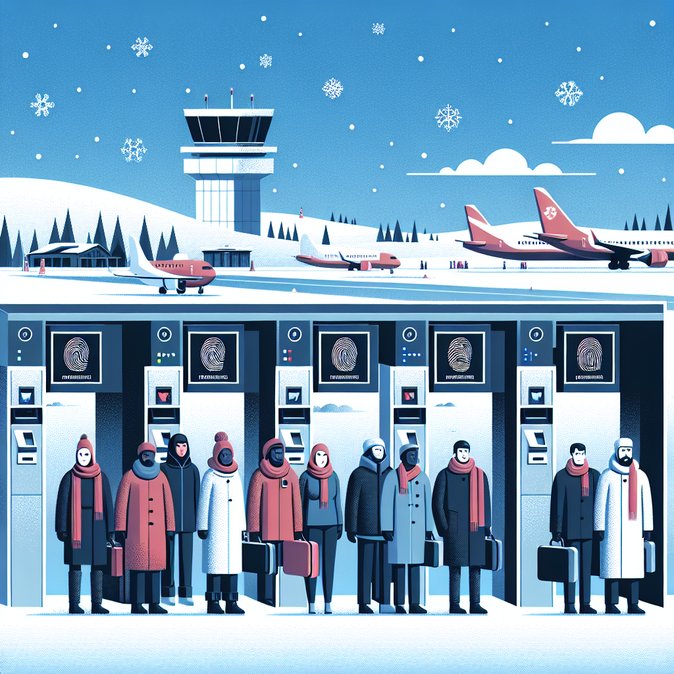
The Finnish Border Guard has confirmed that the European Union’s new biometric Entry/Exit System (EES) will be rolled out to Lapland’s four busiest airports—Rovaniemi, Kittilä, Ivalo and Kuusamo—beginning in February 2026. The announcement, issued late on New Year’s Eve, follows a three-month pilot at Helsinki-Vantaa where automated kiosks now capture fingerprints and facial images of third-country nationals in under 60 seconds.
EES replaces manual passport stamps with a shared EU database that records exactly when and where non-EU travellers enter and leave the Schengen Area. Border officers in Helsinki say the system has already cut average processing times by 25 percent and virtually eliminated errors in calculating overstays. “Expanding to Lapland is critical because winter charter traffic peaks in February,” noted Colonel Marko Saarelainen of the Border Guard. The northern airports handle a surge of British, German and Asian tourists—as well as seasonal staff for ski resorts—making reliable, fast border control essential.
Finavia, the state-owned airport operator, has installed additional e-gates and laid fibre connections to support the secure data links EES requires. Border officers have trained on mock kiosks since November, and a six-month transition period will allow manual counters to stay open for travellers unfamiliar with the technology. Air-carriers must verify that passengers subject to EES have cleared the system before boarding flights to Finland, or face fines.
![Lapland Airports Next to Deploy EU Entry/Exit System After Successful Helsinki Pilot]()
Whether you’re a leisure visitor heading for Lapland’s slopes or an HR manager coordinating multi-country assignments, VisaHQ’s online platform simplifies the process of checking visa requirements, completing application forms and tracking deadlines. Their Finland page (https://www.visahq.com/finland/) provides up-to-date guidance on Schengen rules, work permits, and the upcoming ETIAS registration, allowing travellers to stay compliant before they ever reach an EES kiosk.
For employers and relocation teams, the most immediate impact is on assignees who are third-country nationals but travelling visa-free—for example, UK-based IT consultants on short projects in Oulu. Their permissible stay clock will now be precise to the day; inadvertent overstays could trigger automatic entry bans. Mobility managers are advised to track entries and exits meticulously and to brief frequent travellers on the new fingerprint requirement.
The Border Guard reiterates that EES does not change substantive visa rules, but it is a prerequisite for ETIAS, the EU’s electronic travel authorisation, now scheduled for late 2026. Companies that rely on rapid movements of non-EU talent should therefore review travel-policy alerts and ensure passport details are uploaded correctly in booking systems to avoid boarding denials during the Lapland rollout.
EES replaces manual passport stamps with a shared EU database that records exactly when and where non-EU travellers enter and leave the Schengen Area. Border officers in Helsinki say the system has already cut average processing times by 25 percent and virtually eliminated errors in calculating overstays. “Expanding to Lapland is critical because winter charter traffic peaks in February,” noted Colonel Marko Saarelainen of the Border Guard. The northern airports handle a surge of British, German and Asian tourists—as well as seasonal staff for ski resorts—making reliable, fast border control essential.
Finavia, the state-owned airport operator, has installed additional e-gates and laid fibre connections to support the secure data links EES requires. Border officers have trained on mock kiosks since November, and a six-month transition period will allow manual counters to stay open for travellers unfamiliar with the technology. Air-carriers must verify that passengers subject to EES have cleared the system before boarding flights to Finland, or face fines.

Whether you’re a leisure visitor heading for Lapland’s slopes or an HR manager coordinating multi-country assignments, VisaHQ’s online platform simplifies the process of checking visa requirements, completing application forms and tracking deadlines. Their Finland page (https://www.visahq.com/finland/) provides up-to-date guidance on Schengen rules, work permits, and the upcoming ETIAS registration, allowing travellers to stay compliant before they ever reach an EES kiosk.
For employers and relocation teams, the most immediate impact is on assignees who are third-country nationals but travelling visa-free—for example, UK-based IT consultants on short projects in Oulu. Their permissible stay clock will now be precise to the day; inadvertent overstays could trigger automatic entry bans. Mobility managers are advised to track entries and exits meticulously and to brief frequent travellers on the new fingerprint requirement.
The Border Guard reiterates that EES does not change substantive visa rules, but it is a prerequisite for ETIAS, the EU’s electronic travel authorisation, now scheduled for late 2026. Companies that rely on rapid movements of non-EU talent should therefore review travel-policy alerts and ensure passport details are uploaded correctly in booking systems to avoid boarding denials during the Lapland rollout.