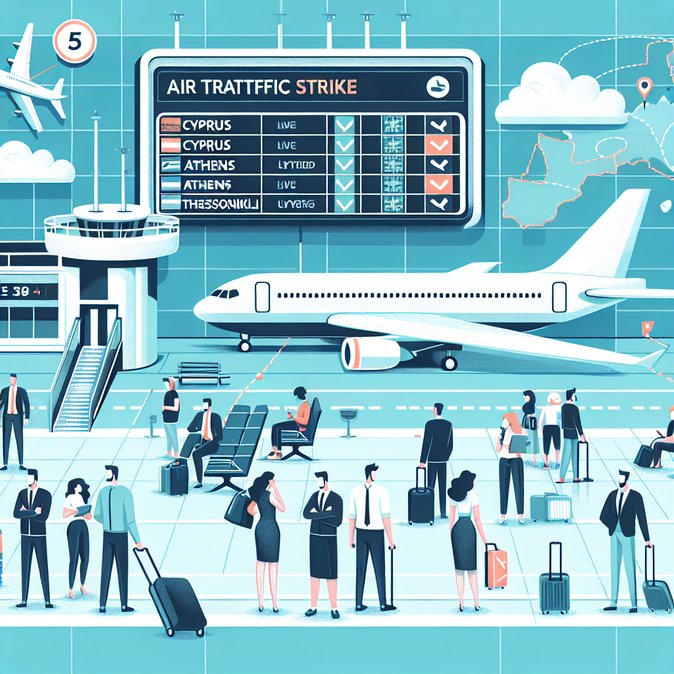
Cyprus’ two international gateways—Larnaca (LCA) and Paphos (PFO)—were unusually quiet on 2 January after Greek air-traffic controllers joined a 24-hour national strike that paralysed the country’s aviation network. Hermes Airports, which manages both Cypriot airports, confirmed that 27 Larnaca rotations and four Paphos services to and from Athens and Thessaloniki were cancelled, while a further seven flights were rescheduled. Travellers already in the terminals were urged to rebook or seek refunds, and airlines activated EU261 contingency plans.
The walk-out was part of a wider stoppage called by Greece’s public- and private-sector unions (ADEDY and GSEE) to demand wage rises, new collective-bargaining agreements and the reinstatement of 13th- and 14th-month salaries. Controllers also highlighted chronic staffing shortages and ageing surveillance equipment that, they say, cannot cope with the post-pandemic rebound in traffic. Cypriot travel agents fear that a prolonged dispute could hit January’s traditionally strong “visiting friends and relatives” market and delay the island’s winter tourism push.
For corporate mobility managers the immediate impact is logistical: crews repositioning to Greece, seafarers joining ships in Piraeus and consultants booked on day-trip hops all faced last-minute itinerary changes. Hermes Airports advises travellers to monitor its live flight board and airlines’ apps for real-time updates, while reminding employers that EU statutes obligate carriers—not passengers—to provide meals, hotels and alternative transport in the event of cancellations caused by labour action.
![Greek Air-Traffic Controllers’ Strike Grounds 31 Flights Between Cyprus and Greece]()
Should travellers need to reroute through alternative European hubs at short notice, VisaHQ’s Cyprus team can fast-track any required transit or Schengen visas online, provide real-time status updates and coordinate group applications for crews and consultants—see https://www.visahq.com/cyprus/ for details.
The episode underscores Cyprus’ dependence on the Hellenic corridor. Athens routes alone accounted for more than 800,000 seats in 2025, making them the island’s single largest business-travel market. Industry observers note that the dispute could strengthen calls for Cyprus to diversify winter connectivity—something the government hopes to achieve through fifth-freedom stop-overs once the country joins the Schengen area.
In the medium term, the strike serves as a timely rehearsal for crisis-management protocols as Cyprus begins its six-month presidency of the EU Council, where aviation decarbonisation and the Single European Sky 2+ reform—both deeply intertwined with air-traffic staffing—sit high on the agenda.
The walk-out was part of a wider stoppage called by Greece’s public- and private-sector unions (ADEDY and GSEE) to demand wage rises, new collective-bargaining agreements and the reinstatement of 13th- and 14th-month salaries. Controllers also highlighted chronic staffing shortages and ageing surveillance equipment that, they say, cannot cope with the post-pandemic rebound in traffic. Cypriot travel agents fear that a prolonged dispute could hit January’s traditionally strong “visiting friends and relatives” market and delay the island’s winter tourism push.
For corporate mobility managers the immediate impact is logistical: crews repositioning to Greece, seafarers joining ships in Piraeus and consultants booked on day-trip hops all faced last-minute itinerary changes. Hermes Airports advises travellers to monitor its live flight board and airlines’ apps for real-time updates, while reminding employers that EU statutes obligate carriers—not passengers—to provide meals, hotels and alternative transport in the event of cancellations caused by labour action.

Should travellers need to reroute through alternative European hubs at short notice, VisaHQ’s Cyprus team can fast-track any required transit or Schengen visas online, provide real-time status updates and coordinate group applications for crews and consultants—see https://www.visahq.com/cyprus/ for details.
The episode underscores Cyprus’ dependence on the Hellenic corridor. Athens routes alone accounted for more than 800,000 seats in 2025, making them the island’s single largest business-travel market. Industry observers note that the dispute could strengthen calls for Cyprus to diversify winter connectivity—something the government hopes to achieve through fifth-freedom stop-overs once the country joins the Schengen area.
In the medium term, the strike serves as a timely rehearsal for crisis-management protocols as Cyprus begins its six-month presidency of the EU Council, where aviation decarbonisation and the Single European Sky 2+ reform—both deeply intertwined with air-traffic staffing—sit high on the agenda.