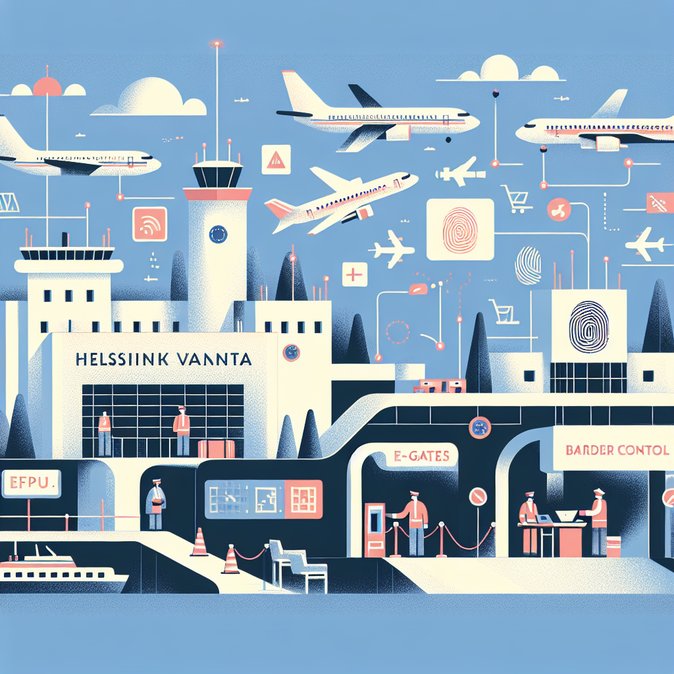
The Finnish Border Guard has confirmed that the European Union’s Entry/Exit System (EES) will expand from Helsinki-Vantaa to Lapland’s four busiest airports—Rovaniemi, Kittilä, Ivalo and Kuusamo—starting in February 2026. The announcement, made late on 31 December, follows a successful three-month pilot at Helsinki, where automated biometric kiosks now capture fingerprints and facial images of third-country nationals.
The northern deployment is timed to coincide with the peak winter-sports season, when Lapland sees a surge of British and Asian charter flights. To avoid holiday-period gridlock, border officers have been training on mock kiosks since November, and Finavia has installed extra e-gates in arrivals halls. A spokesperson said the goal is to keep average processing times below 45 seconds per passenger, matching Helsinki’s post-pilot metrics.
![Lapland Airports to Roll Out EU Entry/Exit System After Helsinki Pilot]()
Travellers who are unsure whether the new EES enrolment suffices for entry, or who still require a Schengen visa because of their nationality, can streamline the paperwork by turning to VisaHQ. The company’s portal, https://www.visahq.com/finland/ offers real-time visa requirement checks, digital application guidance and optional courier services, making it easier for both leisure visitors and corporate mobility teams to stay compliant before arriving at Lapland’s e-gates.
For tour operators and corporate travel planners the change is a mixed blessing: once travellers are pre-enrolled in EES, future crossings are faster, but the first touchpoint adds about a minute to arrival formalities. Airlines must update passenger manifests to include new data fields and distribute EES information to customers along with boarding passes. The Border Guard recommends that non-EU travellers complete the required data pre-check via the forthcoming mobile app (to be launched EU-wide in Q2) to minimise on-site delays.
The Lapland rollout is also a dry run for Finland’s planned 2026 pilot of the Digital Travel Authorisation (DTA), which aims to replace passport stamping with QR-code validation. Mobility managers should watch Lapland’s performance metrics closely; any systemic bottlenecks could reverberate across supply chains that rely on time-sensitive air cargo and project personnel rotations in the Arctic mining and energy sectors.
The northern deployment is timed to coincide with the peak winter-sports season, when Lapland sees a surge of British and Asian charter flights. To avoid holiday-period gridlock, border officers have been training on mock kiosks since November, and Finavia has installed extra e-gates in arrivals halls. A spokesperson said the goal is to keep average processing times below 45 seconds per passenger, matching Helsinki’s post-pilot metrics.

Travellers who are unsure whether the new EES enrolment suffices for entry, or who still require a Schengen visa because of their nationality, can streamline the paperwork by turning to VisaHQ. The company’s portal, https://www.visahq.com/finland/ offers real-time visa requirement checks, digital application guidance and optional courier services, making it easier for both leisure visitors and corporate mobility teams to stay compliant before arriving at Lapland’s e-gates.
For tour operators and corporate travel planners the change is a mixed blessing: once travellers are pre-enrolled in EES, future crossings are faster, but the first touchpoint adds about a minute to arrival formalities. Airlines must update passenger manifests to include new data fields and distribute EES information to customers along with boarding passes. The Border Guard recommends that non-EU travellers complete the required data pre-check via the forthcoming mobile app (to be launched EU-wide in Q2) to minimise on-site delays.
The Lapland rollout is also a dry run for Finland’s planned 2026 pilot of the Digital Travel Authorisation (DTA), which aims to replace passport stamping with QR-code validation. Mobility managers should watch Lapland’s performance metrics closely; any systemic bottlenecks could reverberate across supply chains that rely on time-sensitive air cargo and project personnel rotations in the Arctic mining and energy sectors.