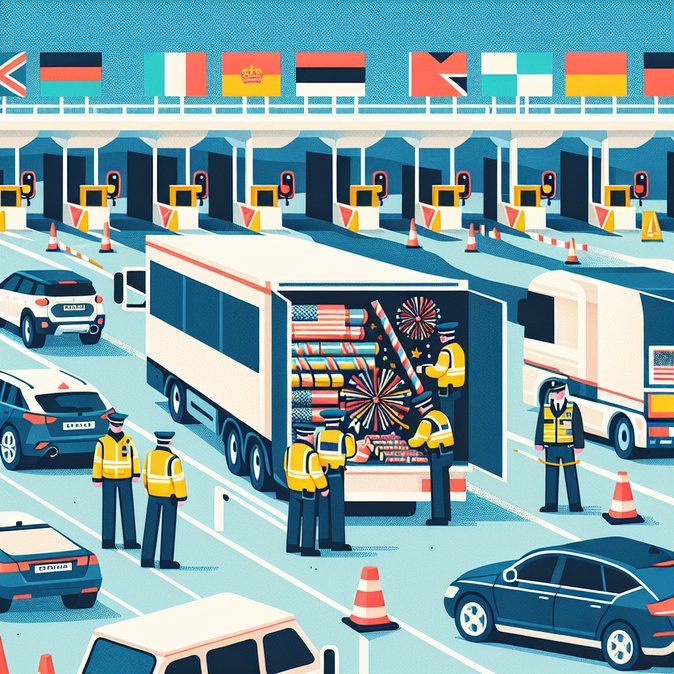
Germany’s Federal Police intensified inspections at the Bavarian-Czech frontier ahead of New-Year celebrations, confiscating roughly 1,140 kg of professional-grade pyrotechnics during December alone—60 % more than in December 2024. The Waidhaus crossing on the A6 remained the busiest seizure point.
Although the operation targets public safety, it has direct mobility implications: private vehicles face extended secondary searches, and coaches bringing seasonal workers from Czechia and Slovakia report delays of up to 90 minutes. Freight forwarders carrying just-in-time components to Bavarian plants also experienced sporadic tailbacks.
For travellers who still need to cross the border for business or leisure, VisaHQ can streamline the paperwork side of things. Their online platform (https://www.visahq.com/germany/) offers up-to-date guidance on Schengen visa requirements, invitation letters, and even same-day passport photos, helping passengers avoid additional headaches as they navigate the heightened checks.
![Bundespolizei Seize 1.1 Tonnes of Illegal Fireworks in New-Year Border Crackdown]()
Offenders caught with banned fireworks can be fined up to €50,000 and have their vehicles impounded under Germany’s Explosives Act. The police noted that the total haul for 2025—around 1.1 tonnes—marks a 17 % year-on-year decline, suggesting that deterrence is beginning to work.
Companies operating cross-border shuttle services should brief drivers on the risk of carrying even small amounts of consumer fireworks and advise passengers to keep luggage accessible for inspection. HR teams organising New-Year retreats in Czech spa towns may want to schedule return trips outside peak inspection windows (18:00–01:00).
The spotlight on fireworks underscores how temporary policing campaigns can ripple into broader border-traffic patterns, reinforcing the need for flexible travel planning during holiday periods.
Although the operation targets public safety, it has direct mobility implications: private vehicles face extended secondary searches, and coaches bringing seasonal workers from Czechia and Slovakia report delays of up to 90 minutes. Freight forwarders carrying just-in-time components to Bavarian plants also experienced sporadic tailbacks.
For travellers who still need to cross the border for business or leisure, VisaHQ can streamline the paperwork side of things. Their online platform (https://www.visahq.com/germany/) offers up-to-date guidance on Schengen visa requirements, invitation letters, and even same-day passport photos, helping passengers avoid additional headaches as they navigate the heightened checks.
Offenders caught with banned fireworks can be fined up to €50,000 and have their vehicles impounded under Germany’s Explosives Act. The police noted that the total haul for 2025—around 1.1 tonnes—marks a 17 % year-on-year decline, suggesting that deterrence is beginning to work.
Companies operating cross-border shuttle services should brief drivers on the risk of carrying even small amounts of consumer fireworks and advise passengers to keep luggage accessible for inspection. HR teams organising New-Year retreats in Czech spa towns may want to schedule return trips outside peak inspection windows (18:00–01:00).
The spotlight on fireworks underscores how temporary policing campaigns can ripple into broader border-traffic patterns, reinforcing the need for flexible travel planning during holiday periods.