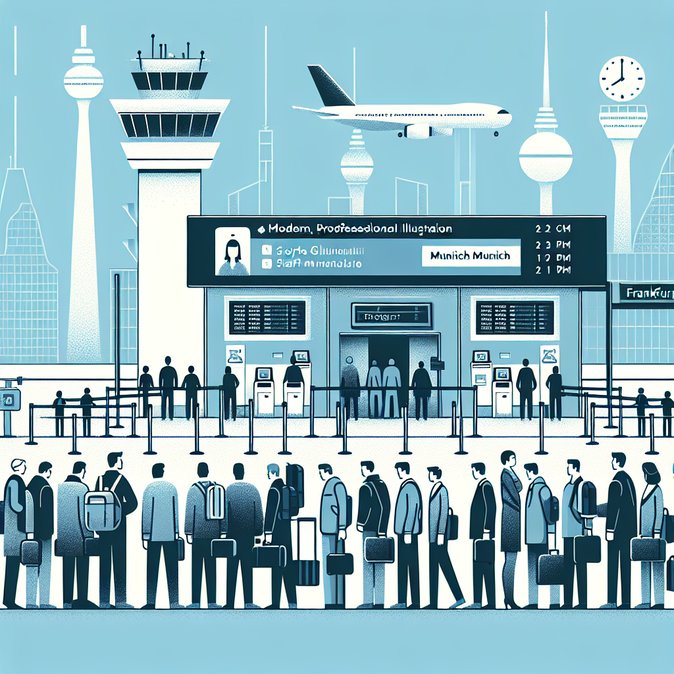
What should have been a quiet post-Christmas travel period deteriorated into hours-long queues on 30 December when Frankfurt-Main and Munich airports pushed more third-country travellers through the EU’s new Entry/Exit System (EES) kiosks. According to reports from VisaHQ correspondents on site, many of the self-service gates failed to cope with peak volumes, prompting ground staff to redirect passengers to manual counters that were themselves understaffed.
Some Lufthansa and Air France feeder flights departed late after connecting passengers were trapped in the bottleneck. Social-media footage showed lines snaking the length of the non-Schengen pier in Frankfurt’s Terminal 1, while Munich’s Terminal 2 saw wait times climb above two hours during the noon rush.
The Federal Police, responsible for border control, blamed “calibration glitches” as software struggled to match live facial scans with stored biometric data in real time. Technicians have since rolled back the forced-use setting, and both airports say they will re-phase deployment in January.
![Biometric Entry/Exit Roll-Out Sparks Holiday Chaos at Frankfurt and Munich]()
To help corporations and individual travellers navigate the shifting EES requirements, VisaHQ offers live compliance alerts, document checks, and expedited visa processing through its German portal. Clients can even pre-screen passports for biometric readability before departure, reducing the risk of airport delays; learn more at https://www.visahq.com/germany/
For mobility managers the incident is a warning to build longer connection buffers into early-2026 itineraries, particularly for assignees originating outside the EU who trigger biometric capture. Employers should advise travellers to keep passport chips clean and remove masks or headgear well before reaching the gate to speed processing.
The episode also adds pressure on Berlin to secure additional staffing ahead of the full EES launch, now pencilled in for May 2026 after multiple EU-wide delays.
Some Lufthansa and Air France feeder flights departed late after connecting passengers were trapped in the bottleneck. Social-media footage showed lines snaking the length of the non-Schengen pier in Frankfurt’s Terminal 1, while Munich’s Terminal 2 saw wait times climb above two hours during the noon rush.
The Federal Police, responsible for border control, blamed “calibration glitches” as software struggled to match live facial scans with stored biometric data in real time. Technicians have since rolled back the forced-use setting, and both airports say they will re-phase deployment in January.

To help corporations and individual travellers navigate the shifting EES requirements, VisaHQ offers live compliance alerts, document checks, and expedited visa processing through its German portal. Clients can even pre-screen passports for biometric readability before departure, reducing the risk of airport delays; learn more at https://www.visahq.com/germany/
For mobility managers the incident is a warning to build longer connection buffers into early-2026 itineraries, particularly for assignees originating outside the EU who trigger biometric capture. Employers should advise travellers to keep passport chips clean and remove masks or headgear well before reaching the gate to speed processing.
The episode also adds pressure on Berlin to secure additional staffing ahead of the full EES launch, now pencilled in for May 2026 after multiple EU-wide delays.