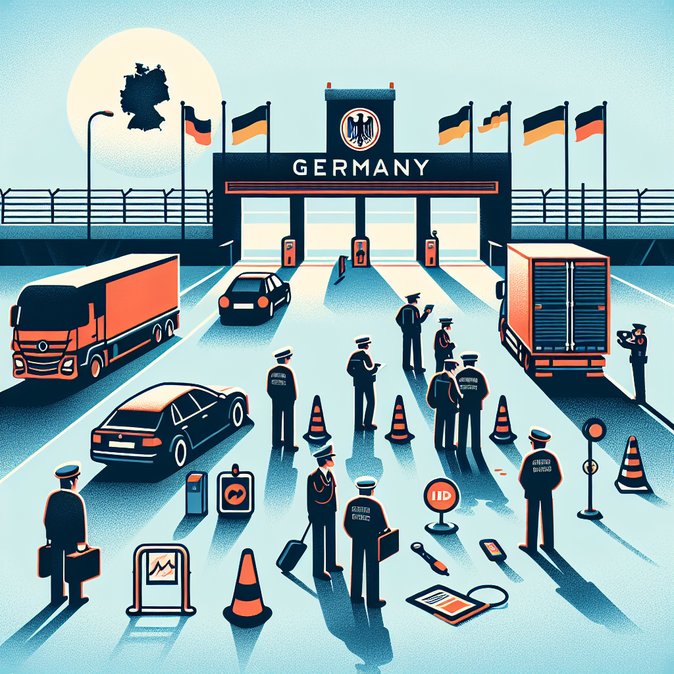
Germany’s Federal Ministry of the Interior has once again stretched the definition of “temporary” by extending the identity checks it re-introduced on all nine of the country’s land frontiers in mid-September. A notice quietly published in the Federal Gazette late on 29 December confirms that spot checks by the Bundespolizei will now run until at least 15 March 2026—the maximum period the current Schengen Borders Code allows without an explicit green light from the European Commission.
In practical terms, anyone entering Germany by road or rail from Austria, Czechia, Poland, Denmark, the Netherlands, Luxembourg, France or Switzerland can be stopped at random and asked to produce a passport or national ID card, proof of residence, evidence of accommodation and sufficient funds. Officers also retain the right to refuse entry where they suspect irregular migration or a security threat. The move comes against a backdrop of increased secondary movements along the Western Balkan route and several high-profile people-smuggling cases that Interior Minister Nancy Faeser described as a “persistent, highly adaptable threat.”
For business travellers, assignees and cross-border commuters, the extension means at least ten more weeks of potential delays and documentation checks that had largely disappeared in the pre-pandemic era. Corporate mobility managers are advised to build extra journey time into itineraries, ensure that non-EU assignees carry residence cards and proof of employment, and remind EU-national staff that an ID card—not a driver’s licence—is required. Coach operators have already reported queues of up to 40 minutes at the Kiefersfelden/Kufstein crossing with Austria during peak hours, and rail passengers on the Munich–Salzburg and Dresden–Prague lines face on-board passport inspections.
![Germany Prolongs Land-Border Checks Until 15 March 2026, Extending ‘Temporary’ Schengen Controls]()
Travellers who want to stay a step ahead of these evolving requirements can use VisaHQ’s Germany platform (https://www.visahq.com/germany/) to generate personalised document checklists, submit digital visa or residence applications, and receive real-time alerts on policy changes. The service is particularly useful for mobility managers juggling multiple assignees, helping them keep staff compliant and journeys smooth even when ad-hoc border controls are reintroduced.
The business community is watching closely to see whether Berlin will attempt a further prolongation under the Schengen Code’s “exceptional circumstances” clause, which would require formal Commission approval. Several neighbouring states have hinted they may lodge complaints if the controls become semi-permanent, arguing that they disrupt supply chains just as Christmas inventory backlogs are being cleared. The Interior Ministry insists the measure is proportionate and points to a 22 % rise in smuggling prosecutions in the third quarter as justification.
Multinational companies should monitor updates from the Federal Police and consider issuing traveller alerts that include a checklist (passport validity, accommodation proof, onward-ticket evidence) to minimise the risk of refusals of entry. Meanwhile, EU institutions are expected to revisit the wider debate on reforming the Schengen Borders Code in early 2026—meaning Germany’s unilateral move could reignite calls for clearer rules on the use, scope and oversight of internal border controls.
In practical terms, anyone entering Germany by road or rail from Austria, Czechia, Poland, Denmark, the Netherlands, Luxembourg, France or Switzerland can be stopped at random and asked to produce a passport or national ID card, proof of residence, evidence of accommodation and sufficient funds. Officers also retain the right to refuse entry where they suspect irregular migration or a security threat. The move comes against a backdrop of increased secondary movements along the Western Balkan route and several high-profile people-smuggling cases that Interior Minister Nancy Faeser described as a “persistent, highly adaptable threat.”
For business travellers, assignees and cross-border commuters, the extension means at least ten more weeks of potential delays and documentation checks that had largely disappeared in the pre-pandemic era. Corporate mobility managers are advised to build extra journey time into itineraries, ensure that non-EU assignees carry residence cards and proof of employment, and remind EU-national staff that an ID card—not a driver’s licence—is required. Coach operators have already reported queues of up to 40 minutes at the Kiefersfelden/Kufstein crossing with Austria during peak hours, and rail passengers on the Munich–Salzburg and Dresden–Prague lines face on-board passport inspections.

Travellers who want to stay a step ahead of these evolving requirements can use VisaHQ’s Germany platform (https://www.visahq.com/germany/) to generate personalised document checklists, submit digital visa or residence applications, and receive real-time alerts on policy changes. The service is particularly useful for mobility managers juggling multiple assignees, helping them keep staff compliant and journeys smooth even when ad-hoc border controls are reintroduced.
The business community is watching closely to see whether Berlin will attempt a further prolongation under the Schengen Code’s “exceptional circumstances” clause, which would require formal Commission approval. Several neighbouring states have hinted they may lodge complaints if the controls become semi-permanent, arguing that they disrupt supply chains just as Christmas inventory backlogs are being cleared. The Interior Ministry insists the measure is proportionate and points to a 22 % rise in smuggling prosecutions in the third quarter as justification.
Multinational companies should monitor updates from the Federal Police and consider issuing traveller alerts that include a checklist (passport validity, accommodation proof, onward-ticket evidence) to minimise the risk of refusals of entry. Meanwhile, EU institutions are expected to revisit the wider debate on reforming the Schengen Borders Code in early 2026—meaning Germany’s unilateral move could reignite calls for clearer rules on the use, scope and oversight of internal border controls.