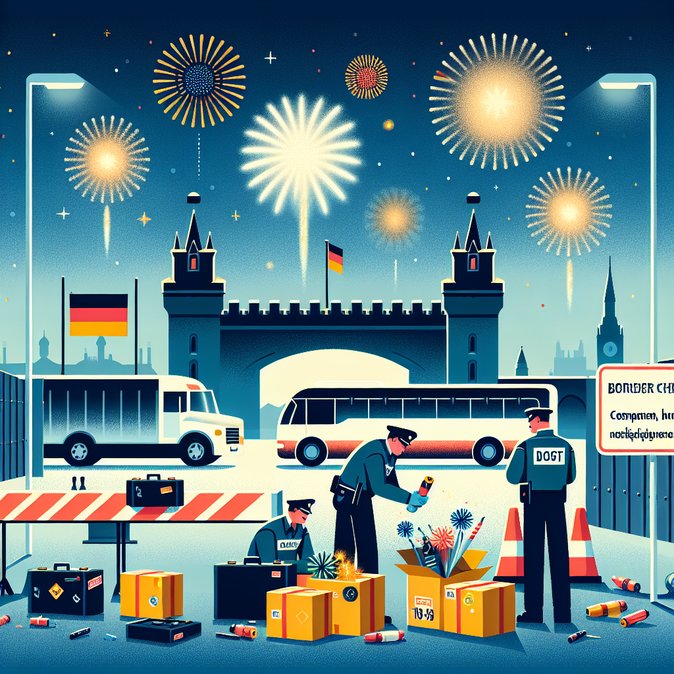
With New-Year celebrations approaching, Germany’s Bundespolizei have intensified inspections at the Bavarian crossings with Czechia, seizing roughly 1,140 kg of illegal fireworks so far in 2025 – a 17 % drop from the previous year but still significant. December alone accounted for 337 kg, 60 % more than in December 2024, as travellers attempted last-minute imports.
The Waidhaus inspection point in the Bavarian Forest remained the busiest seizure site, intercepting large quantities of high-powered shell bombs that are legal only for professional pyrotechnicians. Offenders face charges under Germany’s Explosives Act, fines and potential confiscation of vehicles.
The crackdown illustrates how closely holiday leisure travel and border enforcement intersect. Coaches and private cars carrying cross-border shoppers are subject to more frequent spot checks, leading to delays that can affect legitimate travellers as well. Corporates running year-end shuttle services between Czech production sites and German headquarters should warn passengers of possible holdups at the frontier.
![Federal Police step up New-Year border checks, seize 1.1 tonnes of illegal fireworks]()
To stay ahead of such uncertainties, VisaHQ provides travellers and corporate mobility planners with real-time guidance on German visa requirements, customs regulations and Schengen border measures. Its portal (https://www.visahq.com/germany/) lets users verify documentation, arrange courier submission and receive compliance alerts—helping itineraries stay on track even when unexpected crackdowns like the current fireworks seizures occur.
Although fireworks are not a core mobility issue, the operation underscores the broader point that Germany’s border controls remain unpredictable in the run-up to the New Year – from spot identity checks for migrants to customs searches for dangerous goods. Travel managers should advise staff to allow extra time and ensure all luggage complies with German import rules.
The Bundespolizei say the heightened controls will continue through 1 January. After that, enforcement will revert to normal risk-based profiles, but spot checks linked to the extended Schengen border-control regime (see above) will persist.
The Waidhaus inspection point in the Bavarian Forest remained the busiest seizure site, intercepting large quantities of high-powered shell bombs that are legal only for professional pyrotechnicians. Offenders face charges under Germany’s Explosives Act, fines and potential confiscation of vehicles.
The crackdown illustrates how closely holiday leisure travel and border enforcement intersect. Coaches and private cars carrying cross-border shoppers are subject to more frequent spot checks, leading to delays that can affect legitimate travellers as well. Corporates running year-end shuttle services between Czech production sites and German headquarters should warn passengers of possible holdups at the frontier.
To stay ahead of such uncertainties, VisaHQ provides travellers and corporate mobility planners with real-time guidance on German visa requirements, customs regulations and Schengen border measures. Its portal (https://www.visahq.com/germany/) lets users verify documentation, arrange courier submission and receive compliance alerts—helping itineraries stay on track even when unexpected crackdowns like the current fireworks seizures occur.
Although fireworks are not a core mobility issue, the operation underscores the broader point that Germany’s border controls remain unpredictable in the run-up to the New Year – from spot identity checks for migrants to customs searches for dangerous goods. Travel managers should advise staff to allow extra time and ensure all luggage complies with German import rules.
The Bundespolizei say the heightened controls will continue through 1 January. After that, enforcement will revert to normal risk-based profiles, but spot checks linked to the extended Schengen border-control regime (see above) will persist.