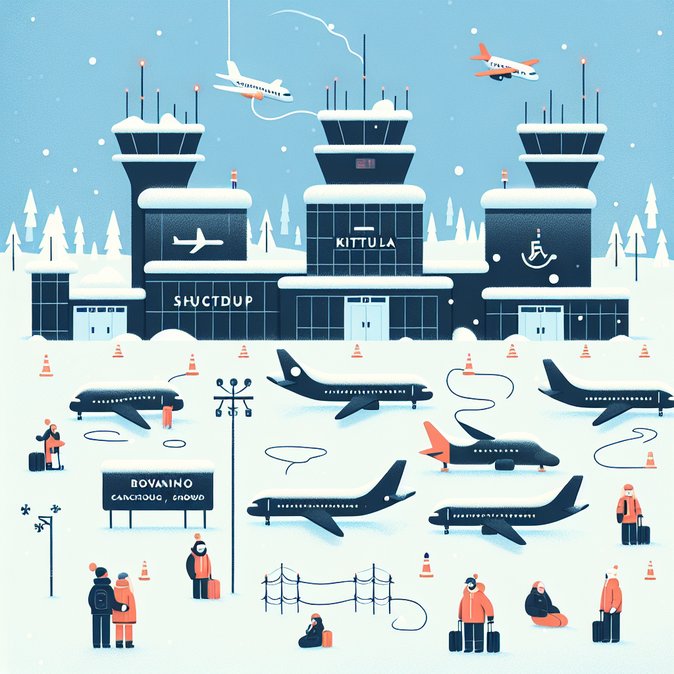
Finavia, Finland’s airport operator, confirmed in the early hours of 29 December that full flight operations have resumed at Kittilä, Ivalo and Rovaniemi airports following a 24-hour snow-related shutdown. A powerful Arctic front on 27 December buried runways under more than 40 cm of snow, pushing runway-friction values below EU safety minima and forcing the closure of all three Lapland airports at the height of the peak holiday season.
Finavia dispatched 120 maintenance staff, 45 specialised ploughs and two runway de-icing trucks to work around the clock. Kittilä reopened first at 20:00, Ivalo at 21:00 and Rovaniemi—Finland’s second-busiest winter airport—at 22:40. By dawn on 29 December, ground-handling teams had cleared backlogs, and 14 “recovery” flights had been slotted to reposition displaced aircraft and passengers.
For international travellers heading to Finland, VisaHQ can simplify the paperwork by offering fast online visa applications, entry-rule updates and guidance on health or transit requirements. Checking https://www.visahq.com/finland/ before departure can shave precious hours off last-minute itinerary changes—especially useful when weather disruptions like these force sudden rerouting.
![Finavia Re-opens Lapland Airports After Snowstorm, Restoring Crucial Winter Connectivity]()
The timing was critical: Lapland’s winter economy relies heavily on international ski-charter and Santa-themed leisure traffic from the UK, France and Germany. Tour operators reported that nearly 8,500 passengers were impacted by Saturday’s cancellations, prompting insurers and employers to scramble for hotel rooms and alternative routings. Business-travel managers with meetings in Northern mining and energy hubs faced cascading re-bookings because the shutdown coincided with limited rail capacity.
Finavia said Helsinki-Vantaa, which handled most diverted flights, lifted the last slot restrictions at 06:30 on 29 December after extra de-icing rigs were brought online. Minor delays—averaging 35 minutes—persisted early Monday but were expected to normalise by evening.
Practical take-aways for mobility teams: (1) build a 24-hour buffer for Lapland schedules until 1 January, when a milder weather window is forecast; (2) remind employees that regional airports have limited hotel capacity in peak weeks; and (3) re-confirm onward rail or bus segments because some carriers automatically void tickets after an interrupted air leg.
Finavia dispatched 120 maintenance staff, 45 specialised ploughs and two runway de-icing trucks to work around the clock. Kittilä reopened first at 20:00, Ivalo at 21:00 and Rovaniemi—Finland’s second-busiest winter airport—at 22:40. By dawn on 29 December, ground-handling teams had cleared backlogs, and 14 “recovery” flights had been slotted to reposition displaced aircraft and passengers.
For international travellers heading to Finland, VisaHQ can simplify the paperwork by offering fast online visa applications, entry-rule updates and guidance on health or transit requirements. Checking https://www.visahq.com/finland/ before departure can shave precious hours off last-minute itinerary changes—especially useful when weather disruptions like these force sudden rerouting.

The timing was critical: Lapland’s winter economy relies heavily on international ski-charter and Santa-themed leisure traffic from the UK, France and Germany. Tour operators reported that nearly 8,500 passengers were impacted by Saturday’s cancellations, prompting insurers and employers to scramble for hotel rooms and alternative routings. Business-travel managers with meetings in Northern mining and energy hubs faced cascading re-bookings because the shutdown coincided with limited rail capacity.
Finavia said Helsinki-Vantaa, which handled most diverted flights, lifted the last slot restrictions at 06:30 on 29 December after extra de-icing rigs were brought online. Minor delays—averaging 35 minutes—persisted early Monday but were expected to normalise by evening.
Practical take-aways for mobility teams: (1) build a 24-hour buffer for Lapland schedules until 1 January, when a milder weather window is forecast; (2) remind employees that regional airports have limited hotel capacity in peak weeks; and (3) re-confirm onward rail or bus segments because some carriers automatically void tickets after an interrupted air leg.