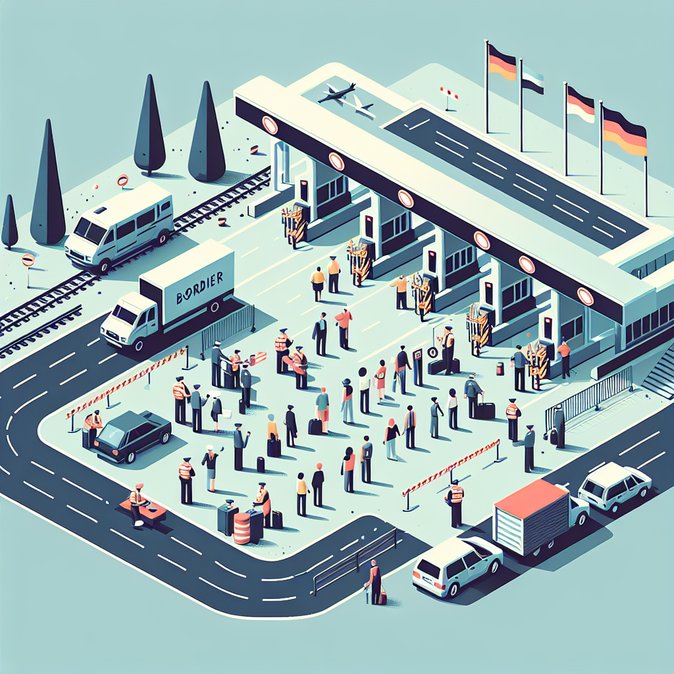
Germany’s Federal Ministry of the Interior has quietly prolonged the “temporary” controls it re-introduced at all nine of the country’s land borders in September, publishing the extension notice in the Bundesanzeiger just after Christmas. The measure means that Bundespolizei officers will continue to conduct spot identity checks on cars, coaches and trains entering from Austria, Czechia, Poland, Denmark, the Netherlands, Luxembourg, France and Switzerland until at least 15 March 2026 .
The government argues that organised smuggling networks and a still-elevated level of secondary movements along the Balkan route justify the extension. Interior-minister Nancy Faeser said that “human-smuggling networks adapt quickly and remain a serious threat to public order”. Critics – including the German Chambers of Commerce – counter that rolling six-month renewals risk normalising an emergency instrument and eroding the Schengen principle of friction-free movement inside the EU .
For corporate mobility teams the decision is immediately operational. Travelers arriving overland must again build extra time into itineraries, and non-EU assignees who normally rely on residence cards instead of passports are advised to carry both documents to avoid entry refusals. Freight forwarders already report delays of up to 45 minutes per truck, costs that are being passed on to shippers .
![Germany Extends Internal Schengen Border Checks Until 15 March 2026]()
If you need help keeping pace with Germany’s constantly shifting border and documentation requirements, VisaHQ’s dedicated portal (https://www.visahq.com/germany/) provides timely alerts, tailored compliance checklists and on-demand assistance in securing visas, residence permits or A1 certificates. The service integrates smoothly with corporate mobility workflows, giving travel managers an extra layer of assurance while spot checks remain in force.
Legally the extension pushes Germany up against the six-month maximum tolerated by Article 25 of the Schengen Borders Code; any renewal beyond mid-March would require explicit approval from the European Commission. Observers therefore expect a political debate in early March: if irregular arrivals continue to decline, Berlin may be pressured to lift the checks before the summer conference season. Until then, travel managers should update policies, remind cross-border commuters to carry passports, and ensure A1 certificates are on hand in case labour inspectors piggy-back on the police checks.
Companies should also monitor whether other Schengen states impose reciprocal measures. Austria has hinted it could extend its own controls on the Slovenian border if Germany keeps its regime in place, a move that would further complicate over-the-road itineraries between Central and Southern Europe.
The government argues that organised smuggling networks and a still-elevated level of secondary movements along the Balkan route justify the extension. Interior-minister Nancy Faeser said that “human-smuggling networks adapt quickly and remain a serious threat to public order”. Critics – including the German Chambers of Commerce – counter that rolling six-month renewals risk normalising an emergency instrument and eroding the Schengen principle of friction-free movement inside the EU .
For corporate mobility teams the decision is immediately operational. Travelers arriving overland must again build extra time into itineraries, and non-EU assignees who normally rely on residence cards instead of passports are advised to carry both documents to avoid entry refusals. Freight forwarders already report delays of up to 45 minutes per truck, costs that are being passed on to shippers .

If you need help keeping pace with Germany’s constantly shifting border and documentation requirements, VisaHQ’s dedicated portal (https://www.visahq.com/germany/) provides timely alerts, tailored compliance checklists and on-demand assistance in securing visas, residence permits or A1 certificates. The service integrates smoothly with corporate mobility workflows, giving travel managers an extra layer of assurance while spot checks remain in force.
Legally the extension pushes Germany up against the six-month maximum tolerated by Article 25 of the Schengen Borders Code; any renewal beyond mid-March would require explicit approval from the European Commission. Observers therefore expect a political debate in early March: if irregular arrivals continue to decline, Berlin may be pressured to lift the checks before the summer conference season. Until then, travel managers should update policies, remind cross-border commuters to carry passports, and ensure A1 certificates are on hand in case labour inspectors piggy-back on the police checks.
Companies should also monitor whether other Schengen states impose reciprocal measures. Austria has hinted it could extend its own controls on the Slovenian border if Germany keeps its regime in place, a move that would further complicate over-the-road itineraries between Central and Southern Europe.