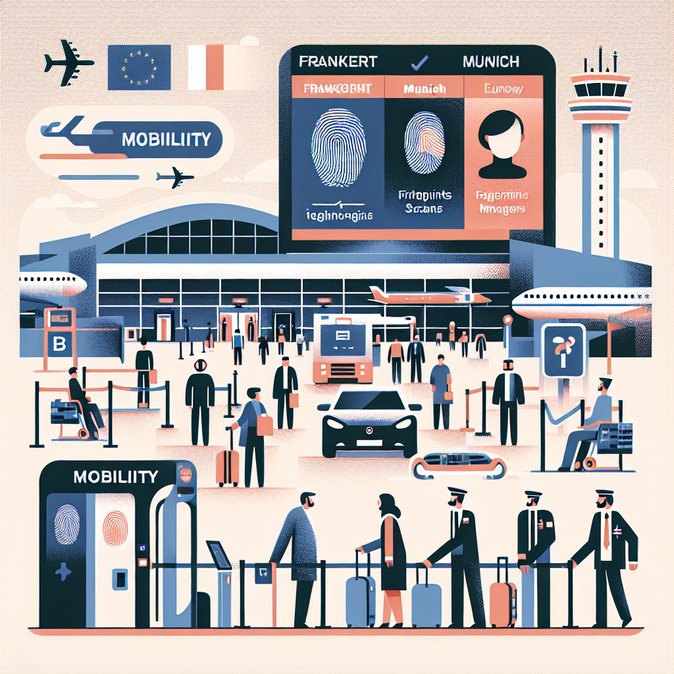
What was supposed to be a quiet post-Christmas travel week turned into a nightmare for many passengers transiting Germany’s two largest hubs. The phased roll-out of the EU’s new Entry/Exit System (EES) and the UK’s ETA scheme produced multi-hour queues at Frankfurt and Munich as passport kiosks struggled to capture fingerprints and facial scans for thousands of third-country nationals .
At Frankfurt, Germany’s main intercontinental hub, travellers reported waiting more than two hours at automated gates before being routed to undermanned manual counters. Munich, a key transfer point for Central-European itineraries, fared little better, with Lufthansa crews forced to hold connecting flights for missing passengers. Airport operator Fraport said staffing levels were already increased by 20 % but the biometric hardware could not cope with peak volumes.
To help travellers stay one step ahead of these evolving entry requirements, VisaHQ offers an online platform that streamlines visa and travel document processing, provides real-time updates on Germany’s EES implementation, and assists with Schengen visa applications. By visiting https://www.visahq.com/germany/ passengers and corporate travel managers can access personalized support and avoid documentation pitfalls long before they reach the airport.
![Biometric Border Checks Trigger Holiday Chaos at Frankfurt and Munich]()
The problems are not uniquely German. Spain, Italy, Greece, Portugal and Iceland are facing similar “teething pains” as the EES moves from pilot to live operation. Yet Germany’s role as a transfer hub magnifies the disruption globally: missed onward flights ripple across airline networks, and tight intra-Schengen connections become impossible when travellers first enter the zone in Frankfurt or Munich.
For mobility managers the advice is clear: build a minimum three-hour buffer for non-EU travellers entering through German hubs, pre-enrol biometric data where possible, and warn staff that traditional passport stamps are disappearing. Airlines have started to re-assign ground staff to coach first-time users through the kiosks, but industry bodies are calling on the federal police to relax the mandatory capture of fingerprints during the peak New-Year rush.
Looking ahead, Germany’s federal police say performance should improve once travellers have a biometric record in the system and kiosks undergo software updates scheduled for mid-January. Until then, companies should consider rerouting critical staff through alternative gateways such as Zurich or Copenhagen if itineraries are time-sensitive.
At Frankfurt, Germany’s main intercontinental hub, travellers reported waiting more than two hours at automated gates before being routed to undermanned manual counters. Munich, a key transfer point for Central-European itineraries, fared little better, with Lufthansa crews forced to hold connecting flights for missing passengers. Airport operator Fraport said staffing levels were already increased by 20 % but the biometric hardware could not cope with peak volumes.
To help travellers stay one step ahead of these evolving entry requirements, VisaHQ offers an online platform that streamlines visa and travel document processing, provides real-time updates on Germany’s EES implementation, and assists with Schengen visa applications. By visiting https://www.visahq.com/germany/ passengers and corporate travel managers can access personalized support and avoid documentation pitfalls long before they reach the airport.

The problems are not uniquely German. Spain, Italy, Greece, Portugal and Iceland are facing similar “teething pains” as the EES moves from pilot to live operation. Yet Germany’s role as a transfer hub magnifies the disruption globally: missed onward flights ripple across airline networks, and tight intra-Schengen connections become impossible when travellers first enter the zone in Frankfurt or Munich.
For mobility managers the advice is clear: build a minimum three-hour buffer for non-EU travellers entering through German hubs, pre-enrol biometric data where possible, and warn staff that traditional passport stamps are disappearing. Airlines have started to re-assign ground staff to coach first-time users through the kiosks, but industry bodies are calling on the federal police to relax the mandatory capture of fingerprints during the peak New-Year rush.
Looking ahead, Germany’s federal police say performance should improve once travellers have a biometric record in the system and kiosks undergo software updates scheduled for mid-January. Until then, companies should consider rerouting critical staff through alternative gateways such as Zurich or Copenhagen if itineraries are time-sensitive.