Germany’s Federal Ministry of the Interior has quietly prolonged the “temporary” identity checks it re-introduced at all nine of the country’s land borders in September, publishing the extension notice in the official Bundesanzeiger on 26 December. The measure, now scheduled to run through at least 15 March 2026, means Bundespolizei units will continue to stop cars, coaches and trains on routes linking Germany with Austria, Czechia, Poland, Denmark, the Netherlands, Luxembourg, France and Switzerland.
Although the 1995 Schengen Agreement abolished systematic passport control inside most of the EU, Article 25 of the Schengen Borders Code allows member states to restore controls for renewable six-month periods in the event of “a serious threat to public policy or internal security.” Berlin first invoked that clause in response to a sharp rise in irregular arrivals along the Balkan route and the dismantling of people-smuggling rings operating out of Eastern Europe. According to the Interior Ministry, officers have since intercepted almost 14,000 unauthorised entrants and seized more than 300 forged documents.
![Germany Extends Land Border Checks Until 15 March 2026]()
For travellers and corporate mobility planners who want to avoid any snags at these reinstated checkpoints, VisaHQ’s Germany portal (https://www.visahq.com/germany/) offers real-time visa guidance, document validation and application support. The platform can help staff confirm whether they need a Schengen visa, arrange business or work permits and store digital copies of passports and residence cards—streamlining compliance ahead of cross-border journeys.
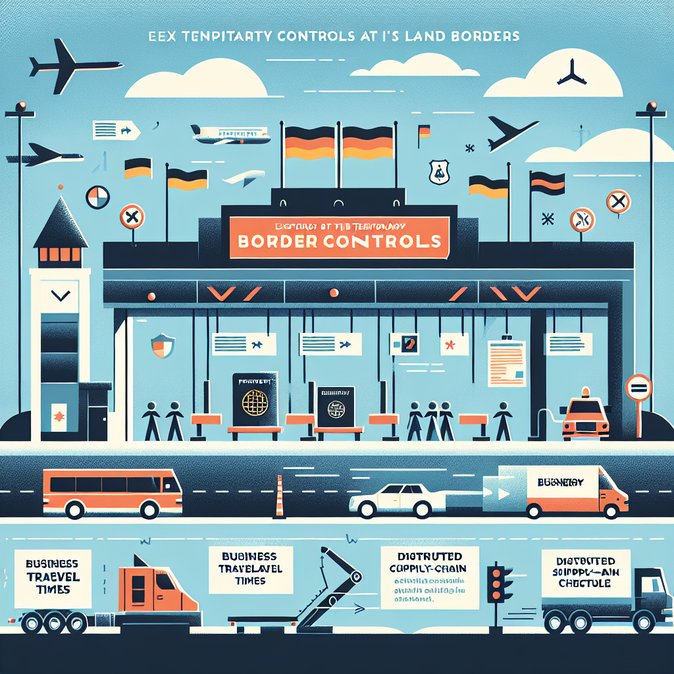
For corporate mobility managers the extension has concrete implications. Coach operators must now factor extra time into journeys, rail carriers will continue on-board checks between Munich and Salzburg or Dresden and Prague, and logistics firms face random inspections of drivers and cargo manifests at motorway rest areas near the frontier. While EU and Schengen nationals may present either a passport or national identity card, non-EU employees on intra-company assignments should carry their residence permit or appropriate work visa at all times.
Business groups are urging predictability. The German Chamber of Commerce and Industry (DIHK) warned that rolling six-month renewals “create planning uncertainty for supply-chain managers” and called on the government to publish clear benchmarks for phasing the measures out. For now, however, the political momentum appears to favour continued enforcement: recent opinion polls show roughly two-thirds of German voters support permanent border controls. Companies should therefore assume the checks will remain in place beyond March and update their travel and relocation policies accordingly.
Although the 1995 Schengen Agreement abolished systematic passport control inside most of the EU, Article 25 of the Schengen Borders Code allows member states to restore controls for renewable six-month periods in the event of “a serious threat to public policy or internal security.” Berlin first invoked that clause in response to a sharp rise in irregular arrivals along the Balkan route and the dismantling of people-smuggling rings operating out of Eastern Europe. According to the Interior Ministry, officers have since intercepted almost 14,000 unauthorised entrants and seized more than 300 forged documents.

For travellers and corporate mobility planners who want to avoid any snags at these reinstated checkpoints, VisaHQ’s Germany portal (https://www.visahq.com/germany/) offers real-time visa guidance, document validation and application support. The platform can help staff confirm whether they need a Schengen visa, arrange business or work permits and store digital copies of passports and residence cards—streamlining compliance ahead of cross-border journeys.
For corporate mobility managers the extension has concrete implications. Coach operators must now factor extra time into journeys, rail carriers will continue on-board checks between Munich and Salzburg or Dresden and Prague, and logistics firms face random inspections of drivers and cargo manifests at motorway rest areas near the frontier. While EU and Schengen nationals may present either a passport or national identity card, non-EU employees on intra-company assignments should carry their residence permit or appropriate work visa at all times.
Business groups are urging predictability. The German Chamber of Commerce and Industry (DIHK) warned that rolling six-month renewals “create planning uncertainty for supply-chain managers” and called on the government to publish clear benchmarks for phasing the measures out. For now, however, the political momentum appears to favour continued enforcement: recent opinion polls show roughly two-thirds of German voters support permanent border controls. Companies should therefore assume the checks will remain in place beyond March and update their travel and relocation policies accordingly.