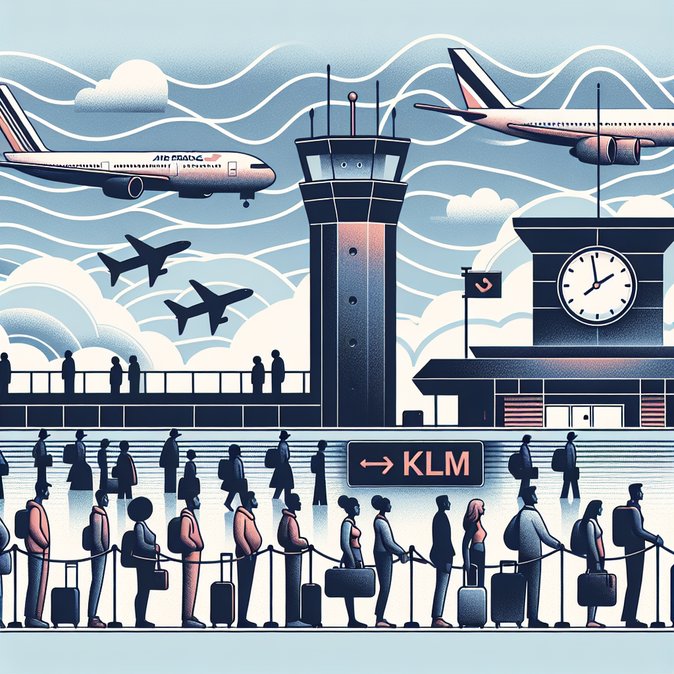
Business- and leisure-travellers connecting through Paris Charles-de-Gaulle (CDG) and Orly on 29 November woke up to a wave of cancellations and rolling delays that rippled across Europe. Data compiled by flight-tracking platform FlightAware and reported by VisaHQ show at least 40 flights scrubbed and more than 500 departures or arrivals delayed, with average outbound holdups from CDG topping 75 minutes during the crucial 08:00-11:00 window. Carriers hardest-hit included Air France, KLM, Delta and Swiss, forcing many corporate flyers onto later departures or unexpected overnight stays.
Air-traffic managers blamed a perfect storm: heavy morning fog reduced runway throughput just as winter rosters—already stretched by sick-leave—left ground-handling crews short-staffed. CDG’s hub-and-spoke model amplifies disruption because missed inbound connections quickly snowball into outbound delays, while Orly lacks spare gates to re-sequence aircraft. The bottleneck radiated to Amsterdam, Liverpool and Riga where crews and aircraft awaited delayed Paris sectors.
![Paris flight chaos: 40 cancellations and 500 delays snarl business travel at CDG and Orly]()
For global-mobility managers the timing is painful. The last week of November traditionally marks the start of peak year-end assignment rotations and holiday travel. Missed meetings mean per-diem extensions, and HR teams face duty-of-care questions when assignees are stranded overnight. Travel buyers with airline-performance SLAs may also see on-time metrics deteriorate just as 2026 contract negotiations begin.
Practical steps: companies should brief travellers to build three-hour buffers for Schengen hub connections through early December and pre-authorise hotel rebooking under EU261. For high-stakes meetings, consider routings via Frankfurt or Zurich, which showed normal operations on the same day. Finally, remind non-EU assignees that extra queue time at border control counts toward the new EES biometric procedures being phased in this winter.
Air-traffic managers blamed a perfect storm: heavy morning fog reduced runway throughput just as winter rosters—already stretched by sick-leave—left ground-handling crews short-staffed. CDG’s hub-and-spoke model amplifies disruption because missed inbound connections quickly snowball into outbound delays, while Orly lacks spare gates to re-sequence aircraft. The bottleneck radiated to Amsterdam, Liverpool and Riga where crews and aircraft awaited delayed Paris sectors.
For global-mobility managers the timing is painful. The last week of November traditionally marks the start of peak year-end assignment rotations and holiday travel. Missed meetings mean per-diem extensions, and HR teams face duty-of-care questions when assignees are stranded overnight. Travel buyers with airline-performance SLAs may also see on-time metrics deteriorate just as 2026 contract negotiations begin.
Practical steps: companies should brief travellers to build three-hour buffers for Schengen hub connections through early December and pre-authorise hotel rebooking under EU261. For high-stakes meetings, consider routings via Frankfurt or Zurich, which showed normal operations on the same day. Finally, remind non-EU assignees that extra queue time at border control counts toward the new EES biometric procedures being phased in this winter.