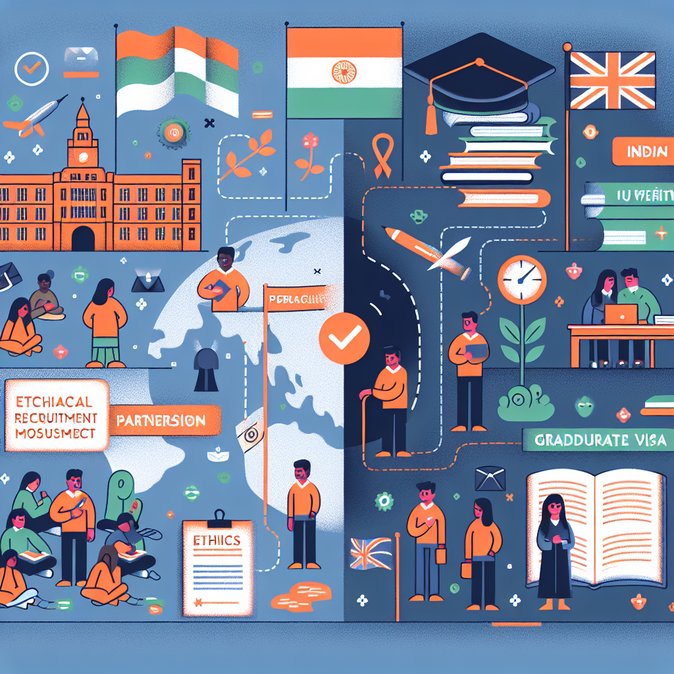
The National Indian Students and Alumni Union (NISAU) UK and global agency ICEF announced a strategic partnership in London on 28 November designed to ‘raise the bar’ on how Indian students are recruited for UK study. The collaboration will draft shared standards for ethical recruitment, publish joint data insights and create an independent awards scheme recognising responsible agents.
More than one million Indians study abroad each year, and over 80 % use private agents. A series of exposés—most recently involving falsified bank statements for UK visa applications—has put pressure on universities and the Home Office to tighten oversight. NISAU chair Sanam Arora said the partnership “puts students at the centre of the process”, while ICEF CEO Markus Badde emphasised transparent guidance from ‘first enquiry to graduation’.
![NISAU-ICEF pact aims to clean up Indian student recruitment to the UK]()
Practical measures include an online code-of-conduct training module for agents, joint webinars for prospective students explaining UK visa rules, and an annual ‘Agent of the Year’ award to debut in February 2026. Institutions that sign up will be able to badge compliant agents, similar to Australia’s QEAC system.
For mobility and admissions teams, the initiative offers a potential due-diligence shortcut: sponsors could rely on certified agents to reduce risk of document fraud, which currently accounts for 6 % of student-visa refusals. It may also improve retention, addressing Department for Education concerns that drop-out rates among Indian students are 30 % higher when expectations are poorly managed.
The move aligns with the UK’s wider push toward a high-integrity, high-value international student offer as the Graduate Visa comes under Treasury review in 2026. Universities that embrace the standards early may gain a competitive edge in the crowded South-Asian market.
More than one million Indians study abroad each year, and over 80 % use private agents. A series of exposés—most recently involving falsified bank statements for UK visa applications—has put pressure on universities and the Home Office to tighten oversight. NISAU chair Sanam Arora said the partnership “puts students at the centre of the process”, while ICEF CEO Markus Badde emphasised transparent guidance from ‘first enquiry to graduation’.

Practical measures include an online code-of-conduct training module for agents, joint webinars for prospective students explaining UK visa rules, and an annual ‘Agent of the Year’ award to debut in February 2026. Institutions that sign up will be able to badge compliant agents, similar to Australia’s QEAC system.
For mobility and admissions teams, the initiative offers a potential due-diligence shortcut: sponsors could rely on certified agents to reduce risk of document fraud, which currently accounts for 6 % of student-visa refusals. It may also improve retention, addressing Department for Education concerns that drop-out rates among Indian students are 30 % higher when expectations are poorly managed.
The move aligns with the UK’s wider push toward a high-integrity, high-value international student offer as the Graduate Visa comes under Treasury review in 2026. Universities that embrace the standards early may gain a competitive edge in the crowded South-Asian market.