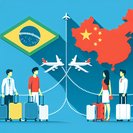
Meeting at the Blue House on 23 February, Brazilian President Luiz Inácio Lula da Silva and South-Korean President Lee Jae-myung agreed to restart the long-stalled negotiations for a free-trade agreement between South Korea and Mercosur. Talks have been frozen since 2021 over market-access concerns but will now resume under a new four-year Korea–Brazil Action Plan covering 2026-2029.
The leaders elevated bilateral relations to a “strategic partnership” and signed ten memoranda of understanding spanning critical minerals, artificial intelligence, defence aerospace and, crucially for mobility professionals, sanitary-quarantine cooperation aimed at accelerating approvals for Brazilian beef and pork. Faster sanitary clearances are a prerequisite for any trade deal and pave the way for streamlined export documentation and business-traveller flows in agri-business.
From a global-mobility standpoint, the trade-talk reboot signals that corporate travel between the two countries is likely to rise sharply. Korean auto-parts suppliers already active in Brazil’s northeast manufacturing corridor can expect more technical-support rotations, while Brazilian food-processing multinationals eyeing the Korean market will be dispatching quality-assurance teams once quarantine protocols are harmonised.
![Lula and Lee Upgrade Ties and Revive Korea–Mercosur Trade Talks]()
For businesses gearing up for this uptick in travel, VisaHQ’s dedicated Brazil page (https://www.visahq.com/brazil/) serves as a one-stop resource for visa eligibility checks, document preparation and expedited filing, ensuring corporate travellers remain compliant as new mobility frameworks emerge from the negotiations.
Both governments pledged to deploy a joint inspection mission to Brazil’s beef-producing regions within weeks—a step that, if successful, could see import permits granted before year-end. The action plan also calls for exchanges of customs-modernisation best practices and people-to-people programmes, hinting at future e-visa pilots or APEC-style business-traveller cards.
Although no immediate visa concessions were announced, trade-law experts note that modern FTAs typically include mobility chapters on business-person entry, intra-corporate transfers and services suppliers. Companies should therefore begin mapping potential labour-law and immigration-compliance impacts in anticipation of accelerated talks.
The leaders elevated bilateral relations to a “strategic partnership” and signed ten memoranda of understanding spanning critical minerals, artificial intelligence, defence aerospace and, crucially for mobility professionals, sanitary-quarantine cooperation aimed at accelerating approvals for Brazilian beef and pork. Faster sanitary clearances are a prerequisite for any trade deal and pave the way for streamlined export documentation and business-traveller flows in agri-business.
From a global-mobility standpoint, the trade-talk reboot signals that corporate travel between the two countries is likely to rise sharply. Korean auto-parts suppliers already active in Brazil’s northeast manufacturing corridor can expect more technical-support rotations, while Brazilian food-processing multinationals eyeing the Korean market will be dispatching quality-assurance teams once quarantine protocols are harmonised.

For businesses gearing up for this uptick in travel, VisaHQ’s dedicated Brazil page (https://www.visahq.com/brazil/) serves as a one-stop resource for visa eligibility checks, document preparation and expedited filing, ensuring corporate travellers remain compliant as new mobility frameworks emerge from the negotiations.
Both governments pledged to deploy a joint inspection mission to Brazil’s beef-producing regions within weeks—a step that, if successful, could see import permits granted before year-end. The action plan also calls for exchanges of customs-modernisation best practices and people-to-people programmes, hinting at future e-visa pilots or APEC-style business-traveller cards.
Although no immediate visa concessions were announced, trade-law experts note that modern FTAs typically include mobility chapters on business-person entry, intra-corporate transfers and services suppliers. Companies should therefore begin mapping potential labour-law and immigration-compliance impacts in anticipation of accelerated talks.