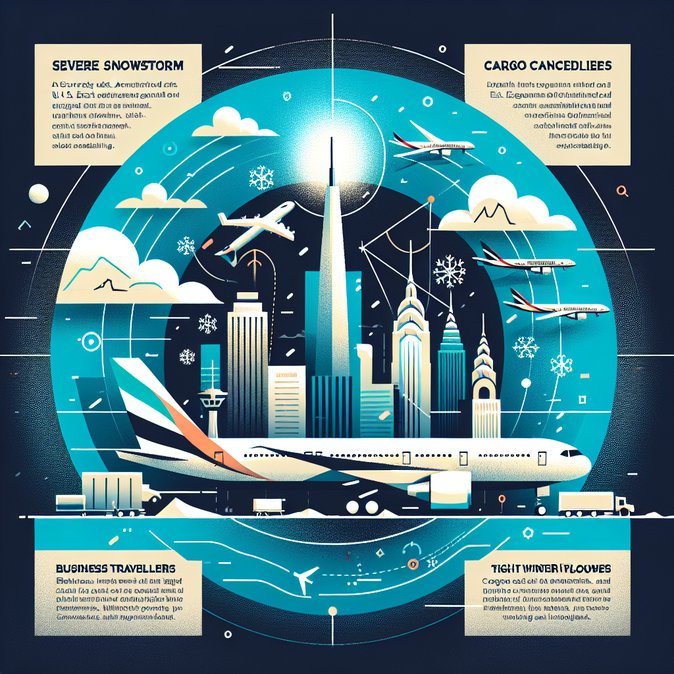
A fast-moving Nor’easter barreling up the United States East Coast on 22 February has upended trans-Atlantic schedules for the UAE’s two largest carriers, Emirates and Etihad Airways. Blizzard conditions forecast for New York, Newark and Boston prompted both airlines to cancel or heavily retime more than a dozen flights through 23 February.
Emirates scrubbed flagship services EK203/204 (Dubai-New York-Dubai) and Athens-Newark tag flights EK209/210, while shifting departure times for EK201/202 and several Milan-New York rotations. Etihad followed suit, cancelling EY1/2 (Abu Dhabi-New York-Abu Dhabi) and warning of further delays if de-icing queues lengthen at JFK. Air India, which carries large volumes of onward Gulf traffic, has also axed its New York and Newark services, exacerbating capacity constraints for UAE-bound travellers.(gulfnews.com)
Although the storm is unfolding 11,000 kilometres away, the disruption illustrates how weather on one continent ricochets through the global mobility ecosystem. Corporate travel managers with UAE-based staff heading to investor roadshows or UN meetings in Manhattan now face missed connections and unexpected hotel costs. Cargo flows—particularly time-sensitive pharmaceuticals trans-shipping through Dubai—will also feel the pinch as belly-hold capacity tightens.
![Nor’easter Forces Emirates and Etihad to Cancel Multiple UAE-US Flights]()
Both airlines are offering rebooking or refunds without fees and have activated their social-media “storm desks” to push live updates. Travellers connecting onwards to Africa and South Asia are being automatically re-protected where possible, but premium-cabin award space has virtually disappeared as displaced passengers scramble for alternatives.
For passengers who suddenly need to secure or amend travel documents—be it a U.S. ESTA update, an emergency Schengen visa, or paperwork for onward destinations—VisaHQ can streamline the process through its UAE portal (https://www.visahq.com/united-arab-emirates/). The platform offers fast online applications, real-time tracking and courier pickup, removing one more headache while itineraries remain in flux.
Practical tips: UAE-origin passengers should monitor Manage-Your-Booking portals, ensure U.S. ESTA validity extends beyond revised arrival dates, and factor in additional layover time if routing through European hubs. Those holding soon-to-expire Schengen visas may need to apply for extensions if forced to overnight in the EU. Business-critical travellers could consider Emirates’ Chicago or Houston services, which remain—so far—outside the storm’s cone of uncertainty.
Emirates scrubbed flagship services EK203/204 (Dubai-New York-Dubai) and Athens-Newark tag flights EK209/210, while shifting departure times for EK201/202 and several Milan-New York rotations. Etihad followed suit, cancelling EY1/2 (Abu Dhabi-New York-Abu Dhabi) and warning of further delays if de-icing queues lengthen at JFK. Air India, which carries large volumes of onward Gulf traffic, has also axed its New York and Newark services, exacerbating capacity constraints for UAE-bound travellers.(gulfnews.com)
Although the storm is unfolding 11,000 kilometres away, the disruption illustrates how weather on one continent ricochets through the global mobility ecosystem. Corporate travel managers with UAE-based staff heading to investor roadshows or UN meetings in Manhattan now face missed connections and unexpected hotel costs. Cargo flows—particularly time-sensitive pharmaceuticals trans-shipping through Dubai—will also feel the pinch as belly-hold capacity tightens.

Both airlines are offering rebooking or refunds without fees and have activated their social-media “storm desks” to push live updates. Travellers connecting onwards to Africa and South Asia are being automatically re-protected where possible, but premium-cabin award space has virtually disappeared as displaced passengers scramble for alternatives.
For passengers who suddenly need to secure or amend travel documents—be it a U.S. ESTA update, an emergency Schengen visa, or paperwork for onward destinations—VisaHQ can streamline the process through its UAE portal (https://www.visahq.com/united-arab-emirates/). The platform offers fast online applications, real-time tracking and courier pickup, removing one more headache while itineraries remain in flux.
Practical tips: UAE-origin passengers should monitor Manage-Your-Booking portals, ensure U.S. ESTA validity extends beyond revised arrival dates, and factor in additional layover time if routing through European hubs. Those holding soon-to-expire Schengen visas may need to apply for extensions if forced to overnight in the EU. Business-critical travellers could consider Emirates’ Chicago or Houston services, which remain—so far—outside the storm’s cone of uncertainty.