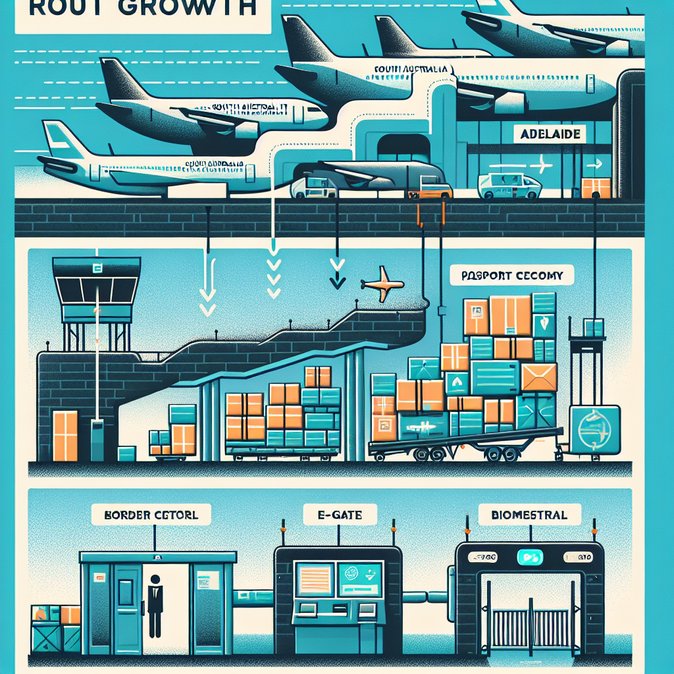
South Australia’s main gateway has become a case study in how aviation capacity drives trade. Adelaide Airport now hosts 13 international carriers flying to 12 overseas cities—double the pre-pandemic network—enabling the state to notch up a record AU$17.6 billion in exports for 2025.
Airport chief Brenton Cox says the AU$600 million ‘Project Flight’ terminal expansion, now under way, will pave the way for direct links to 40 destinations by 2050. Exporters of high-value perishables such as lobster and chilled lamb say Shanghai flights launching in June will be “transformational” for delivery times.
![Adelaide Airport pushes for biometric border funding as export flights boom]()
In parallel with the route expansion, companies scrambling to place staff and customers on these inaugural services can lean on VisaHQ’s digital portal (https://www.visahq.com/australia/), which streamlines both Australian and destination-country visa formalities, provides real-time tracking, and reduces the risk of last-minute travel snags.
With passenger volumes also rising, the Australian Airports Association is lobbying Canberra to reinvest part of the AU$1.3 billion annual Passenger Movement Charge into digital entry systems and biometrics. Industry figures argue that without e-gates and facial-match technology, queues could undo the competitiveness gains from new routes.
For global mobility teams the message is mixed: more direct services reduce connection times for assignees, but until extra border-processing capacity is funded, peak-hour arrivals could lengthen clearance times.
Airport chief Brenton Cox says the AU$600 million ‘Project Flight’ terminal expansion, now under way, will pave the way for direct links to 40 destinations by 2050. Exporters of high-value perishables such as lobster and chilled lamb say Shanghai flights launching in June will be “transformational” for delivery times.

In parallel with the route expansion, companies scrambling to place staff and customers on these inaugural services can lean on VisaHQ’s digital portal (https://www.visahq.com/australia/), which streamlines both Australian and destination-country visa formalities, provides real-time tracking, and reduces the risk of last-minute travel snags.
With passenger volumes also rising, the Australian Airports Association is lobbying Canberra to reinvest part of the AU$1.3 billion annual Passenger Movement Charge into digital entry systems and biometrics. Industry figures argue that without e-gates and facial-match technology, queues could undo the competitiveness gains from new routes.
For global mobility teams the message is mixed: more direct services reduce connection times for assignees, but until extra border-processing capacity is funded, peak-hour arrivals could lengthen clearance times.