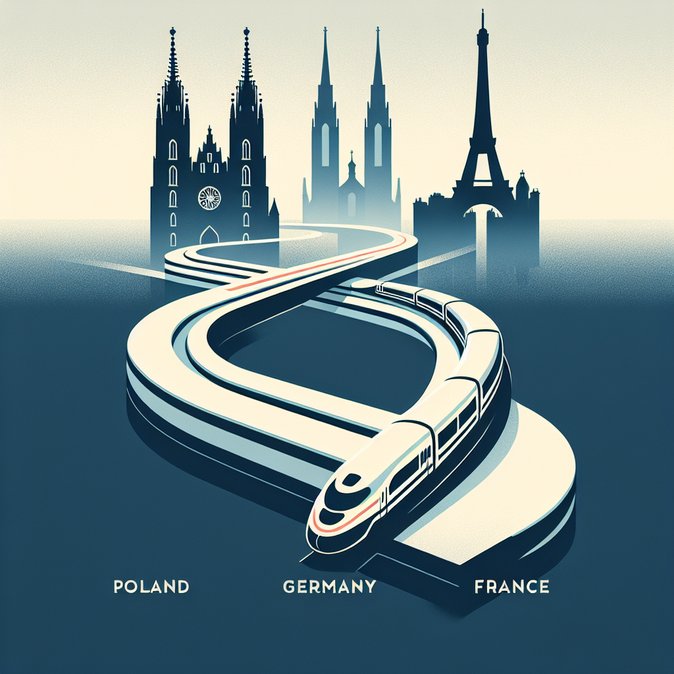
Transport ministers from Poland, Germany and France met in Warsaw on 18 February and signed a joint declaration that puts fast cross-border rail at the heart of the revived Weimar Triangle cooperation format. The agreement—endorsed by PKP Group, Deutsche Bahn and SNCF—commits the three rail incumbents to co-ordinate investment plans, harmonise technical standards and lobby Brussels for Trans-European Transport Network (TEN-T) funding for a 1,600-kilometre high-speed line linking Warsaw, Berlin and Paris.
Under the roadmap, the partners will first boost capacity and cut travel time on existing routes: Warsaw–Berlin, Kraków–Wrocław–Berlin, Gdańsk–Szczecin–Berlin and a freight corridor that runs Przemyśl–Kraków–Leipzig. A joint task-force will deliver an engineering pre-feasibility study for a brand-new high-speed spine by December 2026. Polish infrastructure minister Dariusz Klimczak said the project would "anchor Poland more firmly in the core of Europe’s mobility network" while creating an alternative to short-haul flights for business travellers.
![Weimar Triangle backs Warsaw–Berlin–Paris high-speed rail corridor]()
For travellers preparing to take advantage of these faster links, VisaHQ can streamline the entire visa process. Whether corporate teams need Schengen visas for France and Germany or updated documentation for entry into Poland, the platform provides quick online applications, real-time tracking and dedicated support—details are available at https://www.visahq.com/poland/ This ensures that when the high-speed corridor opens, passengers can focus on their journey rather than paperwork.
For corporate mobility teams, the plan promises one-seat rail access from Warsaw to Paris in under eight hours—versus today’s 14-plus—opening new options for same-day meetings and greener duty-of-care itineraries. Logistics operators expect streamlined customs processes for accompanied freight trains as digital consignment notes and shared security protocols are rolled out. Defence ministries, represented at the signing, highlighted the corridor’s role in rapid military mobility, a priority since Russia’s invasion of Ukraine.
Analysts note that aligning three different signalling systems (ETCS levels, national Class B equipment) and agreeing on cost-sharing will be challenging. Yet the declaration signals rare political momentum: the Weimar partners urged the European Commission to treat the scheme as a “strategic project of Union interest” that merits accelerated permitting under the new TEN-T regulation. If financing is secured, construction on priority Polish and German segments could start as early as 2028, rail officials said.
Under the roadmap, the partners will first boost capacity and cut travel time on existing routes: Warsaw–Berlin, Kraków–Wrocław–Berlin, Gdańsk–Szczecin–Berlin and a freight corridor that runs Przemyśl–Kraków–Leipzig. A joint task-force will deliver an engineering pre-feasibility study for a brand-new high-speed spine by December 2026. Polish infrastructure minister Dariusz Klimczak said the project would "anchor Poland more firmly in the core of Europe’s mobility network" while creating an alternative to short-haul flights for business travellers.
For travellers preparing to take advantage of these faster links, VisaHQ can streamline the entire visa process. Whether corporate teams need Schengen visas for France and Germany or updated documentation for entry into Poland, the platform provides quick online applications, real-time tracking and dedicated support—details are available at https://www.visahq.com/poland/ This ensures that when the high-speed corridor opens, passengers can focus on their journey rather than paperwork.
For corporate mobility teams, the plan promises one-seat rail access from Warsaw to Paris in under eight hours—versus today’s 14-plus—opening new options for same-day meetings and greener duty-of-care itineraries. Logistics operators expect streamlined customs processes for accompanied freight trains as digital consignment notes and shared security protocols are rolled out. Defence ministries, represented at the signing, highlighted the corridor’s role in rapid military mobility, a priority since Russia’s invasion of Ukraine.
Analysts note that aligning three different signalling systems (ETCS levels, national Class B equipment) and agreeing on cost-sharing will be challenging. Yet the declaration signals rare political momentum: the Weimar partners urged the European Commission to treat the scheme as a “strategic project of Union interest” that merits accelerated permitting under the new TEN-T regulation. If financing is secured, construction on priority Polish and German segments could start as early as 2028, rail officials said.